This page describes an image Saturn
Datei runterladen ( Bild 262.21 kB)
Bildunterschrift:
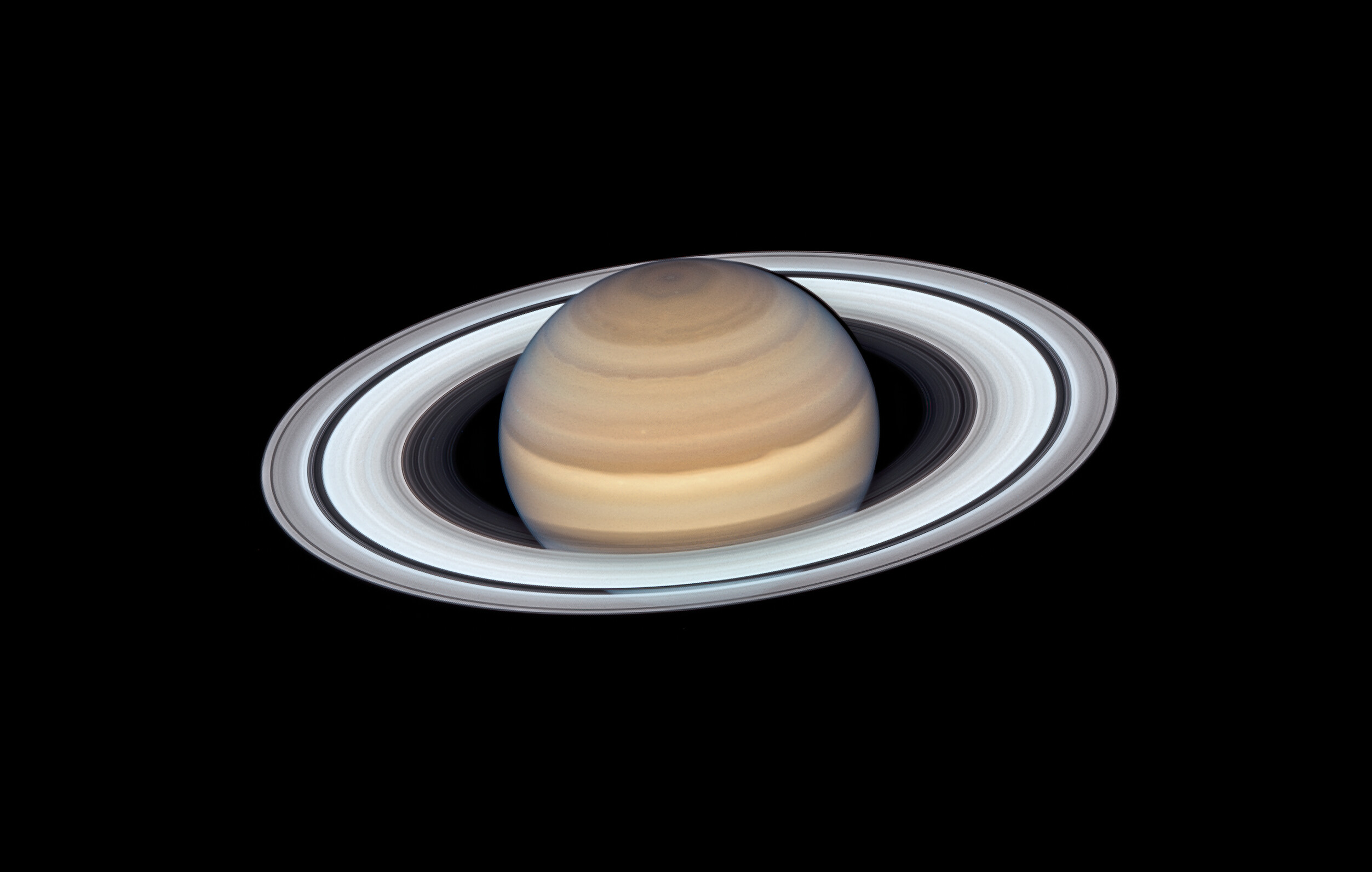
Die Wide Field Camera 3 des Hubble-Weltraumteleskops der NASA/ESA beobachtete den Saturn am 20. Juni 2019, als sich der Planet der Erde in diesem Jahr mit einer Entfernung von etwa 1,36 Milliarden Kilometern am nächsten befand. Das Bild zeigt farbige Gasbänder auf der Oberfläche des Planeten sowie seine auffälligen Ringe aus Eis und Gesteinsmaterial.
Scroll zu Unterschriften auf anderen Sprachen
Bildquelle:
NASA, ESA, A. Simon (Goddard Space Flight Center) und M.H. Wong (University of California, Berkeley) Link zur Quelle
Unterschrift Übersetzungsstatus: Noch nicht bestätigt von einer*einem Rezensent*in
Unterschrift-Übersetzende: Emma Krojanski
Ähnliche Glossarbegriffe:
Gasriese
, Planetenring
, Riesenplanet
, Saturn
, Äußere Planeten
Kategorien:
Sonnensystem
Bildlizenz: Creative Commons Namensnennung 4.0 International (CC BY 4.0) Creative Commons Namensnennung 4.0 International (CC BY 4.0) Symbole
The media file captions presented on the OAE website were written, translated and reviewed by a collective effort from the OAE, the OAE Centers and Nodes, the OAE National Astronomy Education Coordinators (NAECs) and other volunteers. You can find a full list of credits for our translation project here. All media file captions are released under a Creative Commons CC BY-4.0 license and should be credited to "IAU OAE". The media files themselves may have different licenses (see above) and should be credited as listed above under "credit".
Falls dir ein inhaltlicher Fehler in dieser Unterschrift oder ein Fehler in einer der Übersetzungen auffällt, bitte kontaktiere uns.
Unterschriften auf verschiedenen Sprachen:
Bildunterschrift: The NASA/ESA Hubble Space Telescope’s Wide Field Camera 3 observed Saturn on 20 June 2019 as the planet made its closest approach to Earth this year, at approximately 1.36 billion kilometres away. The image shows coloured bands of gas on the planet's surface as well as its prominent rings made of ice and rocky material.
Bildquelle: NASA, ESA, A. Simon (Goddard Space Flight Center), and M.H. Wong (University of California, Berkeley)
Ähnliche Glossarbegriffe: Gas Giant , Giant Planet , Outer Planets , Ring , Saturn
Bildunterschrift: La caméra à grand champ 3 du télescope spatial Hubble de la NASA/ESA a observé Saturne le 20 juin 2019, alors que la planète s'approchait au plus près de la Terre, à une distance d'environ 1,36 milliard de kilomètres. L'image montre des bandes colorées de gaz à la surface de la planète ainsi que ses anneaux proéminents composés de glace et de matériaux rocheux.
Bildquelle: NASA, ESA, A. Simon (Goddard Space Flight Center), et M.H. Wong (Université de Californie, Berkeley)
Ähnliche Glossarbegriffe: Anneau , Géantes gazeuses , Planète géante , Planètes extérieures , Saturne Unterschrift Übersetzungsstatus: Bestätigt von einer*einem Rezensent*in
Unterschrift-Übersetzende: Gilles Remy
Unterschrift-Prüfende: Lionel Ruiz
Bildunterschrift: La Wide Field Camera 3 del telescopio spaziale Hubble della NASA/ESA ha osservato Saturno il 20 giugno 2019, il giorno in cui il pianeta si è avvicinato di più alla Terra in quell'anno, a circa 1,36 miliardi di chilometri di distanza. L'immagine mostra le bande colorate di gas sulla superficie del pianeta e i suoi anelli più evidenti, composti da ghiaccio e materiale roccioso.
Bildquelle: NASA, ESA, A. Simon (Goddard Space Flight Center), e M.H. Wong (Università della California, Berkeley)
Ähnliche Glossarbegriffe: Anello , Gigante gassoso , Pianeta gigante , Pianeti esterni , Saturno Unterschrift Übersetzungsstatus: Bestätigt von einer*einem Rezensent*in
Unterschrift-Übersetzende: Giuliana Giobbi
Unterschrift-Prüfende: Rosa Valiante, Rodolfo Canestrari
Bildunterschrift: A Wide Field Camera 3 do Telescópio Espacial Hubble da NASA/ESA observou Saturno em 20 de junho de 2019, quando o planeta fez sua maior aproximação Terra naquele ano, a aproximadamente 1,36 bilhão de quilômetros de distância. A imagem mostra faixas coloridas de gás na superfície do planeta, bem como seus proeminentes anéis compostos por gelo e material rochoso.
Bildquelle: NASA, ESA, A. Simon (Centro Espacial Goddard) e M.H. Wong (Universidade da Califórnia, Berkeley)
Ähnliche Glossarbegriffe: Anel , Gigante gasoso , Planeta gigante , Planetas Externos , Saturno Unterschrift Übersetzungsstatus: Noch nicht bestätigt von einer*einem Rezensent*in
Unterschrift-Übersetzende: Eduardo Monfardini Penteado
Bildunterschrift: NASA/ESA 哈勃太空望远镜的宽视场相机3号于 2019 年 6 月 20 日观测到土星,当时这颗行星距离地球约 13.6 亿公里,是今年距离地球最近的行星。图像显示了土星表面的彩色气体条带以及由冰和岩石物质组成的突出星环。
Bildquelle: 美国国家航空航天局、欧空局、A. Simon(戈达德太空飞行中心)和 M.H. Wong(加州大学伯克利分校)
Ähnliche Glossarbegriffe: 土星 , 外行星 , 巨行星 , 气态巨行星 , 行星环 Unterschrift Übersetzungsstatus: Noch nicht bestätigt von einer*einem Rezensent*in
Unterschrift-Übersetzende: Hu Xueying
Bildunterschrift: NASA/ESA 哈勃太空望遠鏡的寬視場相機3號於 2019 年 6 月 20 日觀測到土星,當時這顆行星距離地球約 13.6 億公里,是今年距離地球最近的行星。圖像顯示了土星表面的彩色氣體條帶以及由冰和岩石物質組成的突出星環。
Bildquelle: 美國國家航空航天局、歐空局、A. Simon(戈達德太空飛行中心)和 M.H. Wong(加州大學伯克利分校)
Ähnliche Glossarbegriffe: 土星 , 外行星 , 巨行星 , 氣態巨行星 , 行星環 Unterschrift Übersetzungsstatus: Noch nicht bestätigt von einer*einem Rezensent*in
Unterschrift-Übersetzende: Eine automatische Transliteration der vereinfachten chinesischen Übersetzung von - Hu Xueying