Término del glosario: Planeta
Descripción: La Unión Astronómica Internacional define un planeta como un cuerpo celeste que orbita alrededor de una estrella o de los restos de una estrella, lo suficientemente grande como para adoptar una forma casi esférica gracias a su propia fuerza gravitatoria, pero sin la masa suficiente para que se produzca fusión termonuclear en su núcleo. También debe ser lo suficientemente grande como para que su gravedad expulse a otros objetos que se acerquen a su órbita alrededor de la estrella. Por lo tanto, son cuerpos fríos (en comparación con las estrellas) que brillan en el espectro visible únicamente por la luz reflejada de sus estrellas, pero emiten luz en longitudes de onda infrarrojas. En nuestro Sistema Solar, ocho planetas orbitan alrededor del Sol. Los planetas pueden ser básicamente objetos rocosos, como los planetas interiores —Mercurio, Venus, la Tierra y Marte— o principalmente de líquido y gas con un pequeño núcleo sólido, como los planetas exteriores —Júpiter, Saturno, Urano y Neptuno—. Los planetas fuera del Sistema Solar se denominan planetas extrasolares o, más brevemente, exoplanetas.
Términos relacionados:
- Tierra
- Exoplaneta
- Gigante gaseoso
- Planeta gigante
- Gigante de hielo
- Unión Astronómica Internacional
- Júpiter
- Marte
- Mercurio
- Neptuno
- Fusión nuclear
- Planetas exteriores
- Saturno
- Sistema Solar
- Planeta terrestre
- Urano
- Venus
Ver este término en otros idiomas
Estado del término y la definición: La definición original de este término en inglés ha sido aprobada por unastrónomo o astrónoma investigadora y un docente La traducción de este término y su definición aún están pendientes de aprobación
El Glosario multilingüe de la OAE es un proyecto de la Oficina de Astronomía para la Educación de la UAI (OAE) en colaboración con la Oficina de Divulgación de Astronomía de la UAI (OAO). Los términos y definiciones fueron seleccionados, redactados y revisados gracias al esfuerzo colectivo de la OAE, los Centros y Nodos de la OAE, los Coordinadores Nacionales de Educación Astronómica (NAECs) y otros voluntarios. Puedes encontrar una lista completa de créditos aquí. Todos los términos del glosario y sus definiciones se publican bajo la licencia Creative Commons CC BY-4.0 y deben atribuirse a la "IAU OAE".
Si detectas algún error de contenido o de traducción en este término del glosario o en ladefinición, ponte en contacto con nosotros.
Contenidos relacionados
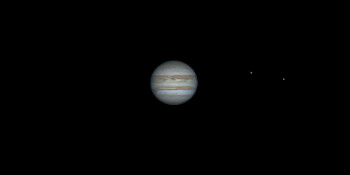
Jupiter's Rotation, by Vishal Sharma, India
Pie de foto: Third place in the 2021 IAU OAE Astrophotography Contest, category Galilean moons: Jupiter’s Rotation, by Vishal Sharma, India.
This time-lapse beautifully shows the rotation of Jupiter and the passage of two Galilean moons on the right side of the frame. Jupiter completes one rotation in just under 10 hours and we see as the Great Red Spot makes its way from left to right. The two moons travel a noticeable fraction of their orbit in this short time. This image was taken in 2020 in the North of India.
Crédito: Vishal Sharma/IAU OAE
License: CC-BY-4.0 Creative Commons Reconocimiento 4.0 Internacional (CC BY 4.0) íconos
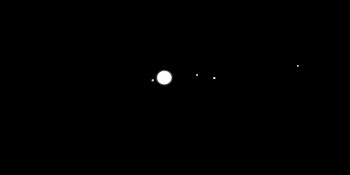
Jupiter Moons Movie2, by Nicolas Hurez, Paul-Antoine Matrangolo, and Carl Pennypacker, United States of America
Pie de foto: Second place in the 2021 IAU OAE Astrophotography Contest, category Galilean moons.
This sequence shows the orbit of the four Galilean moons around the planet Jupiter. Almost two entire orbits of the innermost moon, Io, can be seen, with the other moons (Europa and Ganymede, but in particular Callisto) being further away, orbiting noticeably slower. The images were obtained in 2018 with the Las Cumbres Global Observatory at different locations on Earth, allowing a continuous sequence of images over approximately half a week without gaps during the day. With clear skies and over the course of several nights, the motion of the Galilean moons can also be observed with binoculars (ideally steady your elbows on a surface).
Crédito: Nicolas Hurez, Paul-Antoine Matrangolo and Carl Pennypacker/IAU OAE
License: CC-BY-4.0 Creative Commons Reconocimiento 4.0 Internacional (CC BY 4.0) íconos
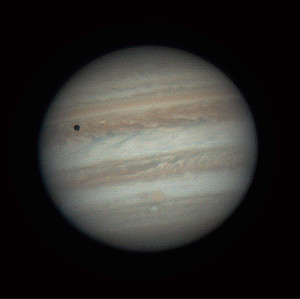
Jupiter, Io and its shadow, by Ralf Burkart, Germany
Pie de foto: First place in the 2021 IAU OAE Astrophotography Contest, category Galilean moons.
This time-lapse of Jupiter taken in 2017 from Germany beautifully illustrates the transit of one of the Galilean moons, Io, in front of Jupiter. As this is simply a moon casting a shadow on a planet it is equivalent to a lunar eclipse on Earth observed from further away. While the shadow of the moon is clearly visible from the beginning, it might be difficult to spot the moon itself against the background of the beautiful atmospheric bands of Jupiter the first time the video is seen. Watching it repeatedly allows appreciating the rapid motion and rotation in this fantastic observation.
Crédito: Ralf Burkart/IAU OAE
License: CC-BY-4.0 Creative Commons Reconocimiento 4.0 Internacional (CC BY 4.0) íconos
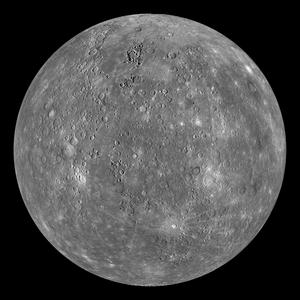
Mercury
Pie de foto: This image is a composite of a picture mosaic of the planet Mercury's surface obtained by the MESSENGER (Mercury Surface, Space Environment, Geochemistry and Ranging) space probe. MESSENGER was launched by NASA in 2004 and explored Mercury from 2011 to 2015.
Crédito: NASA/Johns Hopkins University Applied Physics Laboratory/Carnegie Institution of Washington
enlace de crédito
License: PD Dominio público íconos
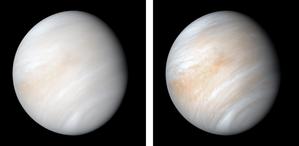
Venus in visible light
Pie de foto: This picture taken by NASA's Mariner 10 probe shows what the planet Venus looks like when looking at it with naked eyes. Venus is enshrouded inside a thick cloudy atmosphere dominated by carbon dioxide, never revealing its hot surface.
Crédito: NASA/JPL-Caltech
enlace de crédito
License: PD Dominio público íconos
Actividades relacionadas
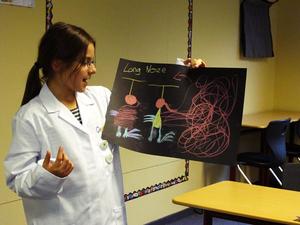
Design Your Alien
astroEDU educational activity (links to astroEDU website) Description: Design an alien life form suited for an extra-terrestrial world.
License: CC-BY-4.0 Creative Commons Reconocimiento 4.0 Internacional (CC BY 4.0) íconos
Etiquetas:
Life
, Environment
, Extra-terrestrial
, Art
, Creativity
, Hands-on
, Alien
Rango de edades:
8-10
, 10-12
Nivel educativo:
Primaria
, Secondary