Término del glosario: Venus
Descripción: Venus es el segundo planeta más cercano al Sol. A menudo denominado «el gemelo de la Tierra», es un planeta rocoso y terrestre con un radio ligeramente superior a los 6 000 kilómetros (km), lo que supone aproximadamente el 95 % del radio de la Tierra. Su masa es 0.815 veces la de la Tierra. La atmósfera de Venus es 90 veces más densa que la de la Tierra. Está compuesta principalmente por dióxido de carbono, junto con densas nubes de ácido sulfúrico que envuelven toda la superficie. La densa atmósfera produce un efecto invernadero muy intenso, lo que da lugar a una temperatura superficial de 460 grados Celsius.
Su distancia típica al Sol es de 108 millones de kilómetros, lo que equivale aproximadamente a 0.72 unidades astronómicas (distancias Tierra-Sol). Tarda 224.7 días en completar una órbita. Venus tarda mucho tiempo en dar una vuelta completa sobre su eje con respecto a las estrellas lejanas; un día venusiano corresponde a 243 días terrestres. Este periodo es más largo que el tiempo que tarda Venus en completar una órbita alrededor del Sol. No se conoce que Venus tenga lunas.
Venus recibe su nombre de la diosa romana del amor. Dado que Venus está tan cerca del Sol, a menudo es visible en el cielo nocturno poco antes del amanecer o después del atardecer. En estas ocasiones, Venus brilla de forma llamativa incluso a simple vista, y se le conoce tradicionalmente como la estrella de la mañana o la estrella de la tarde, respectivamente. Con binoculares, se puede observar que Venus presenta fases similares a las de la Luna.
Términos relacionados:
Ver este término en otros idiomas
Estado del término y la definición: La definición original de este término en inglés ha sido aprobada por unastrónomo o astrónoma investigadora y un docente La traducción de este término y su definición aún están pendientes de aprobación
El Glosario multilingüe de la OAE es un proyecto de la Oficina de Astronomía para la Educación de la UAI (OAE) en colaboración con la Oficina de Divulgación de Astronomía de la UAI (OAO). Los términos y definiciones fueron seleccionados, redactados y revisados gracias al esfuerzo colectivo de la OAE, los Centros y Nodos de la OAE, los Coordinadores Nacionales de Educación Astronómica (NAECs) y otros voluntarios. Puedes encontrar una lista completa de créditos aquí. Todos los términos del glosario y sus definiciones se publican bajo la licencia Creative Commons CC BY-4.0 y deben atribuirse a la "IAU OAE".
Si detectas algún error de contenido o de traducción en este término del glosario o en ladefinición, ponte en contacto con nosotros.
En otros idiomas
- Árabe: كوكب الزهرة
- Alemán: Venus (Planet)
- Inglés: Venus
- Francés: Vénus
- Italiano: Venere (pianeta)
- Japonés: 金星 (enlace externo)
- Coreano: 금성
- Portugués de Brasil: Vênus
- Chino simplificado: 金星
- Chino tradicional: 金星
Contenidos relacionados
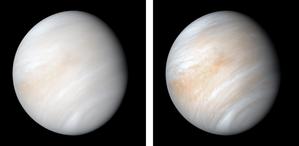
Venus in visible light
Pie de foto: This picture taken by NASA's Mariner 10 probe shows what the planet Venus looks like when looking at it with naked eyes. Venus is enshrouded inside a thick cloudy atmosphere dominated by carbon dioxide, never revealing its hot surface.
Crédito: NASA/JPL-Caltech
enlace de crédito
License: PD Dominio público íconos
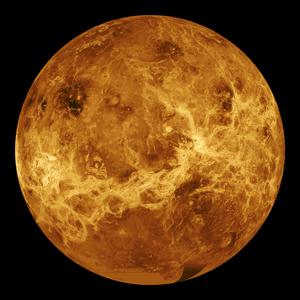
Venus' surface
Pie de foto: This image is a computer-aided rendering of the surface of the planet Venus. Since visual light cannot penetrate the thick clouds in Venus' atmosphere, the image was obtained with radio waves. NASA's space probe Megallan, launched in 1989 mapped Venus' surface between 1990 and 1994.
Crédito: NASA/JPL
enlace de crédito
License: PD Dominio público íconos

To guard the Stars and the Sea Together
Pie de foto: Winner in the 2022 IAU OAE Astrophotography Contest, category Still images of celestial patterns.
This image composition is amazing. In the far background of the landscape we see a chain of mountains that seems to mirror the structure of the Milky Way in the sky above. The strong daylight-like colours of the landscape are caused by the Moon, the bright light at the top of the image.
Taken in Kinabalu, Malaysia, in February 2019, this image shows the alignment of planets and the Moon, conveying the idea of the ecliptic as the central line of the Zodiac, the plane within which all planets orbit the Sun. The ecliptic is the central line of the Zodiac, so the region of about five to 10 degrees either side of the ecliptic is where the constellations of the Zodiac are located. Starting from the horizon towards the bottom left of the image we can see the planets Venus, Saturn and Jupiter. The planets have different cultural significance for people around the world, and are deeply embedded in social, religious and practical aspects of life. For example, Wardaman traditions of Indigenous Australians associate the planets with ancestor spirits who traverse the Celestial Road (ecliptic). The appearance and disappearance of planets in the sky are associated with various ceremonies. For example, when Venus starts being the “Morning star” after having been the “Evening star”, this marks the Banumbirr ceremony for the Yolnu people of Arnhem Land, in Australia.
The image also shows the constellations Scorpius, Aquila, Lupus and Triangulum Australe, the asterism of the Teapot, and the two pointer stars Alpha and Beta Centauri. The constellations, asterisms and individual stars within them have significance in many different cultures.
Malaysia, being close to the equator, has had connections to the north as well as to the south and almost the whole sky is visible over the course of the year. The star Antares is seen by the Kokatha people of the Western Desert as Kogolongo, the red tailed black cockatoo, while the Boorong refer to it as Djuit, the red-rumped parrot. The two stars which form the stinger of Scorpius (Shaula and Lesath), are called Karik Karik, the Australian Kestrel.
Crédito: Likai Lin/IAU OAE
License: CC-BY-4.0 Creative Commons Reconocimiento 4.0 Internacional (CC BY 4.0) íconos
Romanian Orion
Pie de foto: Winner in the 2022 IAU OAE Astrophotography Contest, category Still images of celestial patterns.
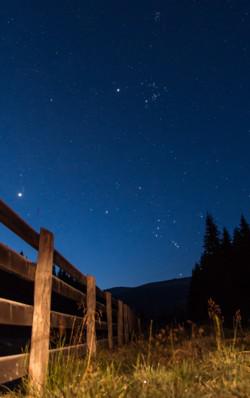
Taken in Romania in August 2012, this image shows two of the most recognisable constellations in the sky, Orion and Taurus.
Orion, the Hunter, is found near the horizon. The most prominent star visible in this image is Betelgeuse, while the asterism of Orion’s belt is formed by three aligned bright stars. Just above Orion we can find Taurus, one of the constellations of the Zodiac. As the Zodiac is inherited from Babylon, The Bull of Heaven represents a mighty but dangerous creature that was defeated by King Gilgamesh and his friend Enkidu. They cut the Bull in half and sacrificed the animal to the gods in order to protect their people. Taurus is also home to the star cluster Pleiades, also known as the Seven Sisters. Two planets are visible: Venus, the bright spot near the fence, and Jupiter, the bright spot at the top, next to the Bull’s face.
Different cultures have included the stars of these constellations in their own mythology. The Romanians, for instance, after Christianisation identified four other constellations using some of the stars of Orion and others surrounding it. One such constellation is called Trisfetitele (the Three Saints), which is associated with the three stars comprising Orion's Belt, representing the Three Hierarchs Basil, Gregory and John. This same asterism is also called Three Wise Men, Kings from the East or just Three Kings — all of these names being rooted in the Christian religion.
The agricultural calendar, in contrast, led farmers to define two other constellations, the Little Plough and the Sickle. Both are seen in the southern half of the Orion rectangle; the Little Plough is drawn by connecting the southern quadrilateral with Orion’s left shoulder, and the Sickle is formed by connecting Orion’s left foot (Rigel) with the belt stars, forming an arch and completing the form of a hoe. In the cultural calendar, these constellations were used to announce the harvest of wheat/grain. Finally, the fourth Romanian constellation is the Great Auger, where Orion’s belt represents the handle of the auger, and Betelgeuse is the tip, facing towards Pollux in Gemini. This constellation is associated with treasure, as Romanian peasants believe that the Auger points to the treasure when they approach the end of the world.
Most of the official star names in Orion are Arabic; Mintaka (meaning “belt”) is at the waist; Alnitak (meaning “girdle”) and Alnilam (meaning “string”) are at the belt; and Rigel (meaning foot) is at the left foot. The star on the left shoulder is named Bellatrix, the Latin term for a female warrior. The star at the right leg is called Saiph, for the sword or sabre of the Arabic Orion.
Crédito: Alex Conu/IAU OAE
License: CC-BY-4.0 Creative Commons Reconocimiento 4.0 Internacional (CC BY 4.0) íconos
A Matter of Perspective
Pie de foto: Second place winner in the 2023 IAU OAE Astrophotography Contest, category of Still images of phases of Venus.
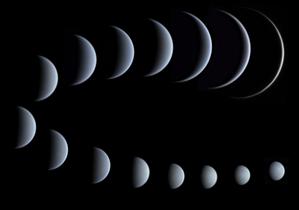
This exquisite series of images, captured from Santo Domingo, Dominican Republic, between 17 December 2019 and 25 May 2020, shows the phases of Venus as seen from Earth. As Venus and Earth orbit the Sun, we observe different portions of Venus’s sunlit half, similar to the Moon’s phases. The sequence clearly shows Venus as distant, small, bright and gibbous in the lower frames, and ends with Venus reaching the biggest apparent size of all planets (upper frames), very close to the Sun with a small elongation, and appearing as a thin crescent. In the last frame, only 2.8% of the planet’s surface is illuminated.
Crédito: Christofer Baez/IAU OAE (CC BY 4.0)
License: CC-BY-4.0 Creative Commons Reconocimiento 4.0 Internacional (CC BY 4.0) íconos
Actividades relacionadas
Children's Planetary Maps: Venus
astroEDU educational activity (links to astroEDU website) Description: Learn more about our nearest neighbour
License: CC-BY-4.0 Creative Commons Reconocimiento 4.0 Internacional (CC BY 4.0) íconos
Etiquetas:
Planetary cartography
, Spatial thinking
Rango de edades:
6-8
, 8-10
, 10-12
, 12-14
Nivel educativo:
Educación secundaria
, Primaria
, Secondary
Áreas de aprendizaje:
Aprendizaje basado en la investigación estructurada
Costos:
Bajo coste
Duración:
2 horas
Tamaño del grupo:
Grupo
Competencias:
Analizar e interpretar datos
, Plantear preguntas
, Comunicar información
, Elaborar explicaciones
, Desarrollar y utilizar modelos
, Participar en debates basados en pruebas
, Planificar y llevar a cabo investigaciones

Meet our neighbours: Venus
astroEDU educational activity (links to astroEDU website) Description: Ever dreamed of building a tactile version of planet Venus?
License: CC-BY-4.0 Creative Commons Reconocimiento 4.0 Internacional (CC BY 4.0) íconos
Rango de edades:
6-8
, 8-10
, 10-12
Nivel educativo:
Primaria
Áreas de aprendizaje:
Actividad lúdica
, Modelización
Costos:
Bajo coste
Duración:
1 hora
Tamaño del grupo:
Grupo
Competencias:
Analizar e interpretar datos
, Desarrollar y utilizar modelos