Glossary term: ग्रह (प्लैनट)
Description: अंतर्राष्ट्रीय खगोलीय संघ के अनुसार, ग्रह एक तारे या तारे के अवशेष की परिक्रमा करने वाला एक खगोलीय पिंड है, जो इतना बड़ा हो सकता है कि अपने गुरुत्वाकर्षण से लगभग गोलाकार हो सकता है, लेकिन इतना बड़ा नहीं कि थर्मोन्यूक्लियर संलयन से गुजर सके। इस खगोलीय पिंड के गुरुत्वाकर्षण खिंचाव को अन्य खगोलीय पिंडों को अपनी कक्षा से बाहर खींचना चाहिए। ये वस्तुएं पास के सूर्य की रोशनी से चमकती हैं। उनके पास अपना स्वयं का प्रकाश नहीं है, लेकिन वे अवरक्त तरंग दैर्ध्य में प्रकाश उत्सर्जित करते हैं। हमारे सौरमंडल में आठ ग्रह सूर्य की परिक्रमा करते हैं। ग्रह मूल रूप से चट्टानी वस्तुएं हो सकते हैं, जैसे आंतरिक ग्रह - बुध, शुक्र, पृथ्वी और मंगल - या ज्यादातर तरल और गैसीय बाहरी ग्रहों - बृहस्पति, शनि, यूरेनस और नेपच्यून की तरह छोटे ठोस कोर हो सकते हैं। सौर मंडल के बाहर के ग्रहों को संक्षेप में एक्स्ट्रासोलर ग्रह या एक्सोप्लैनेट कहा जाता है।
Related Terms:
- पृथ्वी
- Exoplanet
- Gas Giant
- Giant Planet
- Ice Giant
- International Astronomical Union
- Jupiter
- Mars
- Mercury
- Neptune
- Nuclear Fusion
- Outer Planets
- Saturn
- Solar System
- Terrestrial Planet
- Uranus
- Venus
See this term in other languages
Term and definition status: The original definition of this term in English have been approved by a research astronomer and a teacher The translation of this term and its definition is still awaiting approval
The OAE Multilingual Glossary is a project of the IAU Office of Astronomy for Education (OAE) in collaboration with the IAU Office of Astronomy Outreach (OAO). The terms and definitions were chosen, written and reviewed by a collective effort from the OAE, the OAE Centers and Nodes, the OAE National Astronomy Education Coordinators (NAECs) and other volunteers. You can find a full list of credits here. All glossary terms and their definitions are released under a Creative Commons CC BY-4.0 license and should be credited to "IAU OAE".
If you notice a factual or translation error in this glossary term or definition then please get in touch.
Related Media
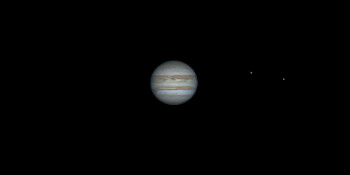
Jupiter's Rotation, by Vishal Sharma, India
Caption: Third place in the 2021 IAU OAE Astrophotography Contest, category Galilean moons: Jupiter’s Rotation, by Vishal Sharma, India.
This time-lapse beautifully shows the rotation of Jupiter and the passage of two Galilean moons on the right side of the frame. Jupiter completes one rotation in just under 10 hours and we see as the Great Red Spot makes its way from left to right. The two moons travel a noticeable fraction of their orbit in this short time. This image was taken in 2020 in the North of India.
Credit: Vishal Sharma/IAU OAE
License: CC-BY-4.0 Creative Commons Attribution 4.0 International (CC BY 4.0) icons
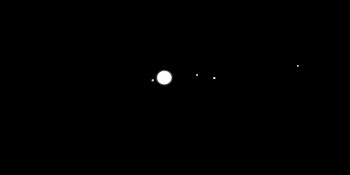
Jupiter Moons Movie2, by Nicolas Hurez, Paul-Antoine Matrangolo, and Carl Pennypacker, United States of America
Caption: Second place in the 2021 IAU OAE Astrophotography Contest, category Galilean moons.
This sequence shows the orbit of the four Galilean moons around the planet Jupiter. Almost two entire orbits of the innermost moon, Io, can be seen, with the other moons (Europa and Ganymede, but in particular Callisto) being further away, orbiting noticeably slower. The images were obtained in 2018 with the Las Cumbres Global Observatory at different locations on Earth, allowing a continuous sequence of images over approximately half a week without gaps during the day. With clear skies and over the course of several nights, the motion of the Galilean moons can also be observed with binoculars (ideally steady your elbows on a surface).
Credit: Nicolas Hurez, Paul-Antoine Matrangolo and Carl Pennypacker/IAU OAE
License: CC-BY-4.0 Creative Commons Attribution 4.0 International (CC BY 4.0) icons
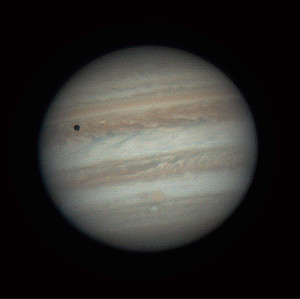
Jupiter, Io and its shadow, by Ralf Burkart, Germany
Caption: First place in the 2021 IAU OAE Astrophotography Contest, category Galilean moons.
This time-lapse of Jupiter taken in 2017 from Germany beautifully illustrates the transit of one of the Galilean moons, Io, in front of Jupiter. As this is simply a moon casting a shadow on a planet it is equivalent to a lunar eclipse on Earth observed from further away. While the shadow of the moon is clearly visible from the beginning, it might be difficult to spot the moon itself against the background of the beautiful atmospheric bands of Jupiter the first time the video is seen. Watching it repeatedly allows appreciating the rapid motion and rotation in this fantastic observation.
Credit: Ralf Burkart/IAU OAE
License: CC-BY-4.0 Creative Commons Attribution 4.0 International (CC BY 4.0) icons
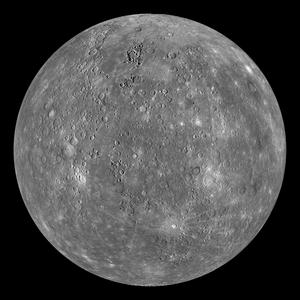
Mercury
Caption: This image is a composite of a picture mosaic of the planet Mercury's surface obtained by the MESSENGER (Mercury Surface, Space Environment, Geochemistry and Ranging) space probe. MESSENGER was launched by NASA in 2004 and explored Mercury from 2011 to 2015.
Credit: NASA/Johns Hopkins University Applied Physics Laboratory/Carnegie Institution of Washington
credit link
License: PD Public Domain icons
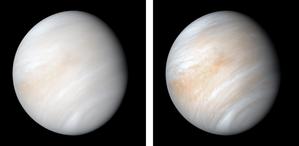
Venus in visible light
Caption: This picture taken by NASA's Mariner 10 probe shows what the planet Venus looks like when looking at it with naked eyes. Venus is enshrouded inside a thick cloudy atmosphere dominated by carbon dioxide, never revealing its hot surface.
Credit: NASA/JPL-Caltech
credit link
License: PD Public Domain icons
Related Activities
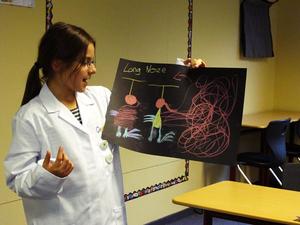
Design Your Alien
astroEDU educational activity (links to astroEDU website) Description: Design an alien life form suited for an extra-terrestrial world.
License: CC-BY-4.0 Creative Commons Attribution 4.0 International (CC BY 4.0) icons
Tags:
Life
, Environment
, Extra-terrestrial
, Art
, Creativity
, Hands-on
, Alien
Age Ranges:
8-10
, 10-12
Education Level:
Primary
, Secondary