Término del glosario: Marte
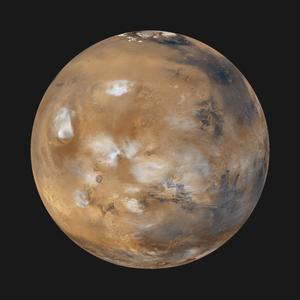
Descripción: Marte es el cuarto planeta desde el Sol en el Sistema Solar. Es un planeta rocoso y terrestre con un radio de poco menos de 3400 kilómetros (km), algo más de la mitad del radio de la Tierra. Marte tiene una atmósfera muy fina, un extenso sistema de cañones y la montaña más alta del Sistema Solar: un volcán extinto llamado Monte Olimpo. Se cree que en épocas anteriores de su historia albergó agua en estado líquido.
Su distancia típica al Sol es de unos 228 millones de km o 1.52 unidades astronómicas (distancias Tierra-Sol). Tarda 687 días en completar una órbita alrededor del Sol. Marte tiene dos pequeñas lunas, Fobos y Deimos.
Lleva el nombre del dios romano de la guerra. A menudo se le llama el «planeta rojo» debido a su color rojizo y oxidado. A lo largo de los años, los científicos han enviado numerosos módulos de exploración a Marte para estudiar su composición y su atmósfera.
Términos relacionados:
Ver este término en otros idiomas
Estado del término y la definición: La definición original de este término en inglés ha sido aprobada por unastrónomo o astrónoma investigadora y un docente La traducción de este término y su definición aún están pendientes de aprobación
El Glosario multilingüe de la OAE es un proyecto de la Oficina de Astronomía para la Educación de la UAI (OAE) en colaboración con la Oficina de Divulgación de Astronomía de la UAI (OAO). Los términos y definiciones fueron seleccionados, redactados y revisados gracias al esfuerzo colectivo de la OAE, los Centros y Nodos de la OAE, los Coordinadores Nacionales de Educación Astronómica (NAECs) y otros voluntarios. Puedes encontrar una lista completa de créditos aquí. Todos los términos del glosario y sus definiciones se publican bajo la licencia Creative Commons CC BY-4.0 y deben atribuirse a la "IAU OAE".
Si detectas algún error de contenido o de traducción en este término del glosario o en ladefinición, ponte en contacto con nosotros.
Contenidos relacionados
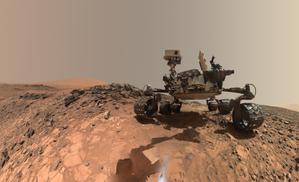
Mars rover Curiosity
Pie de foto: This self-portrait of NASA's Curiosity Mars rover shows the vehicle at the site from which it reached down to drill into a rock target called "Buckskin" on lower Mount Sharp. The selfie combines several component images taken by Curiosity's Mars Hand Lens Imager (MAHLI) on 5 August 2015, during the 1,065th Martian day, or sol, of the rover's work on Mars.
Crédito: NASA/JPL-Caltech/MSSS
enlace de crédito
License: PD Dominio público íconos
Mars
Pie de foto: This image of the planet Mars taken by NASA's Mars Global Surveyor Orbiter in 1999 shows its dry surface. The picture features the most spectacular geological regions on Mars. Besides the deep Valles Marineris valley we see four volcanoes. While three of them form the Tharsis ridge, the Olympus Mons is largest volcano we have so far discovered in the Solar System. Ice clouds cover parts of the Martian surface.
Crédito: NASA/JPL/MSSS
enlace de crédito
License: PD Dominio público íconos
Equatorial Milky Way
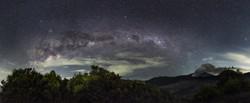
Pie de foto: Honourable mention in the 2022 IAU OAE Astrophotography Contest, category Still images of celestial patterns: Equatorial Milky Way
Taken in Bromo-Tengger-Semeru National Park, Java Island, Indonesia, in March 2016, this image captures regions of the southern Milky Way and, at its left edge, the two planets Mars and Saturn. Mars appears orange and is similar in colour to the star Antares, whose Greek name — anti Ares — references this. Saturn is a little bit fainter than Mars, but clearly visible among the stars of Ophiuchus, above the Pipe Nebula and forming an isosceles triangle with Mars and Antares.
Mars is on the top and Saturn is vertically below. Visible to the naked eye, both planets have significance in many cultures around the world. In Roman mythology Mars is the god of war and fertility, and Saturn the god of sowing and agriculture. Its Greek equivalent, the god Kronos, is also considered the regent of completion. Indigenous Australians, including the Kamilaroi and Wailan people, associate Saturn with “wunygal”, a small bird. Mars is called Iherm-penh (something burnt in flames) by the Anmatyerre people of the Central Desert, while the Kokatha people of the Western Desert associate Mars and the star Anatres with the red-tailed black cockatoo (Kogolongo).
In the middle of this photograph, the most famous southern constellations are clearly recognisable: the Southern Cross (Crux), the pointer stars, Alpha and Beta Centauri, the dark Coalsack Nebula and the red Eta Carina Nebula, which is not visible to the unaided eye but is prominent in modern photographs. In the 19th century, the star eta Carinae had been the second-brightest star in the sky for some time, but since it varies irregularly, it has hardly been recognisable in recent decades, and its future visibility is unpredictable.
Triangulum Australe is visible between the pointer stars and the Scorpion, and in the constellation of Centaurus, the bright globular star cluster Omega Centauri is clearly displayed. It was considered a “nebulous star” since antiquity and, thus, was listed in star catalogues for at least 2000 years. Only within the last century did astronomers discover that globular star clusters are in the halo of our galaxy and that this one consists of roughly 10 million stars.
The dark regions in the Milky Way, which are cool, dense clouds of dust and gas, form the head and body of the Celestial Emu Tchingal. Together with the Southern Cross and the pointer stars, they appear in the Dreamtime stories of many Indigenous Australians. One story associated with the Djab Wurrung and the Jardwadjali people is part of a Dreamtime Story involving Tchingal, the Bram-bram-bult brothers (the pointer stars), their mother Druk (Delta Crux), and Bunya the hunter, who gets transformed into a possum (Gacrux, the red star at the top of the Southern Cross).
Crédito: Giorgia Hofer/IAU OAE
License: CC-BY-4.0 Creative Commons Reconocimiento 4.0 Internacional (CC BY 4.0) íconos
Retrograde Motion of Mars
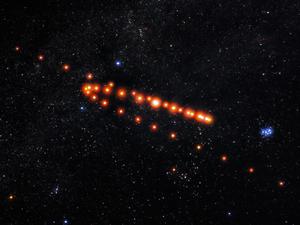
Pie de foto: Winner in the 2023 IAU OAE Astrophotography Contest, category Still images with smartphones-mobile devices.
This image captures the celestial waltz of Mars as it demonstrates its intriguing retrograde motion against the background of fixed stars. This event, when Mars appears to backtrack in its orbit, arises from the different speeds at which Earth and Mars orbit the Sun. Earth’s faster movement occasionally positions it ahead of Mars, creating the illusion of the Red Planet moving in reverse from our perspective. This retrograde motion occurs when Mars is on the other side of the sky from the Sun, when it is said to be in opposition. Following Mars from 14 August 2022 to 5 April 2023, this smartphone image stands as a testament to perseverance and precision in the tranquil setting of Bataan, Philippines. Enduring unpredictable weather and ever-shifting celestial alignments, the photographer meticulously captured each shot at regular intervals of five to eight days. The process involved aligning 35 distinct images of Mars, taken without any external lens or telescope, alongside a stacked background image composed of 54 frames lasting 15 seconds each, portraying the starry expanse. Fusing these images involved precisely aligning them and cropping Mars in order to centre its position, revealing its retrograde movement against the backdrop of stars. This intricate process, blending the images seamlessly into the background by masking, highlights the planet’s unique motion. In the lower right corner, the Pleiades star cluster is visible.
Crédito: Rob Kerby Guevarra/IAU OAE (CC BY 4.0)
License: CC-BY-4.0 Creative Commons Reconocimiento 4.0 Internacional (CC BY 4.0) íconos

Tránsito de Fobos desde Marte
Pie de foto: Este vídeo muestra el Sol visto desde Marte mientras su luna, Fobos, transita por el disco solar. Este vídeo está compuesto por imágenes tomadas desde la superficie marciana el 30 de septiembre de 2024 por la cámara Mastcam-Z del vehículo explorador Perseverance Mars de la NASA. Mientras que nuestra Luna tiene el tamaño perfecto para eclipsar al Sol vista desde la superficie terrestre, el tamaño y la órbita de Fobos hacen que no pueda cubrir completamente el disco solar. Esto significa que se trata de un tránsito y no de un eclipse.
Este vídeo es en tiempo real, y el tránsito completo dura sólo 32 segundos. Esto contrasta con las horas que dura un eclipse solar en la Tierra desde que la Luna oscurece parte del Sol hasta que este vuelve a ser completamente visible. Esto se debe a que el período orbital de Fobos es mucho más corto, de poco más de siete horas y media, que el de la Luna, de 27 días, y a que el disco solar parece ligeramente más pequeño desde Marte que desde la Tierra. Nótese la forma no esférica de Fobos al cruzar el disco solar.
Crédito: NASA/JPL-Caltech/ASU/MSSS
enlace de crédito
License: PD Dominio público íconos
Actividades relacionadas
Children's Planetary Maps: Mars
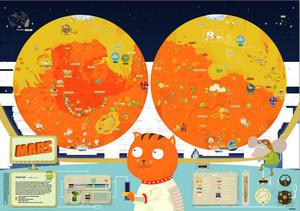
astroEDU educational activity (links to astroEDU website) Description: Explore planet Mars, learning how to use planetary maps!
License: CC-BY-4.0 Creative Commons Reconocimiento 4.0 Internacional (CC BY 4.0) íconos
Etiquetas:
Maps
, Planetary cartography
Rango de edades:
6-8
, 8-10
, 10-12
, 12-14
Nivel educativo:
Educación secundaria
, Primaria
, Secondary
Áreas de aprendizaje:
Aprendizaje basado en la investigación estructurada
Costos:
Gratis
Duración:
2 horas
Tamaño del grupo:
Grupo
Competencias:
Analizar e interpretar datos
, Plantear preguntas
, Elaborar explicaciones
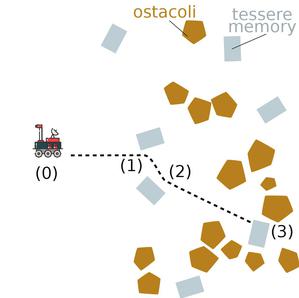
Driving on Mars
astroEDU educational activity (links to astroEDU website) Description: An educational interdisciplinary game to drive a rover on Mars
License: CC-BY-4.0 Creative Commons Reconocimiento 4.0 Internacional (CC BY 4.0) íconos
Etiquetas:
Game
, robot
, robotics
, simulation
, telecommunications
Rango de edades:
14-16
, 16-19
Nivel educativo:
Educación secundaria
, Secondary
Áreas de aprendizaje:
Aprendizaje por descubrimiento guiado
Costos:
Bajo coste
Duración:
2 horas
Tamaño del grupo:
Grupo
Competencias:
Comunicar información
, Desarrollar y utilizar modelos
, Utilizar las matemáticas y el pensamiento computacional

Meet our neighbours: Mars
astroEDU educational activity (links to astroEDU website) Description: Build a tactile version of the red planet!
License: CC-BY-4.0 Creative Commons Reconocimiento 4.0 Internacional (CC BY 4.0) íconos
Rango de edades:
6-8
, 8-10
, 10-12
Nivel educativo:
Primaria
Áreas de aprendizaje:
Actividad lúdica
, Modelización
Costos:
Bajo coste
Duración:
1 hora
Tamaño del grupo:
Grupo
Competencias:
Analizar e interpretar datos
, Desarrollar y utilizar modelos