وسائط ذات صلة
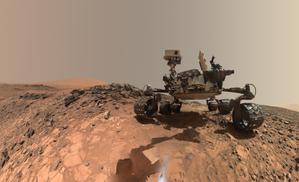
مسبار المريخ كيروستى
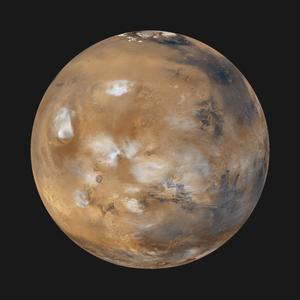
كوكب المريخ
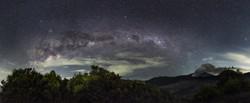
Equatorial Milky Way
الشرح: Honourable mention in the 2022 IAU OAE Astrophotography Contest, category Still images of celestial patterns: Equatorial Milky Way
Taken in Bromo-Tengger-Semeru National Park, Java Island, Indonesia, in March 2016, this image captures regions of the southern Milky Way and, at its left edge, the two planets Mars and Saturn. Mars appears orange and is similar in colour to the star Antares, whose Greek name — anti Ares — references this. Saturn is a little bit fainter than Mars, but clearly visible among the stars of Ophiuchus, above the Pipe Nebula and forming an isosceles triangle with Mars and Antares.
Mars is on the top and Saturn is vertically below. Visible to the naked eye, both planets have significance in many cultures around the world. In Roman mythology Mars is the god of war and fertility, and Saturn the god of sowing and agriculture. Its Greek equivalent, the god Kronos, is also considered the regent of completion. Indigenous Australians, including the Kamilaroi and Wailan people, associate Saturn with “wunygal”, a small bird. Mars is called Iherm-penh (something burnt in flames) by the Anmatyerre people of the Central Desert, while the Kokatha people of the Western Desert associate Mars and the star Anatres with the red-tailed black cockatoo (Kogolongo).
In the middle of this photograph, the most famous southern constellations are clearly recognisable: the Southern Cross (Crux), the pointer stars, Alpha and Beta Centauri, the dark Coalsack Nebula and the red Eta Carina Nebula, which is not visible to the unaided eye but is prominent in modern photographs. In the 19th century, the star eta Carinae had been the second-brightest star in the sky for some time, but since it varies irregularly, it has hardly been recognisable in recent decades, and its future visibility is unpredictable.
Triangulum Australe is visible between the pointer stars and the Scorpion, and in the constellation of Centaurus, the bright globular star cluster Omega Centauri is clearly displayed. It was considered a “nebulous star” since antiquity and, thus, was listed in star catalogues for at least 2000 years. Only within the last century did astronomers discover that globular star clusters are in the halo of our galaxy and that this one consists of roughly 10 million stars.
The dark regions in the Milky Way, which are cool, dense clouds of dust and gas, form the head and body of the Celestial Emu Tchingal. Together with the Southern Cross and the pointer stars, they appear in the Dreamtime stories of many Indigenous Australians. One story associated with the Djab Wurrung and the Jardwadjali people is part of a Dreamtime Story involving Tchingal, the Bram-bram-bult brothers (the pointer stars), their mother Druk (Delta Crux), and Bunya the hunter, who gets transformed into a possum (Gacrux, the red star at the top of the Southern Cross).
المصدر: Giorgia Hofer/IAU OAE
License: CC-BY-4.0 المشاع الإبداعي نَسب المُصنَّف 4.0 دولي (CC BY 4.0) أيقونات
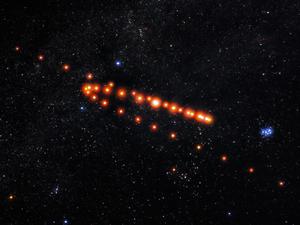
الحركة التراجعية للمريخ

Transit of Phobos from Mars
الشرح: This video shows the Sun viewed from Mars as Mars’ moon Phobos transits across the solar disk. This video is composed of images taken from the Martian surface on the 30th of September 2024 by the Mastcam-Z camera of NASA’s Perseverance Mars rover. While our Moon is perfectly sized to eclipse the Sun when seen from the Earth’s surface, Phobos’s size and orbit mean that it cannot cover the solar disk completely. This means that this event is a transit and not an eclipse.
This video is in real time, with the entire transit lasting just 32 seconds. This compares with the several hours a solar eclipse on Earth takes from the Moon first obscuring part of the Sun to the Sun being completely visible again. This is due to Phobos’ much shorter orbital period of just over seven and a half hours compared to the Moon’s orbital period of 27 days as well as the solar disk appearing slightly smaller from Mars than it does from Earth. Note the non-spherical shape of Phobos as it crosses the solar disk.
المصدر: NASA/JPL-Caltech/ASU/MSSS
رابط المصدر
License: PD الملكية العامة أيقونات
الأنشطة المرتبطة
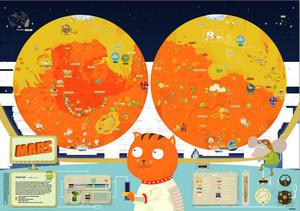
Children's Planetary Maps: Mars
astroEDU educational activity (links to astroEDU website) Description: Explore planet Mars, learning how to use planetary maps!
License: CC-BY-4.0 المشاع الإبداعي نَسب المُصنَّف 4.0 دولي (CC BY 4.0) أيقونات
وسوم:
Maps
, Planetary cartography
الفئات العمرية:
6-8
, 8-10
, 10-12
, 12-14
المرحلة التعليمية:
المرحلة المتوسطة
, المرحلة الابتدائية
, المرحلة الثانوية
مجالات التعلم:
تعلم منظم قائم على الاستقصاء
التكاليف:
مجاني
المدة:
ساعتان
حجم المجموعة:
جماعي
المهارات:
تحليل البيانات وتفسيرها
, طرح الأسئلة
, صياغة التفسيرات
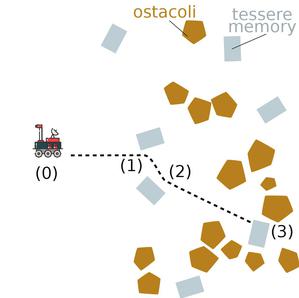
Driving on Mars
astroEDU educational activity (links to astroEDU website) Description: An educational interdisciplinary game to drive a rover on Mars
License: CC-BY-4.0 المشاع الإبداعي نَسب المُصنَّف 4.0 دولي (CC BY 4.0) أيقونات
وسوم:
Game
, robot
, robotics
, simulation
, telecommunications
الفئات العمرية:
14-16
, 16-19
المرحلة التعليمية:
المرحلة المتوسطة
, المرحلة الثانوية
مجالات التعلم:
تعلم استكشافي موجه
التكاليف:
تكلفة منخفضة
المدة:
ساعتان
حجم المجموعة:
جماعي
المهارات:
توصيل المعلومات
, تطوير النماذج واستخدامها
, استخدام الرياضيات والتفكير الحاسوبي

Meet our neighbours: Mars
astroEDU educational activity (links to astroEDU website) Description: Build a tactile version of the red planet!
License: CC-BY-4.0 المشاع الإبداعي نَسب المُصنَّف 4.0 دولي (CC BY 4.0) أيقونات
الفئات العمرية:
6-8
, 8-10
, 10-12
المرحلة التعليمية:
المرحلة الابتدائية
مجالات التعلم:
نشاط ممتع
, النمذجة
التكاليف:
تكلفة منخفضة
المدة:
ساعة واحدة
حجم المجموعة:
جماعي
المهارات:
تحليل البيانات وتفسيرها
, تطوير النماذج واستخدامها