Término del glosario: Gigante de hielo
Descripción: En el Sistema Solar hay cuatro planetas gigantes: Júpiter, Saturno, Urano y Neptuno. Los dos últimos, Urano y Neptuno, se conocen como gigantes helados. Tienen núcleos rocosos sólidos rodeados por una gruesa capa de agua, amoníaco y metano. Estas sustancias químicas se encuentran en un extraño estado de la materia a alta presión: ni del todo sólidas, ni del todo líquidas. La atmósfera exterior de ambos planetas es una capa densa y esponjosa de hidrógeno y helio.
En el Sistema Solar temprano, en las regiones alejadas del Sol, hacía suficiente frío como para que el agua, el metano y el amoníaco se congelaran y se convirtieran en hielo. Aquí, «hielo» es un término general para referirse a sustancias químicas congeladas formadas por moléculas. Los jóvenes planetas Urano y Neptuno acrecieron estos hielos gracias a su fuerza gravitatoria. Dado que estos hielos constituían un componente tan importante de estos dos planetas, se les denominó gigantes de hielo.
Términos relacionados:
Ver este término en otros idiomas
Estado del término y la definición: La definición original de este término en inglés ha sido aprobada por unastrónomo o astrónoma investigadora y un docente La traducción de este término y su definición aún están pendientes de aprobación
El Glosario multilingüe de la OAE es un proyecto de la Oficina de Astronomía para la Educación de la UAI (OAE) en colaboración con la Oficina de Divulgación de Astronomía de la UAI (OAO). Los términos y definiciones fueron seleccionados, redactados y revisados gracias al esfuerzo colectivo de la OAE, los Centros y Nodos de la OAE, los Coordinadores Nacionales de Educación Astronómica (NAECs) y otros voluntarios. Puedes encontrar una lista completa de créditos aquí. Todos los términos del glosario y sus definiciones se publican bajo la licencia Creative Commons CC BY-4.0 y deben atribuirse a la "IAU OAE".
Si detectas algún error de contenido o de traducción en este término del glosario o en ladefinición, ponte en contacto con nosotros.
En otros idiomas
- Árabe: العملاق الجليدي
- Alemán: Eisriese
- Inglés: Ice Giant
- Francés: Géante de glace
- Italiano: Gigante di ghiaccio
- Japonés: 巨大氷惑星 (enlace externo)
- Portugués de Brasil: Gigante Gelado
- Chino simplificado: 冰雪巨人
- Chino tradicional: 冰雪巨人
Contenidos relacionados
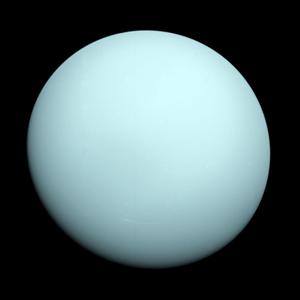
Urano en colores naturales
Pie de foto: Esta es una imagen del planeta Urano tomada por la nave espacial Voyager 2 en 1986. Su aspecto se asemeja bastante al que se vería a simple vista. El color azul verdoso indica que su atmósfera contiene metano.
Crédito: NASA/JPL-Caltech
enlace de crédito
License: PD Dominio público íconos
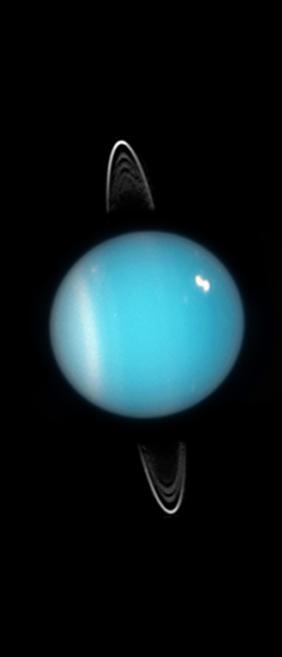
Urano con anillos
Pie de foto: La cámara ACS/HRC del telescopio espacial Hubble de la NASA y la ESA observó Urano en agosto de 2005. En la superficie se aprecian nubes blancas y una región polar brillante. Los anillos que rodean a Urano son estrechos y contienen material rocoso que va desde diminutas partículas de polvo hasta rocas de un metro de tamaño.
Crédito: NASA, ESA y M. Showalter (Instituto SETI)
enlace de crédito
License: PD Dominio público íconos
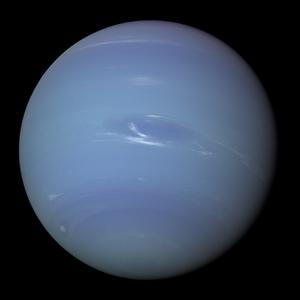
Neptune
Pie de foto: Voyager 2 Narrow Angle Camera image of Neptune taken in August 1989. The Great Dark Spot, flanked by cirrus clouds, is at center. A smaller dark storm, Dark Spot Jr., is rotating into view at bottom left. Additionally, a patch of white cirrus clouds to its north, named "Scooter" for its rapid motion relative to other features, is visible.
Crédito: NASA / JPL / Voyager-ISS / Justin Cowart
enlace de crédito
License: PD Dominio público íconos