Glossary term: Ice Giant
Description: In the Solar System there are four giant planets: Jupiter, Saturn, Uranus, and Neptune. The last two, Uranus and Neptune, are known as ice giants. They have solid rocky cores surrounded by a thick layer of water, ammonia, and methane. These chemicals are in a strange, high-pressure state of matter: not quite solid, not quite liquid. The outer atmosphere of both planets is a thick, puffy layer of hydrogen and helium.
In the early Solar System, in the regions far from the Sun, it was cold enough for water, methane, and ammonia to freeze into ices. Here "ices" is a general term for frozen chemicals made of molecules. The young planets Uranus and Neptune accreted these ices due to their gravitational pull. Because these ices were the source of such an important component of these two planets, they were named the ice giants.
Related Terms:
See this term in other languages
Term and definition status: This term and its definition have been approved by a research astronomer and a teacher
The OAE Multilingual Glossary is a project of the IAU Office of Astronomy for Education (OAE) in collaboration with the IAU Office of Astronomy Outreach (OAO). The terms and definitions were chosen, written and reviewed by a collective effort from the OAE, the OAE Centers and Nodes, the OAE National Astronomy Education Coordinators (NAECs) and other volunteers. You can find a full list of credits here. All glossary terms and their definitions are released under a Creative Commons CC BY-4.0 license and should be credited to "IAU OAE".
If you notice a factual error in this glossary definition then please get in touch.
In Other Languages
- Arabic: العملاق الجليدي
- German: Eisriese
- Spanish: Gigante de hielo
- French: Géante de glace
- Italian: Gigante di ghiaccio
- Japanese: 巨大氷惑星 (external link)
- Brazilian Portuguese: Gigante Gelado
- Simplified Chinese: 冰雪巨人
- Traditional Chinese: 冰雪巨人
Related Media
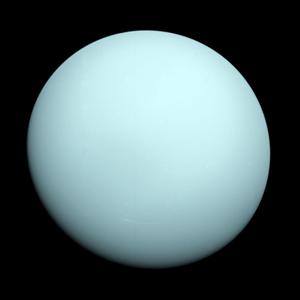
Uranus in natural colours
Caption: This is an image of the planet Uranus taken by the spacecraft Voyager 2 in 1986. Its appearance is close to what the naked eye would see. The greenish-blue colour indicates an atmosphere containing methane.
Credit: NASA/JPL-Caltech
credit link
License: PD Public Domain icons
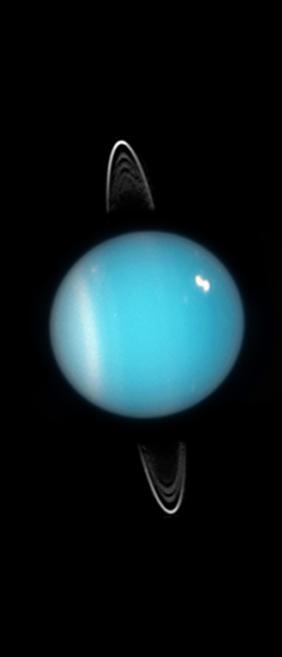
Uranus with rings
Caption: The NASA/ESA Hubble Space Telescope’s ACS/HRC camera observed Uranus in August 2005. The surface depicts white clouds and a bright polar region. The rings around Uranus are narrow and contain rocky material from tiny dust particles up to metre-sized boulders.
Credit: NASA, ESA, and M. Showalter (SETI Institute)
credit link
License: PD Public Domain icons
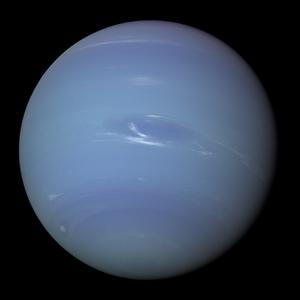
Neptune
Caption: Voyager 2 Narrow Angle Camera image of Neptune taken in August 1989. The Great Dark Spot, flanked by cirrus clouds, is at center. A smaller dark storm, Dark Spot Jr., is rotating into view at bottom left. Additionally, a patch of white cirrus clouds to its north, named "Scooter" for its rapid motion relative to other features, is visible.
Credit: NASA / JPL / Voyager-ISS / Justin Cowart
credit link
License: PD Public Domain icons