Término del glosario: Exoplaneta
Descripción: Un exoplaneta, o planeta extrasolar, es un planeta situado fuera del Sistema Solar. Su existencia se teorizó a partir del siglo XVI y en el siglo XIX se iniciaron investigaciones observacionales para encontrarlos. Los primeros exoplanetas confirmados se descubrieron en la década de 1990. De ellos, el primero en cuya órbita alrededor de una estrella de la secuencia principal se confirmó fue el exoplaneta Dimidium, descubierto indirectamente en el Observatorio de la Alta Provenza. Este exoplaneta orbita alrededor de la estrella 51 Pegasi, una subgigante amarilla, y fue descubierto en 1995. Desde entonces se han identificado miles de exoplanetas.
Términos relacionados:
Ver este término en otros idiomas
Estado del término y la definición: La definición original de este término en inglés ha sido aprobada por unastrónomo o astrónoma investigadora y un docente La traducción de este término y su definición aún están pendientes de aprobación
El Glosario multilingüe de la OAE es un proyecto de la Oficina de Astronomía para la Educación de la UAI (OAE) en colaboración con la Oficina de Divulgación de Astronomía de la UAI (OAO). Los términos y definiciones fueron seleccionados, redactados y revisados gracias al esfuerzo colectivo de la OAE, los Centros y Nodos de la OAE, los Coordinadores Nacionales de Educación Astronómica (NAECs) y otros voluntarios. Puedes encontrar una lista completa de créditos aquí. Todos los términos del glosario y sus definiciones se publican bajo la licencia Creative Commons CC BY-4.0 y deben atribuirse a la "IAU OAE".
Si detectas algún error de contenido o de traducción en este término del glosario o en ladefinición, ponte en contacto con nosotros.
En otros idiomas
- Árabe: الكوكب الخارجي
- Alemán: Exoplanet
- Inglés: Exoplanet
- Francés: Exoplanète
- Italiano: Esopianeta
- Japonés: 太陽系外惑星 (enlace externo)
- Portugués de Brasil: Exoplaneta
- Chino simplificado: 系外行星
- Chino tradicional: 系外行星
Contenidos relacionados
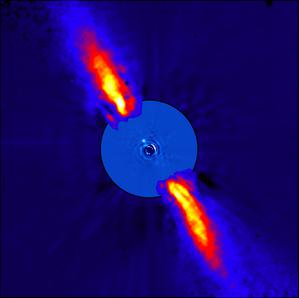
beta Pictoris b
Pie de foto: This composite of two images shows the planet beta Pictoris b and a disk of material both of which orbit the young star beta Pictoris. Both are taken in infrared light. The inner image was one of the first pictures taken of a planet around another star (an exoplanet). This image was made using a technique called adaptive optics which removes the blurring effect of the Earth's atmosphere that spreads out a star's light. The star's light is then concentrated tightly enough that it can be hidden behind a blocking circle (shown here in black) called a coronagraph. The ripples around this are artifacts of the imaging process. Beta Pictoris b, a gas giant planet about twelve times the mass of Jupiter, appears as a dot above and to the left of the black circle.
The outer image shows the thermal emission from the warm disk of material surrounding the young star beta Pictoris. As we are viewing this disk edge-on it appears as a line. This disk of gas and dust provided the material to form beta Pictoris b.
Crédito: ESO/A.-M. Lagrange et al.
enlace de crédito
License: CC-BY-4.0 Creative Commons Reconocimiento 4.0 Internacional (CC BY 4.0) íconos
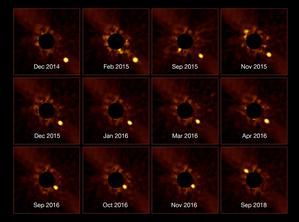
La órbita de Beta Pictoris b
Pie de foto: Esta serie de imágenes muestra el movimiento orbital del planeta extrasolar (exoplaneta) beta Pictoris b. El planeta es el punto brillante que se aprecia en cada imagen. La estrella anfitriona del planeta queda oculta tras el círculo negro situado en el centro de cada imagen. Esto se hace para eliminar el brillo de la estrella anfitriona, que de otro modo eclipsaría la luz del planeta. La órbita del planeta se observa de perfil. Desde esta perspectiva, parece que el planeta se mueve en línea recta.
Entre febrero de 2015 y noviembre de 2016, beta Pictoris b se acerca cada vez más a su estrella anfitriona. El planeta se acercó tanto a la estrella que no se le vio durante casi dos años, tras lo cual reapareció al otro lado de la estrella.
Crédito: Consorcio ESO/Lagrange/SPHERE
enlace de crédito
License: CC-BY-4.0 Creative Commons Reconocimiento 4.0 Internacional (CC BY 4.0) íconos
Diagramas relacionados
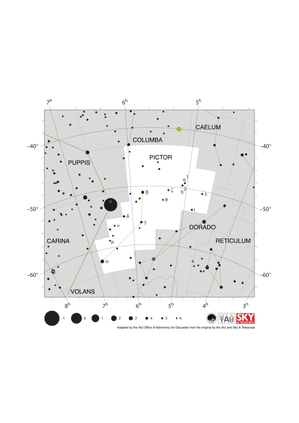
Pictor Constellation Map
Pie de foto: The constellation Pictor with its bright stars and surrounding constellations. Pictor is surrounded by (going clockwise from the top): Columba, Caelum, Dorado, Volans, Carina and Puppis. Pictor is notable for its second brightest star, Beta Pictoris. This young star hosts a large disk of dusty material left over from the planet formation process along with two planets, one of which Beta Pictoris b was one of the first planets to be directly imaged by astronomers.
Pictor is a southern constellation and thus the whole constellation is visible at some point in the year throughout the southern hemisphere. The whole constellation is also visible from some equatorial regions of the northern hemisphere with parts of the constellation visible to the remaining northern equatorial regions and some northern hemisphere temperate zones. Pictor is best viewed in the northern hemisphere winter and southern hemisphere summer.
The y-axis of this diagram is in degrees of declination with north as up and the x-axis is in hours of right ascension with east to the left. The sizes of the stars marked here relate to the star's apparent magnitude, a measure of its apparent brightness. The larger dots represent brighter stars. The Greek letters mark the brightest stars in the constellation. These are ranked by brightness with the brightest star being labeled alpha, the second brightest beta, etc., although this ordering is not always followed exactly. The dotted boundary lines mark the IAU's boundaries of the constellations and the solid green lines mark one of the common forms used to represent the figures of the constellations. Neither the constellation boundaries, nor the lines joining the stars appear on the sky.
Crédito: Adapted by the IAU Office of Astronomy for Education from the original by the IAU and Sky & Telescope
License: CC-BY-4.0 Creative Commons Reconocimiento 4.0 Internacional (CC BY 4.0) íconos
Actividades relacionadas
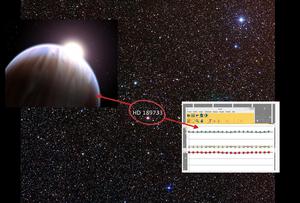
Can you find the exoplanet?
astroEDU educational activity (links to astroEDU website) Description: Find the exoplanet and determine its size using data from the Spitzer Space Telescope!
License: CC-BY-4.0 Creative Commons Reconocimiento 4.0 Internacional (CC BY 4.0) íconos
Rango de edades:
14-16
, 16-19
Nivel educativo:
Secondary
Áreas de aprendizaje:
Aprendizaje por descubrimiento guiado
, Modelización
, Basado en la observación
, Resolución de problemas
, Aprendizaje basado en la investigación estructurada
, Basado en la tecnología
Costos:
Gratis
Duración:
3 horas
Competencias:
Analizar e interpretar datos
, Plantear preguntas
, Utilizar las matemáticas y el pensamiento computacional

Measuring an exoplanet
astroEDU educational activity (links to astroEDU website) Description: Let's learn about exoplanets and how to measure their size!
License: CC-BY-4.0 Creative Commons Reconocimiento 4.0 Internacional (CC BY 4.0) íconos
Rango de edades:
12-14
, 14-16
Nivel educativo:
Educación secundaria
, Secondary
Áreas de aprendizaje:
Basado en la observación
, Resolución de problemas
Costos:
Gratis
Duración:
2 horas
Tamaño del grupo:
Grupo
Competencias:
Analizar e interpretar datos
, Desarrollar y utilizar modelos
, Utilizar las matemáticas y el pensamiento computacional
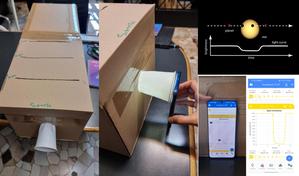
Exoplanet in a box
astroEDU educational activity (links to astroEDU website) Description: Build a "transit simulator" in a box using some very simple material and your cell phone!
License: CC-BY-4.0 Creative Commons Reconocimiento 4.0 Internacional (CC BY 4.0) íconos
Rango de edades:
14-16
, 16-19
Nivel educativo:
Secondary
, Universitario
Áreas de aprendizaje:
Modelización
, Basado en la observación
, Aprendizaje basado en proyectos
, Aprendizaje basado en la investigación estructurada
, Basado en la tecnología
Costos:
Bajo coste
Duración:
3-6 horas
Tamaño del grupo:
Grupo
Competencias:
Analizar e interpretar datos
, Plantear preguntas
, Desarrollar y utilizar modelos
, Planificar y llevar a cabo investigaciones

Hunting for exoplanets with Arduino
astroEDU educational activity (links to astroEDU website) Description: Become a planet hunter with an Arduino kit and some simple components
License: CC-BY-4.0 Creative Commons Reconocimiento 4.0 Internacional (CC BY 4.0) íconos
Rango de edades:
14-16
, 16-19
, 19+
Nivel educativo:
Secondary
, Universitario
Áreas de aprendizaje:
Modelización
, Basado en la observación
, Centrado en la simulación
, Aprendizaje basado en la investigación estructurada
, Basado en la tecnología
Costos:
Coste medio
Duración:
3 horas
Tamaño del grupo:
Grupo
Competencias:
Analizar e interpretar datos
, Plantear preguntas
, Desarrollar y utilizar modelos