بلغات أخرى
- الألمانيّة: Exoplanet
- الإنجليزيّة: Exoplanet
- الإسبانيّة: Exoplaneta
- الفرنسيّة: Exoplanète
- الإيطاليّة: Esopianeta
- اليابانيّة: 太陽系外惑星 (رابط خارجي)
- البرتغاليّة البرازيليّة: Exoplaneta
- الصينيّة المبسطة: 系外行星
- الصينيّة التقليدية: 系外行星
وسائط ذات صلة
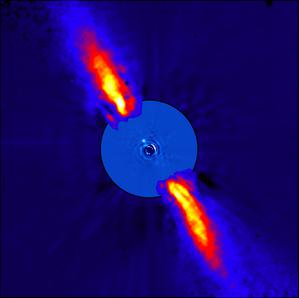
beta Pictoris b
الشرح: This composite of two images shows the planet beta Pictoris b and a disk of material both of which orbit the young star beta Pictoris. Both are taken in infrared light. The inner image was one of the first pictures taken of a planet around another star (an exoplanet). This image was made using a technique called adaptive optics which removes the blurring effect of the Earth's atmosphere that spreads out a star's light. The star's light is then concentrated tightly enough that it can be hidden behind a blocking circle (shown here in black) called a coronagraph. The ripples around this are artifacts of the imaging process. Beta Pictoris b, a gas giant planet about twelve times the mass of Jupiter, appears as a dot above and to the left of the black circle.
The outer image shows the thermal emission from the warm disk of material surrounding the young star beta Pictoris. As we are viewing this disk edge-on it appears as a line. This disk of gas and dust provided the material to form beta Pictoris b.
المصدر: ESO/A.-M. Lagrange et al.
رابط المصدر
License: CC-BY-4.0 المشاع الإبداعي نَسب المُصنَّف 4.0 دولي (CC BY 4.0) أيقونات
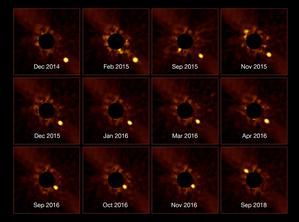
مدار الكوكب الخارجي بيتا الرسام ب (او بيتا ب
الرسوم التوضيحية المرتبطة
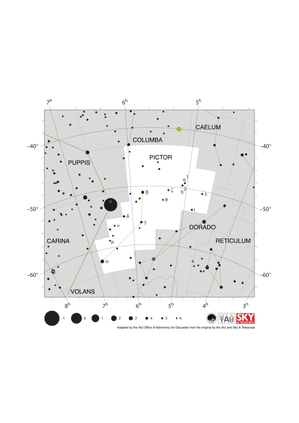
Pictor Constellation Map
الشرح: The constellation Pictor with its bright stars and surrounding constellations. Pictor is surrounded by (going clockwise from the top): Columba, Caelum, Dorado, Volans, Carina and Puppis. Pictor is notable for its second brightest star, Beta Pictoris. This young star hosts a large disk of dusty material left over from the planet formation process along with two planets, one of which Beta Pictoris b was one of the first planets to be directly imaged by astronomers.
Pictor is a southern constellation and thus the whole constellation is visible at some point in the year throughout the southern hemisphere. The whole constellation is also visible from some equatorial regions of the northern hemisphere with parts of the constellation visible to the remaining northern equatorial regions and some northern hemisphere temperate zones. Pictor is best viewed in the northern hemisphere winter and southern hemisphere summer.
The y-axis of this diagram is in degrees of declination with north as up and the x-axis is in hours of right ascension with east to the left. The sizes of the stars marked here relate to the star's apparent magnitude, a measure of its apparent brightness. The larger dots represent brighter stars. The Greek letters mark the brightest stars in the constellation. These are ranked by brightness with the brightest star being labeled alpha, the second brightest beta, etc., although this ordering is not always followed exactly. The dotted boundary lines mark the IAU's boundaries of the constellations and the solid green lines mark one of the common forms used to represent the figures of the constellations. Neither the constellation boundaries, nor the lines joining the stars appear on the sky.
المصدر: Adapted by the IAU Office of Astronomy for Education from the original by the IAU and Sky & Telescope
License: CC-BY-4.0 المشاع الإبداعي نَسب المُصنَّف 4.0 دولي (CC BY 4.0) أيقونات
الأنشطة المرتبطة
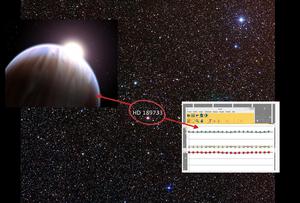
Can you find the exoplanet?
astroEDU educational activity (links to astroEDU website) Description: Find the exoplanet and determine its size using data from the Spitzer Space Telescope!
License: CC-BY-4.0 المشاع الإبداعي نَسب المُصنَّف 4.0 دولي (CC BY 4.0) أيقونات
الفئات العمرية:
14-16
, 16-19
المرحلة التعليمية:
المرحلة الثانوية
مجالات التعلم:
تعلم استكشافي موجه
, النمذجة
, قائم على الملاحظة
, حل المشكلات
, تعلم منظم قائم على الاستقصاء
, معتمد على التكنولوجيا
التكاليف:
مجاني
المدة:
3 ساعات
المهارات:
تحليل البيانات وتفسيرها
, طرح الأسئلة
, استخدام الرياضيات والتفكير الحاسوبي
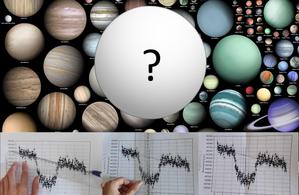
Measuring an exoplanet
astroEDU educational activity (links to astroEDU website) Description: Let's learn about exoplanets and how to measure their size!
License: CC-BY-4.0 المشاع الإبداعي نَسب المُصنَّف 4.0 دولي (CC BY 4.0) أيقونات
الفئات العمرية:
12-14
, 14-16
المرحلة التعليمية:
المرحلة المتوسطة
, المرحلة الثانوية
مجالات التعلم:
قائم على الملاحظة
, حل المشكلات
التكاليف:
مجاني
المدة:
ساعتان
حجم المجموعة:
جماعي
المهارات:
تحليل البيانات وتفسيرها
, تطوير النماذج واستخدامها
, استخدام الرياضيات والتفكير الحاسوبي
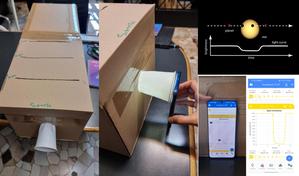
Exoplanet in a box
astroEDU educational activity (links to astroEDU website) Description: Build a "transit simulator" in a box using some very simple material and your cell phone!
License: CC-BY-4.0 المشاع الإبداعي نَسب المُصنَّف 4.0 دولي (CC BY 4.0) أيقونات
الفئات العمرية:
14-16
, 16-19
المرحلة التعليمية:
المرحلة الثانوية
, الجامعة
مجالات التعلم:
النمذجة
, قائم على الملاحظة
, التعلم القائم على المشاريع
, تعلم منظم قائم على الاستقصاء
, معتمد على التكنولوجيا
التكاليف:
تكلفة منخفضة
المدة:
من 3 إلى 6 ساعات
حجم المجموعة:
جماعي
المهارات:
تحليل البيانات وتفسيرها
, طرح الأسئلة
, تطوير النماذج واستخدامها
, تخطيط وتنفيذ التحقيقات

Hunting for exoplanets with Arduino
astroEDU educational activity (links to astroEDU website) Description: Become a planet hunter with an Arduino kit and some simple components
License: CC-BY-4.0 المشاع الإبداعي نَسب المُصنَّف 4.0 دولي (CC BY 4.0) أيقونات
الفئات العمرية:
14-16
, 16-19
, 19+
المرحلة التعليمية:
المرحلة الثانوية
, الجامعة
مجالات التعلم:
النمذجة
, قائم على الملاحظة
, يركز على المحاكاة
, تعلم منظم قائم على الاستقصاء
, معتمد على التكنولوجيا
التكاليف:
تكلفة متوسطة
المدة:
3 ساعات
حجم المجموعة:
جماعي
المهارات:
تحليل البيانات وتفسيرها
, طرح الأسئلة
, تطوير النماذج واستخدامها