Termo do glossário: Exoplaneta
Descrição: Um exoplaneta, ou planeta extrassolar, é um planeta localizado fora do Sistema Solar. Sua existência foi teorizada desde o século XVI e a pesquisa observacional para encontrá-los foi iniciada no século XIX. Os primeiros exoplanetas confirmados foram descobertos na década de 1990. Desses, o primeiro confirmado a orbitar em torno de uma estrela na sequência principal foi o exoplaneta Dimidium, descoberto indiretamente no Observatório de Haute-Provence. Esse exoplaneta está orbitando a estrela 51 Pegasi, uma subgigante amarela, e foi descoberto em 1995. Desde então, milhares de exoplanetas foram identificados.
Termos relacionados:
Ver este termo em outros idiomas
Status do termo e da definição: A definição original deste termo em inglês foi aprovada por um astrônomo(a) pesquisador(a) e um(a) professor(a) A tradução deste termo e de sua definição ainda aguarda aprovação
O Glossário Multilíngue da OAE é um projeto do Escritório da IAU de Astronomia para a Educação (OAE) em colaboração com o Escritório da IAU para Divulgação da Astronomia (OAO). Os termos e definições foram selecionados, escritos e revisados por meio de um esforço coletivo da OAE, dos Centros e Nós da OAE, dos Coordenadores Nacionais de Educação em Astronomia (NAECs) da OAE e de outros voluntários. Você pode encontrar uma lista completa dos créditos aqui. Todos os termos do glossário e suas definições são disponibilizados sob uma licença Creative Commons CC BY-4.0 e devem ser creditados à "IAU OAE".
Se você notar algum erro factual ou de tradução neste termo do glossário ou em sua definição, por favor entre em contato.
Em outros idiomas
- Árabe: الكوكب الخارجي
- Alemão: Exoplanet
- Inglês: Exoplanet
- Espanhol: Exoplaneta
- Francês: Exoplanète
- Italiano: Esopianeta
- Japonês: 太陽系外惑星 (link externo)
- Chinês Simplificado: 系外行星
- Chinês Tradicional: 系外行星
Mídia relacionada
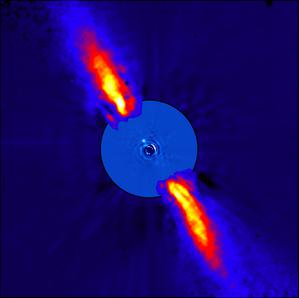
beta Pictoris b
Legenda: This composite of two images shows the planet beta Pictoris b and a disk of material both of which orbit the young star beta Pictoris. Both are taken in infrared light. The inner image was one of the first pictures taken of a planet around another star (an exoplanet). This image was made using a technique called adaptive optics which removes the blurring effect of the Earth's atmosphere that spreads out a star's light. The star's light is then concentrated tightly enough that it can be hidden behind a blocking circle (shown here in black) called a coronagraph. The ripples around this are artifacts of the imaging process. Beta Pictoris b, a gas giant planet about twelve times the mass of Jupiter, appears as a dot above and to the left of the black circle.
The outer image shows the thermal emission from the warm disk of material surrounding the young star beta Pictoris. As we are viewing this disk edge-on it appears as a line. This disk of gas and dust provided the material to form beta Pictoris b.
Crédito: ESO/A.-M. Lagrange et al.
link do crédito
License: CC-BY-4.0 Creative Commons Attribution 4.0 International (CC BY 4.0) ícones
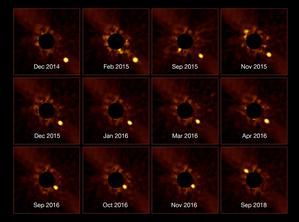
A órbita de beta Pictoris b
Legenda: Esta série de imagens mostra o movimento orbital do planeta extrassolar (exoplaneta) beta Pictoris b. O planeta é o ponto brilhante em cada imagem. A estrela hospedeira do planeta está escondida atrás do círculo preto no centro de cada imagem. Isso é feito para remover a estrela hospedeira, muito mais brilhante, que de outra forma ofuscaria a luz do planeta. A órbita do planeta é vista de perfil. Observar a órbita dessa perspectiva faz parecer que o planeta se move ao longo de uma linha reta. Entre fevereiro de 2015 e novembro de 2016, beta Pictoris b parece se aproximar cada vez mais de sua estrela hospedeira. O planeta então se aproximou tanto da estrela que não foi visto por quase dois anos, depois reaparecendo do outro lado da estrela.
Crédito: Consórcio ESO/Lagrange/SPHERE
link do crédito
License: CC-BY-4.0 Creative Commons Attribution 4.0 International (CC BY 4.0) ícones
Diagramas relacionados
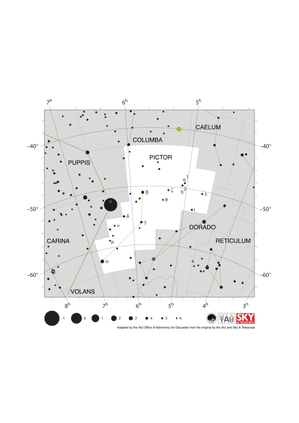
Pictor Constellation Map
Legenda: The constellation Pictor with its bright stars and surrounding constellations. Pictor is surrounded by (going clockwise from the top): Columba, Caelum, Dorado, Volans, Carina and Puppis. Pictor is notable for its second brightest star, Beta Pictoris. This young star hosts a large disk of dusty material left over from the planet formation process along with two planets, one of which Beta Pictoris b was one of the first planets to be directly imaged by astronomers.
Pictor is a southern constellation and thus the whole constellation is visible at some point in the year throughout the southern hemisphere. The whole constellation is also visible from some equatorial regions of the northern hemisphere with parts of the constellation visible to the remaining northern equatorial regions and some northern hemisphere temperate zones. Pictor is best viewed in the northern hemisphere winter and southern hemisphere summer.
The y-axis of this diagram is in degrees of declination with north as up and the x-axis is in hours of right ascension with east to the left. The sizes of the stars marked here relate to the star's apparent magnitude, a measure of its apparent brightness. The larger dots represent brighter stars. The Greek letters mark the brightest stars in the constellation. These are ranked by brightness with the brightest star being labeled alpha, the second brightest beta, etc., although this ordering is not always followed exactly. The dotted boundary lines mark the IAU's boundaries of the constellations and the solid green lines mark one of the common forms used to represent the figures of the constellations. Neither the constellation boundaries, nor the lines joining the stars appear on the sky.
Crédito: Adapted by the IAU Office of Astronomy for Education from the original by the IAU and Sky & Telescope
License: CC-BY-4.0 Creative Commons Attribution 4.0 International (CC BY 4.0) ícones
Atividades relacionadas
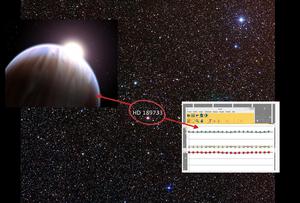
Can you find the exoplanet?
astroEDU educational activity (links to astroEDU website) Description: Find the exoplanet and determine its size using data from the Spitzer Space Telescope!
License: CC-BY-4.0 Creative Commons Attribution 4.0 International (CC BY 4.0) ícones
Faixas etárias:
14-16
, 16-19
Nível de ensino:
Médio
Áreas de aprendizagem:
Aprendizagem por descoberta guiada
, Modelagem
, Baseado em observação
, Resolução de problemas
, Aprendizagem por investigação estruturada
, Baseado em tecnologia
Custos:
Gratuito
Duração:
3 hours
Habilidades:
Analisar e interpretar dados
, Fazer perguntas
, Usar matemática e pensamento computacional

Measuring an exoplanet
astroEDU educational activity (links to astroEDU website) Description: Let's learn about exoplanets and how to measure their size!
License: CC-BY-4.0 Creative Commons Attribution 4.0 International (CC BY 4.0) ícones
Faixas etárias:
12-14
, 14-16
Nível de ensino:
Ensino fundamental
, Médio
Áreas de aprendizagem:
Baseado em observação
, Resolução de problemas
Custos:
Gratuito
Duração:
2 hours
Tamanho do grupo:
Grupo
Habilidades:
Analisar e interpretar dados
, Desenvolver e usar modelos
, Usar matemática e pensamento computacional
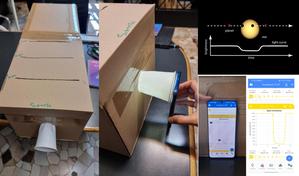
Exoplanet in a box
astroEDU educational activity (links to astroEDU website) Description: Build a "transit simulator" in a box using some very simple material and your cell phone!
License: CC-BY-4.0 Creative Commons Attribution 4.0 International (CC BY 4.0) ícones
Faixas etárias:
14-16
, 16-19
Nível de ensino:
Médio
, Universidade
Áreas de aprendizagem:
Modelagem
, Baseado em observação
, Aprendizagem baseada em projetos
, Aprendizagem por investigação estruturada
, Baseado em tecnologia
Custos:
Baixo custo
Duração:
3-6 hours
Tamanho do grupo:
Grupo
Habilidades:
Analisar e interpretar dados
, Fazer perguntas
, Desenvolver e usar modelos
, Planejar e realizar pesquisas

Hunting for exoplanets with Arduino
astroEDU educational activity (links to astroEDU website) Description: Become a planet hunter with an Arduino kit and some simple components
License: CC-BY-4.0 Creative Commons Attribution 4.0 International (CC BY 4.0) ícones
Faixas etárias:
14-16
, 16-19
, 19+
Nível de ensino:
Médio
, Universidade
Áreas de aprendizagem:
Modelagem
, Baseado em observação
, Com foco em simulação
, Aprendizagem por investigação estruturada
, Baseado em tecnologia
Custos:
Custo médio
Duração:
3 hours
Tamanho do grupo:
Grupo
Habilidades:
Analisar e interpretar dados
, Fazer perguntas
, Desenvolver e usar modelos