Termo do glossário: Cosmologia
Descrição: Cosmologia deriva das palavras gregas kosmos (harmonia ou ordem) e logos (pensamento ou razão). A cosmologia como disciplina tem suas raízes na filosofia e na religião; várias culturas ao redor do mundo têm suas próprias cosmologias que visam interpretar e dar sentido ao Universo. Ao longo dos anos, a cosmologia evoluiu para se tornar uma ciência observacional de precisão. Isso foi possível graças ao desenvolvimento de avançados observatórios terrestres e espaciais, juntamente com trabalhos teóricos pioneiros e simulações computacionais. A cosmologia, como empreendimento científico, tem como objetivo compreender a história evolutiva, a formação, a estrutura e a evolução futura do Universo como um todo nas maiores escalas, através da compreensão dos mecanismos físicos fundamentais que operam no Universo.
Termos relacionados:
- Expansão acelerada do universo
- Astronomia
- Astrofísica
- A Teoria do Big Bang
- Variável Cefeida
- Aglomerado de galáxias
- Princípio Cosmológico
- Cosmos
- Energia escura
- Matéria Escura
- Universo observável
- Teoria da Relatividade Geral
- Universo
Ver este termo em outros idiomas
Status do termo e da definição: A definição original deste termo em inglês foi aprovada por um astrônomo(a) pesquisador(a) e um(a) professor(a) A tradução deste termo e de sua definição ainda aguarda aprovação
O Glossário Multilíngue da OAE é um projeto do Escritório da IAU de Astronomia para a Educação (OAE) em colaboração com o Escritório da IAU para Divulgação da Astronomia (OAO). Os termos e definições foram selecionados, escritos e revisados por meio de um esforço coletivo da OAE, dos Centros e Nós da OAE, dos Coordenadores Nacionais de Educação em Astronomia (NAECs) da OAE e de outros voluntários. Você pode encontrar uma lista completa dos créditos aqui. Todos os termos do glossário e suas definições são disponibilizados sob uma licença Creative Commons CC BY-4.0 e devem ser creditados à "IAU OAE".
Se você notar algum erro factual ou de tradução neste termo do glossário ou em sua definição, por favor entre em contato.
Em outros idiomas
- Árabe: علم الكونيات
- Alemão: Kosmologie
- Inglês: Cosmology
- Espanhol: Cosmología
- Francês: Cosmologie
- Italiano: Cosmologia
- Japonês: 宇宙論 (link externo)
- Chinês Simplificado: 宇宙学
- Chinês Tradicional: 宇宙學
Mídia relacionada
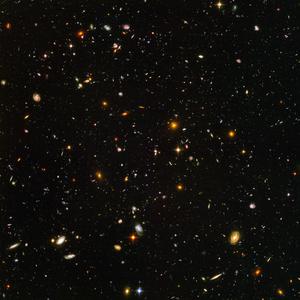
Hubble Ultra Deep Field
Legenda: This awe-inspiring image referred to as the Hubble Ultra-Deep Field (HUDF), was obtained using the Hubble Space Telescope (HST), by combining 800 exposures from 400 orbits of the HST, which equates to 11.3 days of total exposure time.
The image shows nearly 10,000 galaxies and was taken in the direction of a patch of sky with the least amount of stars from the Milky Way galaxy in the field of view. The region of sky that the HST observed corresponds to 1/10 the angular size of the Full Moon, which is roughly equal to approximately a 1 millimeter-sized object placed 1 meter away.
Every object in the image, except for the bright points with the crosshairs, are galaxies. As a consequence of the speed of light being a constant in a vacuum, the more distant an object, the further back in time we are observing. Therefore, the light from some of the galaxies in the HUDF image is from when the Universe as only a few hundred million years old. The HUDF image takes us through on a journey through space, and also in time.
Crédito: NASA, ESA, and S. Beckwith (STScI) and the HUDF Team
link do crédito
License: CC-BY-4.0 Creative Commons Attribution 4.0 International (CC BY 4.0) ícones
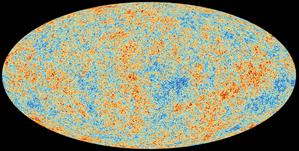
Radiação Cósmica de Fundo em Micro-ondas
Legenda: Esta imagem é uma representação da Radiação Cósmica de Fundo (em Micro-ondas CMB), criada a partir de dados do satélite Planck. A CMB é o brilho remanescente da época em que o Universo tinha aproximadamente 380.000 anos. O Universo primitivo era quente e denso, de modo que os fótons daquela época possuíam alta energia. Devido à expansão do Universo ao longo de 13,8 bilhões de anos, os fótons de “luz” do Universo primitivo foram esticados para comprimentos de onda mais longos e hoje podem ser detectados em comprimentos de onda milimétricos (região de micro-ondas do espectro eletromagnético). O padrão “manchado” na imagem é conhecido como anisotropias e representa flutuações de temperatura muito pequenas. Essas flutuações correspondem a regiões com densidades ligeiramente diferentes e funcionam essencialmente as sementes das estruturas maiores no Universo, por exemplo: galáxias, aglomerados de galáxias e as primeiras estrelas.
Os dados da CMB permitem deduzir várias características do Universo, como composição, forma e idade, além de possibilitar certas previsões sobre a evolução futura do Universo. A forma da imagem é resultado de uma projeção cartográfica, na qual todo o céu é mapeado em uma única forma oval plana, chamada projeção de Molleweide. O centro da Via Láctea está localizado no centro da imagem.
Crédito: ESA/Planck Collaboration
link do crédito
License: CC-BY-SA-4.0 Creative Commons Attribution-ShareAlike 4.0 International (CC BY-SA 4.0) ícones