Termo do glossário: Universo
Descrição: Espaço, tempo, matéria, energia, objetos, fenômenos e leis que regem os mecanismos fundamentais subjacentes estão contidos no Universo. O Universo é frequentemente referido como o cosmos, uma vez que todos os vários aspectos do Universo se reúnem em um sistema “ordenado”, embora existam diferenças técnicas sutis entre os dois termos. Universo é derivado do latim universus. Os cientistas frequentemente se referem ao Universo observável, para enfatizar os limites do que pode ser observado e medido.
Termos relacionados:
Ver este termo em outros idiomas
Status do termo e da definição: A definição original deste termo em inglês foi aprovada por um astrônomo(a) pesquisador(a) e um(a) professor(a) A tradução deste termo e de sua definição ainda aguarda aprovação
O Glossário Multilíngue da OAE é um projeto do Escritório da IAU de Astronomia para a Educação (OAE) em colaboração com o Escritório da IAU para Divulgação da Astronomia (OAO). Os termos e definições foram selecionados, escritos e revisados por meio de um esforço coletivo da OAE, dos Centros e Nós da OAE, dos Coordenadores Nacionais de Educação em Astronomia (NAECs) da OAE e de outros voluntários. Você pode encontrar uma lista completa dos créditos aqui. Todos os termos do glossário e suas definições são disponibilizados sob uma licença Creative Commons CC BY-4.0 e devem ser creditados à "IAU OAE".
Se você notar algum erro factual ou de tradução neste termo do glossário ou em sua definição, por favor entre em contato.
Mídia relacionada
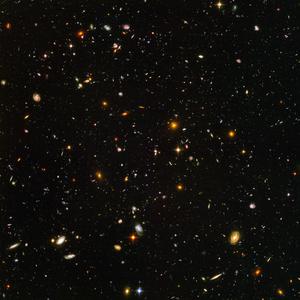
Hubble Ultra Deep Field
Legenda: This awe-inspiring image referred to as the Hubble Ultra-Deep Field (HUDF), was obtained using the Hubble Space Telescope (HST), by combining 800 exposures from 400 orbits of the HST, which equates to 11.3 days of total exposure time.
The image shows nearly 10,000 galaxies and was taken in the direction of a patch of sky with the least amount of stars from the Milky Way galaxy in the field of view. The region of sky that the HST observed corresponds to 1/10 the angular size of the Full Moon, which is roughly equal to approximately a 1 millimeter-sized object placed 1 meter away.
Every object in the image, except for the bright points with the crosshairs, are galaxies. As a consequence of the speed of light being a constant in a vacuum, the more distant an object, the further back in time we are observing. Therefore, the light from some of the galaxies in the HUDF image is from when the Universe as only a few hundred million years old. The HUDF image takes us through on a journey through space, and also in time.
Crédito: NASA, ESA, and S. Beckwith (STScI) and the HUDF Team
link do crédito
License: CC-BY-4.0 Creative Commons Attribution 4.0 International (CC BY 4.0) ícones
Atividades relacionadas
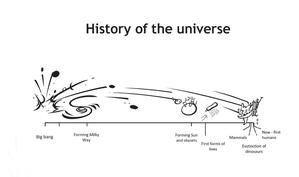
History of the Universe
astroEDU educational activity (links to astroEDU website) Description: Build a timeline of the all Universe!
License: CC-BY-4.0 Creative Commons Attribution 4.0 International (CC BY 4.0) ícones
Tags:
History
, Timeline
, Mathematics
, Humans
Faixas etárias:
8-10
, 10-12
, 12-14
Nível de ensino:
Ensino fundamental
, Básico
Áreas de aprendizagem:
Resolução de problemas
, Aprendizagem por investigação estruturada
Custos:
Baixo custo
Duração:
1 hour 30 mins
Tamanho do grupo:
Grupo
Habilidades:
Fazer perguntas
, Comunicar informações
, Desenvolver e usar modelos
, Usar matemática e pensamento computacional

Dark matter & dark energy (Part 2) – Understanding the nature of dark matter and dark energy
astroEDU educational activity (links to astroEDU website) Description: Let's investigate the nature of dark matter and energy with gravitational lensing!
License: CC-BY-4.0 Creative Commons Attribution 4.0 International (CC BY 4.0) ícones
Tags:
Experiment
, Invisible
Faixas etárias:
12-14
, 14-16
, 16-19
, 19+
Nível de ensino:
Informal
, Ensino fundamental
Áreas de aprendizagem:
Aprendizagem por descoberta guiada
, Aula interativa
, Modelagem
, Resolução de problemas
Custos:
Custo médio
Duração:
45 mins
Tamanho do grupo:
Grupo
Habilidades:
Construir explicações
, Desenvolver e usar modelos
, Engajar-se em argumentação com base em evidências

Dark matter and Dark energy (Part 1) – Discovering the main components of the Universe
astroEDU educational activity (links to astroEDU website) Description: Lets' investigate gravity, dark matter and dark energy with some very simple experiments!
License: CC-BY-4.0 Creative Commons Attribution 4.0 International (CC BY 4.0) ícones
Tags:
Experiment
, Galaxies
Faixas etárias:
12-14
, 14-16
, 16-19
, 19+
Nível de ensino:
Informal
, Ensino fundamental
Áreas de aprendizagem:
Aprendizagem por descoberta guiada
, Aula interativa
, Modelagem
, Baseado em observação
, Outro
, Resolução de problemas
Custos:
Baixo custo
Duração:
45 mins
Tamanho do grupo:
Grupo
Habilidades:
Construir explicações
, Desenvolver e usar modelos
, Engajar-se em argumentação com base em evidências
, Planejar e realizar pesquisas