Glossary term: Universe
Description: Space, time, matter, energy, objects, phenomena, and laws that govern the underlying fundamental mechanisms are contained within the Universe. The Universe is often referred to as the cosmos, given that all the various aspects of the Universe come together in an "ordered" system, although there are subtle technical differences between the two terms. Universe is derived from the Latin universus. Scientists often refer to the observable Universe, to emphasize the limits of what can be observed and measured.
Related Terms:
See this term in other languages
Term and definition status: This term and its definition have been approved by a research astronomer and a teacher
The OAE Multilingual Glossary is a project of the IAU Office of Astronomy for Education (OAE) in collaboration with the IAU Office of Astronomy Outreach (OAO). The terms and definitions were chosen, written and reviewed by a collective effort from the OAE, the OAE Centers and Nodes, the OAE National Astronomy Education Coordinators (NAECs) and other volunteers. You can find a full list of credits here. All glossary terms and their definitions are released under a Creative Commons CC BY-4.0 license and should be credited to "IAU OAE".
If you notice a factual error in this glossary definition then please get in touch.
Related Media
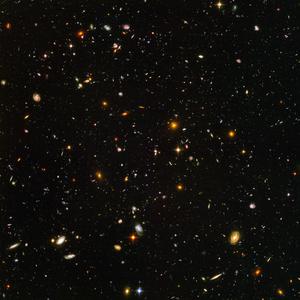
Hubble Ultra Deep Field
Caption: This awe-inspiring image referred to as the Hubble Ultra-Deep Field (HUDF), was obtained using the Hubble Space Telescope (HST), by combining 800 exposures from 400 orbits of the HST, which equates to 11.3 days of total exposure time.
The image shows nearly 10,000 galaxies and was taken in the direction of a patch of sky with the least amount of stars from the Milky Way galaxy in the field of view. The region of sky that the HST observed corresponds to 1/10 the angular size of the Full Moon, which is roughly equal to approximately a 1 millimeter-sized object placed 1 meter away.
Every object in the image, except for the bright points with the crosshairs, are galaxies. As a consequence of the speed of light being a constant in a vacuum, the more distant an object, the further back in time we are observing. Therefore, the light from some of the galaxies in the HUDF image is from when the Universe as only a few hundred million years old. The HUDF image takes us through on a journey through space, and also in time.
Credit: NASA, ESA, and S. Beckwith (STScI) and the HUDF Team
credit link
License: CC-BY-4.0 Creative Commons Attribution 4.0 International (CC BY 4.0) icons
Related Activities
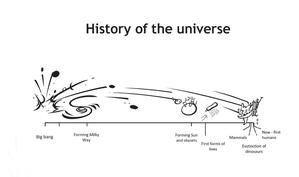
History of the Universe
astroEDU educational activity (links to astroEDU website) Description: Build a timeline of the all Universe!
License: CC-BY-4.0 Creative Commons Attribution 4.0 International (CC BY 4.0) icons
Tags:
History
, Timeline
, Mathematics
, Humans
Age Ranges:
8-10
, 10-12
, 12-14
Education Level:
Middle School
, Primary
Areas of Learning:
Problem-solving
, Structured-inquiry learning
Costs:
Low Cost
Duration:
1 hour 30 mins
Group Size:
Group
Skills:
Asking questions
, Communicating information
, Developing and using models
, Using mathematics and computational thinking

Dark matter & dark energy (Part 2) – Understanding the nature of dark matter and dark energy
astroEDU educational activity (links to astroEDU website) Description: Let's investigate the nature of dark matter and energy with gravitational lensing!
License: CC-BY-4.0 Creative Commons Attribution 4.0 International (CC BY 4.0) icons
Tags:
Experiment
, Invisible
Age Ranges:
12-14
, 14-16
, 16-19
, 19+
Education Level:
Informal
, Middle School
Areas of Learning:
Guided-discovery learning
, Interactive Lecture
, Modelling
, Problem-solving
Costs:
Medium Cost
Duration:
45 mins
Group Size:
Group
Skills:
Constructing explanations
, Developing and using models
, Engaging in argument from evidence

Dark matter and Dark energy (Part 1) – Discovering the main components of the Universe
astroEDU educational activity (links to astroEDU website) Description: Lets' investigate gravity, dark matter and dark energy with some very simple experiments!
License: CC-BY-4.0 Creative Commons Attribution 4.0 International (CC BY 4.0) icons
Tags:
Experiment
, Galaxies
Age Ranges:
12-14
, 14-16
, 16-19
, 19+
Education Level:
Informal
, Middle School
Areas of Learning:
Guided-discovery learning
, Interactive Lecture
, Modelling
, Observation based
, Other
, Problem-solving
Costs:
Low Cost
Duration:
45 mins
Group Size:
Group
Skills:
Constructing explanations
, Developing and using models
, Engaging in argument from evidence
, Planning and carrying out investigations