Glossar-Begriff: Universum
Beschreibung: Das Universum enthält Raum, Zeit, Materie, Energie, Objekte, Phänomene sowie Gesetze, welche die zugrundeliegenden Abläufe bestimmen. Das Universum wird oft als der Kosmos bezeichnet, da alle verschiedenen Aspekte des Universums in einem "geordneten" System zusammenkommen. Allerdings gibt es subtile Unterschiede zwischen den beiden Begriffen. Der Begriff Universum leitet sich vom lateinischen universus ab. Wissenschaftler beziehen sich oft auf das beobachtbare Universum, um zu betonen, dass nur ein Teil des Universums von Menschen beobachtet werden kann.
Ähnliche Begriffe:
Dieser Begriff in anderen Sprachen
Begriffs- und Definitionsstatus Die Originaldefinition dieses Begriffes auf Englisch wurden von einem forschenden Astronom und einer Lehrkraft bestätigt Die Übersetzung dieses Begriffs und seiner Definition warten auf Prüfung und Bestätigung
The OAE Multilingual Glossary is a project of the IAU Office of Astronomy for Education (OAE) in collaboration with the IAU Office of Astronomy Outreach (OAO). The terms and definitions were chosen, written and reviewed by a collective effort from the OAE, the OAE Centers and Nodes, the OAE National Astronomy Education Coordinators (NAECs) and other volunteers. You can find a full list of credits here. All glossary terms and their definitions are released under a Creative Commons CC BY-4.0 license and should be credited to "IAU OAE".
Wenn dir ein inhaltlicher oder Übersetzungsfehler in diesem Glossarbegriff oder dieser Definition auffallen, bitte kontaktiere uns.
Ähnliche Medien
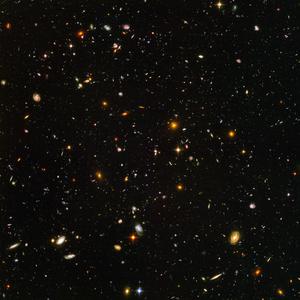
Hubble Ultra Deep Field
Unterschrift: Dieses beeindruckende Bild, das als Hubble Ultra-Deep Field (HUDF) bezeichnet wird, wurde mit dem Hubble-Weltraumteleskop (HST) durch die Kombination von 800 Aufnahmen aus 400 Umläufen des HST erzielt, was einer Gesamtbelichtungszeit von 11,3 Tagen entspricht.
Das Bild zeigt fast 10.000 Galaxien und wurde in Richtung eines Himmelsbereichs mit der geringsten Anzahl von Sternen der Milchstraße im Sichtfeld aufgenommen. Die Himmelsregion, die das HST beobachtete, entspricht 1/10 der Winkelgröße des Vollmonds, was ungefähr einem 1 Millimeter großen Objekt in 1 Meter Entfernung entspricht.
Alle Objekte auf dem Bild, mit Ausnahme der hellen Punkte im Fadenkreuz, sind Galaxien. Da die Lichtgeschwindigkeit im Vakuum eine Konstante ist, gilt: Je weiter ein Objekt entfernt ist, desto weiter liegt es in der Zeit zurück, die wir beobachten. Daher stammt das Licht einiger Galaxien auf dem HUDF-Bild aus einer Zeit, als das Universum erst einige hundert Millionen Jahre alt war. Das HUDF-Bild nimmt uns also mit auf eine Reise durch den Raum und die Zeit.
Bild: NASA, ESA, und S. Beckwith (STScI) und das HUDF-Team
Quellenlink
License: CC-BY-4.0 Creative Commons Namensnennung 4.0 International (CC BY 4.0) Symbole
Ähnliche Aktivitäten
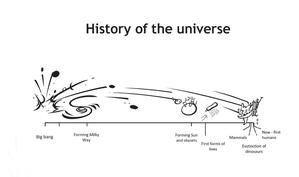
History of the Universe
astroEDU educational activity (links to astroEDU website) Description: Build a timeline of the all Universe!
License: CC-BY-4.0 Creative Commons Namensnennung 4.0 International (CC BY 4.0) Symbole
Schlagworte
History
, Timeline
, Mathematics
, Humans
Altersgruppen:
8-10
, 10-12
, 12-14
Bildungsniveau:
Middle School
, Primary
Lernbereiche:
Problem-solving
, Structured-inquiry learning
Kosten:
Low Cost
Dauer:
1 hour 30 mins
Gruppengröße:
Group
Fähigkeiten:
Asking questions
, Communicating information
, Developing and using models
, Using mathematics and computational thinking

Dark matter & dark energy (Part 2) – Understanding the nature of dark matter and dark energy
astroEDU educational activity (links to astroEDU website) Description: Let's investigate the nature of dark matter and energy with gravitational lensing!
License: CC-BY-4.0 Creative Commons Namensnennung 4.0 International (CC BY 4.0) Symbole
Schlagworte
Experiment
, Invisible
Altersgruppen:
12-14
, 14-16
, 16-19
, 19+
Bildungsniveau:
Informal
, Middle School
Lernbereiche:
Guided-discovery learning
, Interactive Lecture
, Modelling
, Problem-solving
Kosten:
Medium Cost
Dauer:
45 mins
Gruppengröße:
Group
Fähigkeiten:
Constructing explanations
, Developing and using models
, Engaging in argument from evidence

Dark matter and Dark energy (Part 1) – Discovering the main components of the Universe
astroEDU educational activity (links to astroEDU website) Description: Lets' investigate gravity, dark matter and dark energy with some very simple experiments!
License: CC-BY-4.0 Creative Commons Namensnennung 4.0 International (CC BY 4.0) Symbole
Schlagworte
Experiment
, Galaxies
Altersgruppen:
12-14
, 14-16
, 16-19
, 19+
Bildungsniveau:
Informal
, Middle School
Lernbereiche:
Guided-discovery learning
, Interactive Lecture
, Modelling
, Observation based
, Other
, Problem-solving
Kosten:
Low Cost
Dauer:
45 mins
Gruppengröße:
Group
Fähigkeiten:
Constructing explanations
, Developing and using models
, Engaging in argument from evidence
, Planning and carrying out investigations
Experimente zur raumzeitlichen Krümmung mit Alltagsgegenständen
astroEDU educational activity (links to astroEDU website) Description: Viele Gegenstände aus dem Alltag eignen sich zur Darstellung der allgemeinen Relativitätstheorie oder Kosmologie. Im WIS-Beitrag finden sie eine Einkaufsliste und eine Anleitung, wie sie mit Gummibändern, Luftballons und verschiedenen Metermaßen raumzeitliche und räumliche Krümmung, sowie Abstandsmaße in Experimenten mit ihren Schülern richtig darstellen.
Altersgruppen: 16-19 Bildungsniveau: Secundaria