Término del glosario: Cosmología
Descripción: El término «cosmología» deriva de las palabras griegas kosmos (armonía u orden) y logos (pensamiento o razón). La cosmología, como disciplina, tiene sus raíces en la filosofía y la religión; diversas culturas de todo el mundo cuentan con sus propias cosmologías, cuyo objetivo es interpretar y dar sentido al Universo. A lo largo de los años, la cosmología ha evolucionado hasta convertirse en una ciencia observacional de precisión. Esto ha sido posible gracias al desarrollo de observatorios avanzados, tanto terrestres como espaciales, junto con trabajos teóricos pioneros y simulaciones por ordenador o computadora. La cosmología, como disciplina científica, tiene como objetivo comprender la historia evolutiva, la formación, la estructura y la evolución futura del Universo en su conjunto a las escalas más grandes, mediante les estudio de los mecanismos físicos fundamentales que operan en su interior.
Términos relacionados:
- Aceleración del Universo
- Astronomía
- Astrofísica
- Teoría del Big Bang
- Variable cefeida
- Cúmulo de galaxias
- Principio cosmológico
- Cosmos
- Energía oscura
- Materia oscura
- Universo observable
- Teoría de la relatividad general
- Universo
Ver este término en otros idiomas
Estado del término y la definición: La definición original de este término en inglés ha sido aprobada por unastrónomo o astrónoma investigadora y un docente La traducción de este término y su definición aún están pendientes de aprobación
El Glosario multilingüe de la OAE es un proyecto de la Oficina de Astronomía para la Educación de la UAI (OAE) en colaboración con la Oficina de Divulgación de Astronomía de la UAI (OAO). Los términos y definiciones fueron seleccionados, redactados y revisados gracias al esfuerzo colectivo de la OAE, los Centros y Nodos de la OAE, los Coordinadores Nacionales de Educación Astronómica (NAECs) y otros voluntarios. Puedes encontrar una lista completa de créditos aquí. Todos los términos del glosario y sus definiciones se publican bajo la licencia Creative Commons CC BY-4.0 y deben atribuirse a la "IAU OAE".
Si detectas algún error de contenido o de traducción en este término del glosario o en ladefinición, ponte en contacto con nosotros.
En otros idiomas
- Árabe: علم الكونيات
- Alemán: Kosmologie
- Inglés: Cosmology
- Francés: Cosmologie
- Italiano: Cosmologia
- Japonés: 宇宙論 (enlace externo)
- Portugués de Brasil: Cosmologia
- Chino simplificado: 宇宙学
- Chino tradicional: 宇宙學
Contenidos relacionados
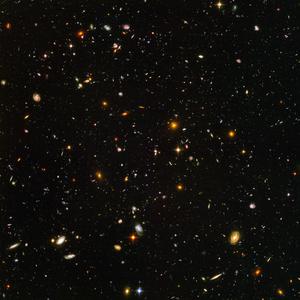
Hubble Ultra Deep Field
Pie de foto: This awe-inspiring image referred to as the Hubble Ultra-Deep Field (HUDF), was obtained using the Hubble Space Telescope (HST), by combining 800 exposures from 400 orbits of the HST, which equates to 11.3 days of total exposure time.
The image shows nearly 10,000 galaxies and was taken in the direction of a patch of sky with the least amount of stars from the Milky Way galaxy in the field of view. The region of sky that the HST observed corresponds to 1/10 the angular size of the Full Moon, which is roughly equal to approximately a 1 millimeter-sized object placed 1 meter away.
Every object in the image, except for the bright points with the crosshairs, are galaxies. As a consequence of the speed of light being a constant in a vacuum, the more distant an object, the further back in time we are observing. Therefore, the light from some of the galaxies in the HUDF image is from when the Universe as only a few hundred million years old. The HUDF image takes us through on a journey through space, and also in time.
Crédito: NASA, ESA, and S. Beckwith (STScI) and the HUDF Team
enlace de crédito
License: CC-BY-4.0 Creative Commons Reconocimiento 4.0 Internacional (CC BY 4.0) íconos
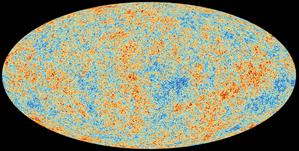
Cosmic Microwave Background Radiation
Pie de foto: This image is a representation of the Cosmic Microwave Background (CMB) Radiation created using data from the Planck satellite. The CMB is the glow left over from when the Universe was approximately 380,000 years old. The early Universe was hot and dense, so the photons from that era were high energy. Due to the expansion of the Universe over 13.8 billion years photons of ""light"" from the early Universe have been stretched to longer wavelengths and are detectable in millimetre wavelengths (microwave region of the electromagnetic spectrum). The ""mottled"" pattern in the image is referred to as anisotropies, and it represents very small temperature fluctuations. These fluctuations correspond to regions of slightly different densities, and are essentially the seeds for larger structure in the Universe e.g.: galaxies, galaxy clusters, and the very first stars.
The data from the CMB allows various characteristics of the Universe to be derived, for example, composition, shape, age, and allows for certain predictions to be made about the future evolution of the Universe.
The shape of the image is the result of a mapping projection, where the entire sky is mapped onto a single flat oval shape called Molleweide projection. The center of the Milky Way galaxy is located at the centre of the image.
Crédito: ESA/Planck Collaboration
enlace de crédito
License: CC-BY-SA-4.0 Creative Commons Reconocimiento-CompartirIgual 4.0 Internacional (CC BY-SA 4.0) íconos