Termo do glossário: Matéria Escura
Descrição: A matéria escura é uma forma hipotética de matéria que possui massa, mas é completamente transparente e não emite luz. Ela foi proposta como uma explicação conjunta para uma variedade de fenômenos relacionados às interações gravitacionais.
As primeiras evidências da existência da matéria escura vieram de galáxias em aglomerados de galáxias, que se observou estarem se movendo a velocidades comparativamente altas. A hipótese de massa adicional serviu para explicar por que, apesar de suas velocidades, as galáxias em questão permaneciam gravitacionalmente ligadas ao seu aglomerado, em vez de escaparem. As medições realizadas por Vera Rubin e outros pesquisadores das velocidades com que estrelas e gás orbitam em galáxias de disco levaram a uma aceitação mais ampla do conceito de matéria escura. Nesses sistemas, as leis usuais da gravidade exigem a existência de uma quantidade considerável de massa adicional à matéria visível para explicar as altas velocidades de rotação observadas. Mais recentemente, observações de lentes gravitacionais indicaram a presença de uma massa não luminosa considerável em aglomerados de galáxias.
Na cosmologia, a história da expansão do Universo aponta para a existência de mais matéria no Universo do que aquela contabilizada na forma de matéria luminosa. A explicação comum para o crescimento das estruturas no Universo primitivo também se baseia na presença de matéria escura. Por essas razões, os modelos cosmológicos padrão são conhecidos como modelos Lambda-CDM, em que CDM significa Cold Dark Matter (matéria escura fria, em inglês), isto é, matéria escura composta por partículas que se movem lentamente.
A natureza da matéria escura é um tema de intensa pesquisa e debate tanto na cosmologia quanto na física de partículas. As evidências da existência da matéria escura permanecem indiretas, baseando-se em observações dos efeitos da massa da matéria escura sobre a matéria luminosa ou a luz. Existem várias propostas de tipos de partículas elementares ainda não detectadas que poderiam compor a matéria escura, mas os experimentos realizados para encontrar evidências diretas dessas partículas candidatas não tiveram sucesso até o momento. Há também explicações alternativas propostas que afirmam dar conta das observações relevantes sem o envolvimento de novos tipos de partículas.
Termos relacionados:
Ver este termo em outros idiomas
Status do termo e da definição: A definição original deste termo em inglês foi aprovada por um astrônomo(a) pesquisador(a) e um(a) professor(a) A tradução deste termo e de sua definição ainda aguarda aprovação
O Glossário Multilíngue da OAE é um projeto do Escritório da IAU de Astronomia para a Educação(OAE) em colaboração com o Escritório da IAU para Divulgação da Astronomia (OAO). Os termos e definições foram selecionados, escritos e revisados por meio de um esforço coletivo da OAE, dos Centros e Nós da OAE, dos Coordenadores Nacionais de Educação em Astronomia (NAECs) da OAE e de outros voluntários. Você pode encontrar uma lista completa dos créditos aqui. Todos os termos do glossário e suas definições são disponibilizados sob uma licença Creative Commons CC BY-4.0 e devem ser creditados à "IAU OAE".
Se você notar algum erro factual ou de tradução neste termo do glossário ou em sua definição, por favor entre em contato.
Em outros idiomas
- Árabe: المادة المظلمة
- Alemão: Dunkle Materie
- Inglês: Dark Matter
- Espanhol: Materia oscura
- Francês: Matière noire
- Italiano: Materia oscura
- Japonês: ダークマター (link externo)
- Coreano: 암흑물질
- Chinês Simplificado: 暗物质
- Chinês Tradicional: 暗物質
Mídia relacionada
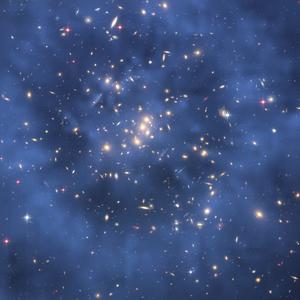
Dark matter
Legenda: This image of the galaxy cluster ZwCl0024+1652 is created using mathematical modelling, together with observations from the Hubble Space Telescope (HST).
The Hubble observations were taken in November 2004 by the Advanced Camera for Surveys (ACS). The exquisite resolution of the ACS, allowed very detailed measurements to be made of the gravitational lensing in the cluster. The blue nebulosity is a superimposed ""map"" of the dark matter distribution in the galaxy cluster and is not visible in the observations, but is a mathematical model created based on the gravitational lensing data.
The ""dark matter ring"" the is present in the image is one of the strongest pieces of evidence to date for the existence of dark matter. Observational data provides evidence that Dark matter makes up about 1/4 of the Universe, and is believed to make up the underlying structure of the cosmos. In addition, a large percentage the mass in galaxies and galaxy clusters is dark matter, which is not visible via direct observations.
Crédito: NASA, ESA, M.J. Jee and H. Ford (Johns Hopkins University)
link do crédito
License: CC-BY-4.0 Creative Commons Attribution 4.0 International (CC BY 4.0) ícones
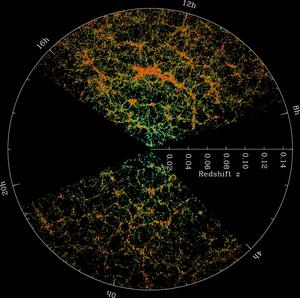
SDSS Redshift Map
Legenda: This image shows a map of the distribution of galaxies and is based on redshift data from the Sloan Digital Sky Survey (SDSS). Redshift measurements provides information on the distances, positions and motions of the galaxies.
The Earth is located at the center of the image, and each dot represents a galaxy. The outer circle represents a ""distance"" of about 2 billion light years. The idea of distance in cosmology is complex because the usual measurement of distance is the separation between two points in space at the same time. However, because of the speed of light, the further a distance, the farther back in time we are observing. The numbers on the outer circle are Right Ascension coordinates mapped onto a flat circle, and provides information on the position of the galaxies on the sky. The colours used represent the ages of the stars in the galaxies, the redder, more strongly clustered points represent galaxies comprising of older stars. The dark wedges that do not contain any dots are regions that were not mapped by the SDSS due to dust from the Milky Way galaxy obscuring the view.
Crédito: M. Blanton and Sloan Digital Sky Survey
link do crédito
License: CC-BY-4.0 Creative Commons Attribution 4.0 International (CC BY 4.0) ícones
Atividades relacionadas

Dark matter & dark energy (Part 2) – Understanding the nature of dark matter and dark energy
astroEDU educational activity (links to astroEDU website) Description: Let's investigate the nature of dark matter and energy with gravitational lensing!
License: CC-BY-4.0 Creative Commons Attribution 4.0 International (CC BY 4.0) ícones
Tags:
Experiment
, Invisible
Faixas etárias:
12-14
, 14-16
, 16-19
, 19+
Nível de ensino:
Informal
, Ensino fundamental
Áreas de aprendizagem:
Aprendizagem por descoberta guiada
, Aula interativa
, Modelagem
, Resolução de problemas
Custos:
Custo médio
Duração:
45 mins
Tamanho do grupo:
Grupo
Habilidades:
Construir explicações
, Desenvolver e usar modelos
, Engajar-se em argumentação com base em evidências

Dark matter and Dark energy (Part 1) – Discovering the main components of the Universe
astroEDU educational activity (links to astroEDU website) Description: Lets' investigate gravity, dark matter and dark energy with some very simple experiments!
License: CC-BY-4.0 Creative Commons Attribution 4.0 International (CC BY 4.0) ícones
Tags:
Experiment
, Galaxies
Faixas etárias:
12-14
, 14-16
, 16-19
, 19+
Nível de ensino:
Informal
, Ensino fundamental
Áreas de aprendizagem:
Aprendizagem por descoberta guiada
, Aula interativa
, Modelagem
, Baseado em observação
, Outro
, Resolução de problemas
Custos:
Baixo custo
Duração:
45 mins
Tamanho do grupo:
Grupo
Habilidades:
Construir explicações
, Desenvolver e usar modelos
, Engajar-se em argumentação com base em evidências
, Planejar e realizar pesquisas