Glossary term: 암흑물질
Description: 암흑물질은 질량은 가지고 있지만 빛을 내지 않고, 완전히 투명한 물질로 제안되고 있습니다. 이 물질은 중력 상호작용과 관련된 여러 현상을 하나로 설명하기 위한 가정에서 등장했습니다.
암흑물질의 존재에 대한 첫 번째 단서는 은하단 안의 은하들이 예상보다 빠르게 움직인다는 관측에서 나왔습니다. 이 움직임을 설명하려면, 보이지 않는 추가 질량이 있어야만 그 은하들이 중력에 의해 은하단에 묶여 있을 수 있다는 계산이 나왔습니다. 이후 베라 루빈(Vera Rubin)과 다른 천문학자들은 원반 은하의 별과 가스가 공전하는 속도를 측정했습니다. 그 결과, 보이는 물질만으로는 은하의 빠른 회전 속도를 설명할 수 없었고, 눈에 보이지 않지만 상당한 질량을 가진 물질, 즉 암흑물질이 있어야 함이 드러났습니다. 또한, 중력 렌즈 효과를 이용한 관측에서도 빛을 내지 않는 대량의 물질(비발광 질량)이 은하단에 존재한다는 증거가 발견되었습니다.
우주론적 관점에서도 암흑물질은 중요합니다. 우주의 팽창과 구조 형성 과정을 살펴보면, 빛을 내는 물질만으로는 우주의 모습을 설명할 수 없기 때문입니다. 이 때문에 현대 우주론에서는 ‘람다-CDM 모델(ΛCDM model)’이 표준으로 사용되며, 여기서 CDM은 ‘차가운 암흑물질(cold dark matter)’을 의미합니다. 이는 암흑물질이 상대적으로 느리게 움직이는 입자라고 가정한 것입니다.
하지만 암흑물질의 정체는 아직 밝혀지지 않았습니다. 암흑물질에 대한 증거는 그 물질이 중력으로 다른 물질이나 빛에 영향을 주는 간접적인 관측에 기반하고 있습니다. 입자물리학자들은 암흑물질을 이루는 새로운 기본 입자 후보를 제안했지만, 지금까지 진행된 직접 검출 실험에서는 아무것도 발견되지 않았습니다. 일부 과학자들은 새로운 입자를 가정하지 않고도 이 현상을 설명할 수 있는 다른 이론(수정된 중력이론 등)을 제시하기도 합니다.
Related Terms:
See this term in other languages
Term and definition status: The original definition of this term in English have been approved by a research astronomer and a teacher The translation of this term and its definition is still awaiting approval
The OAE Multilingual Glossary is a project of the IAU Office of Astronomy for Education (OAE) in collaboration with the IAU Office of Astronomy Outreach (OAO). The terms and definitions were chosen, written and reviewed by a collective effort from the OAE, the OAE Centers and Nodes, the OAE National Astronomy Education Coordinators (NAECs) and other volunteers. You can find a full list of credits here. All glossary terms and their definitions are released under a Creative Commons CC BY-4.0 license and should be credited to "IAU OAE".
If you notice a factual or translation error in this glossary term or definition then please get in touch.
In Other Languages
- 아랍어: المادة المظلمة
- 독일어: Dunkle Materie
- 영어: Dark Matter
- 스페인어: Materia oscura
- 프랑스어: Matière noire
- 이탈리아어: Materia oscura
- 일본어: ダークマター (external link)
- 브라질 포르투갈어: Matéria Escura
- 중국어 간체: 暗物质
- 중국어 번체: 暗物質
Related Media
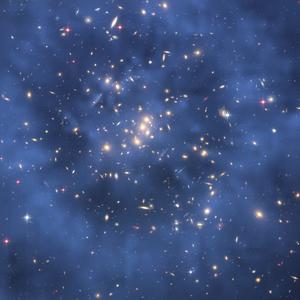
Dark matter
Caption: This image of the galaxy cluster ZwCl0024+1652 is created using mathematical modelling, together with observations from the Hubble Space Telescope (HST).
The Hubble observations were taken in November 2004 by the Advanced Camera for Surveys (ACS). The exquisite resolution of the ACS, allowed very detailed measurements to be made of the gravitational lensing in the cluster. The blue nebulosity is a superimposed ""map"" of the dark matter distribution in the galaxy cluster and is not visible in the observations, but is a mathematical model created based on the gravitational lensing data.
The ""dark matter ring"" the is present in the image is one of the strongest pieces of evidence to date for the existence of dark matter. Observational data provides evidence that Dark matter makes up about 1/4 of the Universe, and is believed to make up the underlying structure of the cosmos. In addition, a large percentage the mass in galaxies and galaxy clusters is dark matter, which is not visible via direct observations.
Credit: NASA, ESA, M.J. Jee and H. Ford (Johns Hopkins University)
credit link
License: CC-BY-4.0 Creative Commons 저작자표시 4.0 국제 (CC BY 4.0) icons
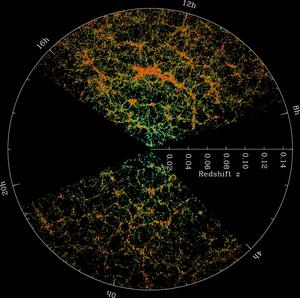
SDSS Redshift Map
Caption: This image shows a map of the distribution of galaxies and is based on redshift data from the Sloan Digital Sky Survey (SDSS). Redshift measurements provides information on the distances, positions and motions of the galaxies.
The Earth is located at the center of the image, and each dot represents a galaxy. The outer circle represents a ""distance"" of about 2 billion light years. The idea of distance in cosmology is complex because the usual measurement of distance is the separation between two points in space at the same time. However, because of the speed of light, the further a distance, the farther back in time we are observing. The numbers on the outer circle are Right Ascension coordinates mapped onto a flat circle, and provides information on the position of the galaxies on the sky. The colours used represent the ages of the stars in the galaxies, the redder, more strongly clustered points represent galaxies comprising of older stars. The dark wedges that do not contain any dots are regions that were not mapped by the SDSS due to dust from the Milky Way galaxy obscuring the view.
Credit: M. Blanton and Sloan Digital Sky Survey
credit link
License: CC-BY-4.0 Creative Commons 저작자표시 4.0 국제 (CC BY 4.0) icons
Related Activities

Dark matter & dark energy (Part 2) – Understanding the nature of dark matter and dark energy
astroEDU educational activity (links to astroEDU website) Description: Let's investigate the nature of dark matter and energy with gravitational lensing!
License: CC-BY-4.0 Creative Commons 저작자표시 4.0 국제 (CC BY 4.0) icons
Tags:
Experiment
, Invisible
Age Ranges:
12-14
, 14-16
, 16-19
, 19+
Education Level:
Informal
, Middle School
Areas of Learning:
Guided-discovery learning
, Interactive Lecture
, Modelling
, Problem-solving
Costs:
Medium Cost
Duration:
45 mins
Group Size:
Group
Skills:
Constructing explanations
, Developing and using models
, Engaging in argument from evidence

Dark matter and Dark energy (Part 1) – Discovering the main components of the Universe
astroEDU educational activity (links to astroEDU website) Description: Lets' investigate gravity, dark matter and dark energy with some very simple experiments!
License: CC-BY-4.0 Creative Commons 저작자표시 4.0 국제 (CC BY 4.0) icons
Tags:
Experiment
, Galaxies
Age Ranges:
12-14
, 14-16
, 16-19
, 19+
Education Level:
Informal
, Middle School
Areas of Learning:
Guided-discovery learning
, Interactive Lecture
, Modelling
, Observation based
, Other
, Problem-solving
Costs:
Low Cost
Duration:
45 mins
Group Size:
Group
Skills:
Constructing explanations
, Developing and using models
, Engaging in argument from evidence
, Planning and carrying out investigations