Termo do glossário: Astronomia Óptica
Descrição: A astronomia óptica é a prática de estudar e observar o Universo (estrelas, planetas, planetas anões, asteróides etc.) no infravermelho próximo, na luz visível e na luz ultravioleta. A razão para agrupar esses três tipos de radiação eletromagnética é que os telescópios ópticos, com lentes de vidro e/ou espelhos metálicos, que os astrônomos construíram originalmente para observar a luz visível proveniente de objetos celestes, são igualmente adequados para observar a luz do infravermelho próximo ou do ultravioleta. Além disso, a atmosfera terrestre é transparente não apenas para a luz visível, mas também para as regiões do infravermelho e do ultravioleta diretamente adjacentes, permitindo os três tipos de observação a partir do solo. Por último, mas não menos importante, os sensores de câmera que os astrônomos utilizam para observações na luz visível também podem detectar luz no infravermelho próximo e no ultravioleta. Juntando tudo isso, os telescópios e instrumentos que os astrônomos utilizam para observar a luz visível funcionam igualmente bem para observações no infravermelho próximo e no ultravioleta. Consequentemente, faz sentido que os astrônomos descrevam coletivamente as observações nessa faixa do espectro eletromagnético com um único termo: astronomia óptica. O adjetivo “óptico” também é usado para descrever a faixa espectral, como em “a parte óptica do espectro”. As observações nessa faixa são “observações ópticas”.
Termos relacionados:
Ver este termo em outros idiomas
Status do termo e da definição: A definição original deste termo em inglês foi aprovada por um astrônomo(a) pesquisador(a) e um(a) professor(a) A tradução deste termo e de sua definição ainda aguarda aprovação
O Glossário Multilíngue da OAE é um projeto do Escritório da IAU de Astronomia para a Educação (OAE) em colaboração com o Escritório da IAU para Divulgação da Astronomia (OAO). Os termos e definições foram selecionados, escritos e revisados por meio de um esforço coletivo da OAE, dos Centros e Nós da OAE, dos Coordenadores Nacionais de Educação em Astronomia (NAECs) da OAE e de outros voluntários. Você pode encontrar uma lista completa dos créditos aqui. Todos os termos do glossário e suas definições são disponibilizados sob uma licença Creative Commons CC BY-4.0 e devem ser creditados à "IAU OAE".
Se você notar algum erro factual ou de tradução neste termo do glossário ou em sua definição, por favor entre em contato.
Em outros idiomas
- Árabe: علم الفلك البصري
- Alemão: Optische Astronomie
- Inglês: Optical Astronomy
- Espanhol: Astronomía óptica
- Francês: Astronomie optique
- Italiano: Astronomia ottica
- Coreano: 광학천문학
- Chinês Simplificado: 光学天文学
- Chinês Tradicional: 光學天文學
Mídia relacionada
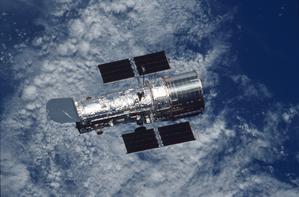
Telescópio Espacial Hubble sobre a Terra
Legenda: O Telescópio Espacial Hubble, da NASA/ESA, em órbita da Terra. Essa foto foi tirada pelos astronautas a bordo do ônibus espacial Columbia, logo após a Missão de Manutenção 3B do próprio telescópio espacial. O telescópio tem uma abertura que permite a entrada de luz (vista aqui à esquerda). A luz percorre a óptica do telescópio até chegar às câmeras e espectrógrafos localizados na outra extremidade do telescópio (visto aqui à direita). Os dados desses instrumentos são então enviados de volta à Terra por meio de uma antena. Os retângulos pretos em cada lado do observatório são os painéis solares que fornecem energia ao telescópio
Crédito: NASA/ESA
link do crédito
License: CC-BY-4.0 Creative Commons Attribution 4.0 International (CC BY 4.0) ícones
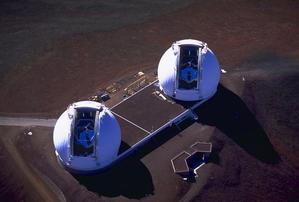
Telescópios Keck
Legenda: Os dois telescópios Keck em Mauna Kea, na ilha do Havaí. Esses dois telescópios são refletores com espelhos primários de 10 m de diâmetro.
Crédito: NASA/JPL
link do crédito
License: PD Domínio Público ícones

The Pillars of Creation in comparison
Legenda: The 'Pillars of Creation' are a renowned astronomical feature situated within the Eagle Nebula in the Serpens constellation. The illustration provides a direct comparison between images captured by the Hubble Space Telescope (HST) and the James Webb Space Telescope (JWST), showcasing the pillars, which span several light years in diameter, in both visible light (also known as optical light) and infrared light. On the left are the pillars as seen by Hubble in visual light, taken in 2014. It displays dark pillars against an opaque background, with only a handful of visible stars. Conversely, the counterpart on the right is Webb’s near-infrared view published in 2022, penetrating the dust and revealing numerous stars of varying sizes.
Their distance from Earth is approximately 6,500 to 7,000 light years. Within these pillars, new stars are constantly forming, making them a subject of extensive study by astronomers. Composed mostly of cool molecular hydrogen and small amounts of interstellar dust, they are subject to erosion by the intense ultraviolet radiation emitted by nearby massive and newborn stars, a process known as photoevaporation.
Crédito: NASA, ESA, CSA, STScI
link do crédito
License: CC-BY-2.0 Creative Commons Attribution 2.0 Generic ícones






.png)
