Término del glosario: Astronomía óptica
Descripción: La astronomía óptica es la disciplina que se dedica al estudio y la observación del Universo (estrellas, planetas, planetas enanos, asteroides, etc.) en el infrarrojo cercano, en la luz visible y en la luz ultravioleta. La razón para agrupar estos tres tipos de radiación electromagnética es que los telescopios ópticos, con lentes de cristal y/o espejos metálicos, que los astrónomos construyeron originalmente para observar la luz visible de los objetos celestes, son igualmente adecuados para observar la luz del infrarrojo cercano o la luz ultravioleta. Además, la atmósfera terrestre es transparente no solo para la luz visible, sino también para las regiones del infrarrojo y el ultravioleta directamente adyacentes, lo que permite realizar los tres tipos de observaciones desde tierra. Por último, pero no por ello menos importante, los sensores de las cámaras que utilizan los astrónomos para las observaciones en luz visible también pueden detectar luz del infrarrojo cercano y ultravioleta. Si se tiene en cuenta todo esto, los telescopios e instrumentos que utilizan los astrónomos para observar la luz visible funcionan igual de bien para las observaciones en el infrarrojo cercano y el ultravioleta. En consecuencia, tiene sentido que los astrónomos describan colectivamente las observaciones en este rango del espectro electromagnético con un único término: la astronomía óptica. El adjetivo «óptico» también se utiliza para describir el rango espectral, como en «la parte óptica del espectro». Las observaciones en ese rango son «observaciones ópticas».
Términos relacionados:
Ver este término en otros idiomas
Estado del término y la definición: La definición original de este término en inglés ha sido aprobada por unastrónomo o astrónoma investigadora y un docente La traducción de este término y su definición aún están pendientes de aprobación
El Glosario multilingüe de la OAE es un proyecto de la Oficina de Astronomía para la Educación de la UAI (OAE) en colaboración con la Oficina de Divulgación de Astronomía de la UAI (OAO). Los términos y definiciones fueron seleccionados, redactados y revisados gracias al esfuerzo colectivo de la OAE, los Centros y Nodos de la OAE, los Coordinadores Nacionales de Educación Astronómica (NAECs) y otros voluntarios. Puedes encontrar una lista completa de créditos aquí. Todos los términos del glosario y sus definiciones se publican bajo la licencia Creative Commons CC BY-4.0 y deben atribuirse a la "IAU OAE".
Si detectas algún error de contenido o de traducción en este término del glosario o en ladefinición, ponte en contacto con nosotros.
En otros idiomas
- Árabe: علم الفلك البصري
- Alemán: Optische Astronomie
- Inglés: Optical Astronomy
- Francés: Astronomie optique
- Italiano: Astronomia ottica
- Coreano: 광학천문학
- Portugués de Brasil: Astronomia Óptica
- Chino simplificado: 光学天文学
- Chino tradicional: 光學天文學
Contenidos relacionados
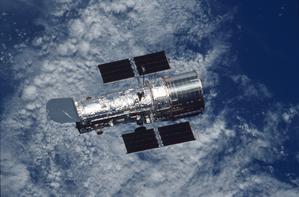
Hubble Space Telescope over Earth
Pie de foto: The NASA/ESA Hubble Space Telescope orbiting Earth. This picture was taken by astronauts on board the space shuttle Columbia, right after the Servicing Mission 3B to the space telescope itself. The telescope has an opening that allows light in (seen here on the left). The light travels through the telescope optics to the cameras and spectrographs located in the bulge at the other end of the observatory (seen here on the right). Data from these instruments is then sent back to Earth using an antenna. The black rectangles on either side of the observatory are the solar panels that provide it with power.
Crédito: NASA/ESA
enlace de crédito
License: CC-BY-4.0 Creative Commons Reconocimiento 4.0 Internacional (CC BY 4.0) íconos
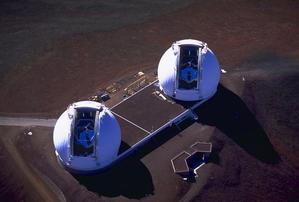
Telescopios Keck
Pie de foto: Los dos telescopios Keck están situados en Mauna Kea, en la isla de Hawái. Ambos son telescopios reflectores con espejos primarios de 10 m de diámetro.
Crédito: NASA/JPL
enlace de crédito
License: PD Dominio público íconos

The Pillars of Creation in comparison
Pie de foto: The 'Pillars of Creation' are a renowned astronomical feature situated within the Eagle Nebula in the Serpens constellation. The illustration provides a direct comparison between images captured by the Hubble Space Telescope (HST) and the James Webb Space Telescope (JWST), showcasing the pillars, which span several light years in diameter, in both visible light (also known as optical light) and infrared light. On the left are the pillars as seen by Hubble in visual light, taken in 2014. It displays dark pillars against an opaque background, with only a handful of visible stars. Conversely, the counterpart on the right is Webb’s near-infrared view published in 2022, penetrating the dust and revealing numerous stars of varying sizes.
Their distance from Earth is approximately 6,500 to 7,000 light years. Within these pillars, new stars are constantly forming, making them a subject of extensive study by astronomers. Composed mostly of cool molecular hydrogen and small amounts of interstellar dust, they are subject to erosion by the intense ultraviolet radiation emitted by nearby massive and newborn stars, a process known as photoevaporation.
Crédito: NASA, ESA, CSA, STScI
enlace de crédito
License: CC-BY-2.0 Creative Commons Atribución 2.0 Genérica íconos






.png)
