Glossary term: 光學天文學
Description: 光學天文學主要研究和觀測宇宙(恆星、行星、矮行星、小行星等)輻射的近紅外線、可見光和紫外線。將這三種電磁輻射放在一起的原因是,天文學家最初為觀測來自天體的可見光而建造的帶有玻璃鏡片和/或金屬鏡面的光學望遠鏡,同樣也適用於觀測近紅外線或紫外線。此外,地球大氣層不僅對可見光是透明的,而且對直接相鄰的紅外線和紫外線區域也是透明的,因此可以從地面同時對這三種輻射進行觀測。最後,天文學家用於可見光觀測的相機芯片也同時能探測到近紅外線和紫外線。呲上所述,天文學家用於觀測可見光的望遠鏡和儀器同樣適用於近紅外和紫外線觀測。因此,天文學家們用一個術語,即 "光學天文學",來統稱對電磁波譜這一範圍的觀測。形容詞 "光學 "也用於描述光譜範圍,如 "光譜的光學部分"。在這一範圍內的觀測就是 "光學觀測"。
Related Terms:
See this term in other languages
Term and definition status: The original definition of this term in English have been approved by a research astronomer and a teacher The translation of this term and its definition is still awaiting approval
This is an automated transliteration of the simplified Chinese translation of this term
The OAE Multilingual Glossary is a project of the IAU Office of Astronomy for Education (OAE) in collaboration with the IAU Office of Astronomy Outreach (OAO). The terms and definitions were chosen, written and reviewed by a collective effort from the OAE, the OAE Centers and Nodes, the OAE National Astronomy Education Coordinators (NAECs) and other volunteers. You can find a full list of credits here. All glossary terms and their definitions are released under a Creative Commons CC BY-4.0 license and should be credited to "IAU OAE".
If you notice a factual or translation error in this glossary term or definition then please get in touch.
In Other Languages
- 阿拉伯語: علم الفلك البصري
- 德語: Optische Astronomie
- 英語: Optical Astronomy
- 西班牙語: Astronomía óptica
- 法語: Astronomie optique
- 義大利語: Astronomia ottica
- 韓語: 광학천문학
- 巴西葡萄牙語: Astronomia Óptica
- 簡體中文: 光学天文学
Related Media
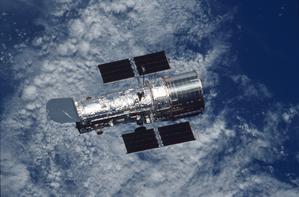
哈勃太空望遠鏡俯瞰地球
Caption: 環繞地球運行的 NASA/ESA 哈勃太空望遠鏡。這張照片是哥倫比亞號航天飛機上的宇航員在對太空望遠鏡本身執行完 3B 號維修任務後拍攝的。望遠鏡有一個開口,允許光線進入(在望遠鏡的左側)。光線穿過望遠鏡的光學系統,到達位於望遠鏡另一端凸起處的照相機和攝譜儀(右側)。這些儀器的數據隨後通過天線傳回地球。望遠鏡兩側的黑色矩形是為天文臺供電的太陽能電池板。
Credit: 美國宇航局/歐空局
credit link
License: CC-BY-4.0 Creative Commons 姓名標示 4.0 國際 (CC BY 4.0) icons
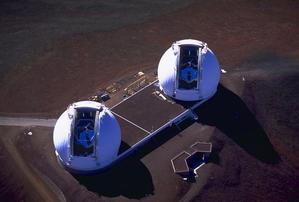
凱克望遠鏡
Caption: 夏威夷島莫納克亞山上的兩臺凱克望遠鏡。這兩臺望遠鏡是反射望遠鏡,主鏡直徑為 10 米。
Credit: 美國宇航局/JPL
credit link
License: PD Public Domain icons

The Pillars of Creation in comparison
Caption: The 'Pillars of Creation' are a renowned astronomical feature situated within the Eagle Nebula in the Serpens constellation. The illustration provides a direct comparison between images captured by the Hubble Space Telescope (HST) and the James Webb Space Telescope (JWST), showcasing the pillars, which span several light years in diameter, in both visible light (also known as optical light) and infrared light. On the left are the pillars as seen by Hubble in visual light, taken in 2014. It displays dark pillars against an opaque background, with only a handful of visible stars. Conversely, the counterpart on the right is Webb’s near-infrared view published in 2022, penetrating the dust and revealing numerous stars of varying sizes.
Their distance from Earth is approximately 6,500 to 7,000 light years. Within these pillars, new stars are constantly forming, making them a subject of extensive study by astronomers. Composed mostly of cool molecular hydrogen and small amounts of interstellar dust, they are subject to erosion by the intense ultraviolet radiation emitted by nearby massive and newborn stars, a process known as photoevaporation.
Credit: NASA, ESA, CSA, STScI
credit link
License: CC-BY-2.0 Creative Commons Attribution 2.0 Generic icons






.png)
