Glossary term: Optical Astronomy
Description: Optical astronomy is the practice of studying and observing the Universe (stars, planets, dwarf planets, asteroids, etc.) in the near-infrared, in visible light, and in ultraviolet light. The reason for lumping those three kinds of electromagnetic radiation together is that the optical telescopes, with glass lenses and/or metallic mirrors, that astronomers had originally constructed for observing visible light from celestial objects, are equally well-suited for observing near-infrared or ultraviolet light. In addition, the Earth's atmosphere is transparent not only for visible light, but for the directly adjacent infrared and ultraviolet regions, allowing all three kinds of observations from the ground. Last but not least, the camera chips astronomers use for visible-light observations can also detect near-infrared and ultraviolet light. Put all of this together, and the telescopes and instruments astronomers use to observe visible light work just as well for near-infrared and ultraviolet observations. In consequence, it makes sense for astronomers to collectively describe observations in that range of the electromagnetic spectrum with a single term, namely optical astronomy. The adjective "optical" is also used to describe the spectral range, as in "the optical part of the spectrum." Observations in that range are "optical observations".
Related Terms:
See this term in other languages
Term and definition status: This term and its definition have been approved by a research astronomer and a teacher
The OAE Multilingual Glossary is a project of the IAU Office of Astronomy for Education (OAE) in collaboration with the IAU Office of Astronomy Outreach (OAO). The terms and definitions were chosen, written and reviewed by a collective effort from the OAE, the OAE Centers and Nodes, the OAE National Astronomy Education Coordinators (NAECs) and other volunteers. You can find a full list of credits here. All glossary terms and their definitions are released under a Creative Commons CC BY-4.0 license and should be credited to "IAU OAE".
If you notice a factual error in this glossary definition then please get in touch.
In Other Languages
- Arabic: علم الفلك البصري
- German: Optische Astronomie
- Spanish: Astronomía óptica
- French: Astronomie optique
- Italian: Astronomia ottica
- Korean: 광학천문학
- Brazilian Portuguese: Astronomia Óptica
- Simplified Chinese: 光学天文学
- Traditional Chinese: 光學天文學
Related Media
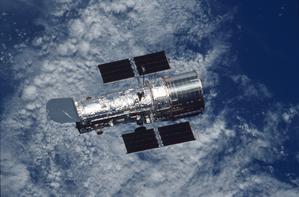
Hubble Space Telescope over Earth
Caption: The NASA/ESA Hubble Space Telescope orbiting Earth. This picture was taken by astronauts on board the space shuttle Columbia, right after the Servicing Mission 3B to the space telescope itself. The telescope has an opening that allows light in (seen here on the left). The light travels through the telescope optics to the cameras and spectrographs located in the bulge at the other end of the observatory (seen here on the right). Data from these instruments is then sent back to Earth using an antenna. The black rectangles on either side of the observatory are the solar panels that provide it with power.
Credit: NASA/ESA
credit link
License: CC-BY-4.0 Creative Commons Attribution 4.0 International (CC BY 4.0) icons
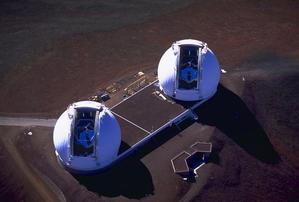
Keck Telescopes
Caption: The two Keck telescopes on Mauna Kea on the island of Hawai`i. These two telescopes are reflecting telescopes with primary mirrors 10m across.
Credit: NASA/JPL
credit link
License: PD Public Domain icons

The Pillars of Creation in comparison
Caption: The 'Pillars of Creation' are a renowned astronomical feature situated within the Eagle Nebula in the Serpens constellation. The illustration provides a direct comparison between images captured by the Hubble Space Telescope (HST) and the James Webb Space Telescope (JWST), showcasing the pillars, which span several light years in diameter, in both visible light (also known as optical light) and infrared light. On the left are the pillars as seen by Hubble in visual light, taken in 2014. It displays dark pillars against an opaque background, with only a handful of visible stars. Conversely, the counterpart on the right is Webb’s near-infrared view published in 2022, penetrating the dust and revealing numerous stars of varying sizes.
Their distance from Earth is approximately 6,500 to 7,000 light years. Within these pillars, new stars are constantly forming, making them a subject of extensive study by astronomers. Composed mostly of cool molecular hydrogen and small amounts of interstellar dust, they are subject to erosion by the intense ultraviolet radiation emitted by nearby massive and newborn stars, a process known as photoevaporation.
Credit: NASA, ESA, CSA, STScI
credit link
License: CC-BY-2.0 Creative Commons Attribution 2.0 Generic icons






.png)