Terme du glossaire : Optique adaptative
Description : Lorsque vous levez les yeux la nuit, vous pouvez voir les étoiles scintiller. L'air de l'atmosphère est toujours en mouvement, et lorsque la lumière d'une étoile traverse une zone de turbulences, elle est plus ou moins déviée. C'est pourquoi ce que nous voyons dans le ciel n'est pas un point lumineux unique et stable pour chaque étoile, mais une succession de points dansants, changeants et déformés. Pour les astronomes, le scintillement signifie qu'ils ne peuvent pas prendre des images d'objets célestes avec autant de détails que leurs grands télescopes terrestres le permettraient. L'optique adaptative permet d'atténuer cet effet. En utilisant une étoile réelle ou une "étoile artificielle" projetée par laser, un système d'optique adaptative ("OA") surveille la distorsion atmosphérique en temps réel. La lumière qui entre dans le télescope est guidée vers un miroir déformable. Contrôlé par un ordinateur, ce miroir est continuellement déformé de la bonne manière pour corriger la distorsion atmosphérique.
Termes associés :
Voir ce terme dans d'autres langues
Statut du terme et de sa définition : La définition initiale de ce terme en anglais a été aprouvée par un·e spécialiste de la recherche en astronomie et un·e spécialiste de l’éducation La traduction de ce terme et de sa définition n'ont pas encore été aprouvées
Le glossaire multilangue de l'OAE est un projet du Bureau de l'IAU de l'Astronomie pour l'Education (OAE) en collaboration avec le Bureau de l'IAU de diffusion de l'Astronomie (OAO). Les termes et définitions ont été choisis, écrits et relues grâce à un effort collectif de l'OAE, les Centres et les Noeuds de l'OAE, les Coordinateurs Nationaux de l'Astronomie pour l'Education de l'OAE(NAECs) et d'autres volontaires. La liste complète des crédits pour ce projet est disponible ici . Tous les termes du glossaire et leur définition sont déposés sous licence Creative Commons CC BY-4.0 et doivent être créditées au nom de "IAU OAE".
Si vous constatez une erreur dans ce terme ou sa définition, veuillez nous contacter .
Dans d'autres langues
- Arabe: البصريات المكيفة
- Bengali: অভিযোজনশীল আলোকবিজ্ঞান (Adaptive Optics)
- Allemand: Adaptive Optik
- Anglais: Adaptive Optics
- Espagnol: Óptica adaptativa
- Hindi: अनुकूली प्रकाशिकी
- Italien: ottica adattiva
- Japonais: 補償光学 (Liens externes)
- Marathi: अनुकूली प्रकाशिकी
- Portugais brésilien: Ótica Adaptativa
- Chinois simplifié: 自适应光学
- Chinois traditionnel: 自適應光學
Media associé
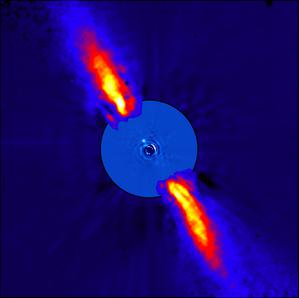
beta Pictoris b
Légende : Ce composite de deux images montre la planète beta Pictoris b et un disque de matière, tous deux en orbite autour de la jeune étoile beta Pictoris. Les deux images sont prises en lumière infrarouge. L'image intérieure est l'une des premières images prises d'une planète autour d'une autre étoile (une exoplanète). Cette image a été réalisée à l'aide d'une technique appelée optique adaptative qui supprime l'effet de flou de l'atmosphère terrestre qui étale la lumière d'une étoile. La lumière de l'étoile est alors suffisamment concentrée pour être cachée derrière un cercle de blocage (ici en noir) appelé coronographe. Les ondulations autour de ce cercle sont des artefacts du processus d'imagerie. Beta Pictoris b, une planète géante gazeuse dont la masse est environ douze fois supérieure à celle de Jupiter, apparaît comme un point au-dessus et à gauche du cercle noir.
L'image extérieure montre l'émission thermique du disque de matière chaude entourant la jeune étoile Beta Pictoris. par la tranche, il apparaît sous forme d'une ligne. Ce disque de gaz et de poussière a fourni la matière nécessaire à la formation de beta Pictoris b.
Crédit : ESO/A.-M. Lagrange et al.
Lien vers les crédits
License: CC-BY-4.0 Creative Commons (CC) Attribution 4.0 International (CC BY 4.0) Icônes
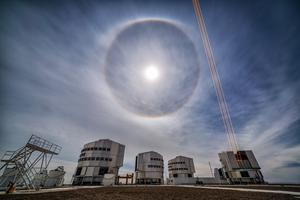
ESO's Very Large Telescope (VLT) at Paranal Observatory with a lunar halo
Légende : The Very Large Telescope on Cerro Paranal in Chile has four reflecting telescopes each with a primary mirror 8.2m across. In this image one dome is open and firing laser beams into the sky. These lasers create artificial stars in the sky that can be used to adjust the telescope optics to remove the blurring effect of the Earth's atmosphere. This process is known as adaptive optics.
In the sky the Moon is surrounded by a bright halo. This is caused by light from the moon reflecting inside ice crystals in the Earth's atmosphere.
Crédit : Juan Carlos Muñoz-Mateos/ESO
Lien vers les crédits
License: CC-BY-4.0 Creative Commons (CC) Attribution 4.0 International (CC BY 4.0) Icônes

The planet PDS 70b inside a protoplanetary disk
Légende : An image of the planet PDS 70b. The young star PDS 70b has a protoplanetary disk surrounding it. Disks like these contains gas, fine sandy particles that astronomers refer to as dust and also larger bodies ranging from objects the size of pebbles to protoplanets (planets that are still forming).
This image was taken in infrared light using adaptive optics. Adaptive optics is a technique that uses flexible mirrors and computer analysis to remove the blurring effect of the Earth's atmosphere. This allows astronomers to search regions close to stars like PDS 70 that would otherwise be swamped by light from the star spread out by the Earth's atmosphere. In the center is a black circle. This is caused by a coronograph, a small circle that blocks out light from the parent star. This is surrounded by a bright oval, infrared light emitted from the material in the protoplanetary disk. To the right of the black circle covering the star is a bright dot. This is PDS 70b, a giant planet that is still forming .
Crédit : ESO/ A. Müller, MPIA
Lien vers les crédits
License: CC-BY-4.0 Creative Commons (CC) Attribution 4.0 International (CC BY 4.0) Icônes
Ceci pourrait vous intéresser également








- Ressources
- Moteur de recherche des ressources pédagogiques
- Parcourir les ressources pédagogiques par Sujet
- Parcourir les images
- AstroEdu - Activités en classe
- Grandes Idées - Littéracie en astronomie
- Glossaire
- Rapports de l'OAE
- L'astronomie pour l'Education à travers le monde
- Sélection de ressources externes