词条 自适应光学
描述: 夜晚抬头仰望,你可能会看到恒星在闪烁。大气中的空气总是在运动,当恒星发出的光经过有湍流的区域时,会发生不同程度的偏转。因此,我们在天空中看到的每颗恒星并不是稳定的单个光点,而是跳跃、不断变化、扭曲的一连串光点。这样的闪烁使得天文学家无法以大型地面望远镜本应达到的水平拍摄到天体的详细图像。自适应光学是减轻这种效应的一种方法。自适应光学(AO)系统利用真实的恒星或是激光投射的“人造恒星”,实时监测大气畸变。进入望远镜的光线被引导到一面可变形的镜子上。在计算机的控制下,镜面以适当的方式不断变形,以抵消大气畸变的影响。
相关词条
用其他语言查看该词条
词条和定义状态: 该术语的英文原始定义已通过天文研究人员和教师的审核 该术语及其定义的译文仍待审核
OAE多语言词汇表是由国际天文学联合会(IAU) 天文教育办公室(OAE) 和 国际天文学联合会(IAU) 天文推广办公室(OAO)合作的项目。. 术语和定义由 OAE中心, OAE 国家天文教育协调员(NAECs) 以及其他志愿者共同选择、撰写和审阅。您可以在 找到完整的致谢列表。所有词汇表术语及其定义均根据 Creative Commons CC BY-4.0许可证发布 且版权归属于 “IAU OAE”。
如果您发现此词汇术语或定义中的事实或翻译错误, 请向 发邮件 联系.
其他语言版本
- 阿拉伯语: البصريات المكيفة
- 孟加拉语: অভিযোজনশীল আলোকবিজ্ঞান (Adaptive Optics)
- 德语: Adaptive Optik
- 英语: Adaptive Optics
- 西班牙语: Óptica adaptativa
- 法语: Optique adaptative
- 北印度语: अनुकूली प्रकाशिकी
- 意大利语: ottica adattiva
- 日语: 補償光学 (外部链接)
- 马拉地语: अनुकूली प्रकाशिकी
- 巴西葡萄牙语: Ótica Adaptativa
- 繁体中文: 自適應光學
相关媒体
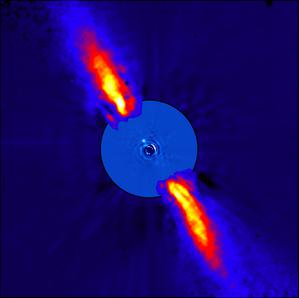
老人增四b
图注: 这幅图像由两张照片合成,显示了系外行星老人增四b和一个物质盘,它们都围绕年轻恒星老人增四运行。这两张照片都是在红外波段拍摄的。围绕太阳之外的恒星运行的行星称为“系外行星”,内侧图像即为首批被拍摄到的系外行星照片之一。这张照片是利用一种叫做“自适应光学”的技术拍摄的,该技术可以消除地球大气引起的模糊效应,从而使星光不再散开。然后,星光被高度集中,并由一个叫做“星冕仪”的遮挡圈(此处显示为黑圈)遮挡,其周围的波纹是成像过程中的伪影。老人增四b是一颗气态巨行星,质量约为木星的12倍,在黑圈左上方显示为一个小点。
外侧图像显示的是年轻恒星老人增四周围温暖物质盘的热辐射。我们的视线处于这个物质盘的侧面,因此它显示为一条线。这个由气体和尘埃组成的物质盘提供了形成老人增四b的物质。
来源: ESO/A.-M. Lagrange et al.
来源链接
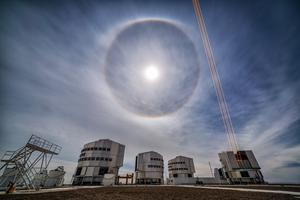
位于帕拉纳尔天文台的欧洲南方天文台甚大望远镜与月晕
图注: 位于智利帕瑞纳山的甚大望远镜由四台反射望远镜组成,每台望远镜的主镜直径为8.2米。在这张照片中图中,其中一个穹顶打开着,并向天空发射激光束。这些激光在天空中创造出“人造星”,用于调整望远镜的光学系统,从而消除地球大气层引起的模糊效应,这一过程被称为自适应光学。
在天空中,月亮被明亮的光晕围绕。该现象是由月光在地球大气中的冰晶内反射而形成的。
来源: 胡安-卡洛斯-穆尼奥斯-马特奥斯/欧空局
来源链接

The planet PDS 70b inside a protoplanetary disk
图注: An image of the planet PDS 70b. The young star PDS 70b has a protoplanetary disk surrounding it. Disks like these contains gas, fine sandy particles that astronomers refer to as dust and also larger bodies ranging from objects the size of pebbles to protoplanets (planets that are still forming).
This image was taken in infrared light using adaptive optics. Adaptive optics is a technique that uses flexible mirrors and computer analysis to remove the blurring effect of the Earth's atmosphere. This allows astronomers to search regions close to stars like PDS 70 that would otherwise be swamped by light from the star spread out by the Earth's atmosphere. In the center is a black circle. This is caused by a coronograph, a small circle that blocks out light from the parent star. This is surrounded by a bright oval, infrared light emitted from the material in the protoplanetary disk. To the right of the black circle covering the star is a bright dot. This is PDS 70b, a giant planet that is still forming .
来源: ESO/ A. Müller, MPIA
来源链接