Glossary term: Adaptive Optics
Description: When you look up at night, you might see the stars twinkle. The air in the atmosphere is always in motion, and as light from a star passes through a region with turbulence, it gets deflected by a varying amount. That is why what we can see in the sky is not a single steady point of light for each star, but a dancing, ever-changing, distorted succession of points. For astronomers, twinkling means that they cannot take images of celestial objects in as much detail as their large ground-based telescopes would otherwise allow. Adaptive optics is a way of mitigating that effect. Using either a real star or a laser-projected "artificial star", an adaptive optics ("AO") system monitors atmospheric distortion in real time. Light that has entered the telescope is guided onto a deformable mirror. Controlled by a computer, that mirror is continuously deformed in just the right way to counteract atmospheric distortion.
Related Terms:
See this term in other languages
Term and definition status: This term and its definition have been approved by a research astronomer and a teacher
The OAE Multilingual Glossary is a project of the IAU Office of Astronomy for Education (OAE) in collaboration with the IAU Office of Astronomy Outreach (OAO). The terms and definitions were chosen, written and reviewed by a collective effort from the OAE, the OAE Centers and Nodes, the OAE National Astronomy Education Coordinators (NAECs) and other volunteers. You can find a full list of credits here. All glossary terms and their definitions are released under a Creative Commons CC BY-4.0 license and should be credited to "IAU OAE".
If you notice a factual error in this glossary definition then please get in touch.
In Other Languages
- Arabic: البصريات المكيفة
- Bengali: অভিযোজনশীল আলোকবিজ্ঞান (Adaptive Optics)
- German: Adaptive Optik
- Spanish: Óptica adaptativa
- French: Optique adaptative
- Hindi: अनुकूली प्रकाशिकी
- Italian: ottica adattiva
- Japanese: 補償光学 (external link)
- Marathi: अनुकूली प्रकाशिकी
- Brazilian Portuguese: Ótica Adaptativa
- Simplified Chinese: 自适应光学
- Traditional Chinese: 自適應光學
Related Media
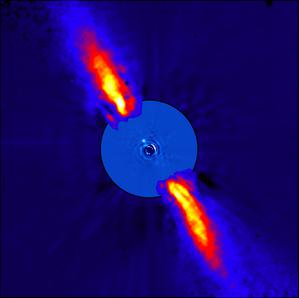
beta Pictoris b
Caption: This composite of two images shows the planet beta Pictoris b and a disk of material both of which orbit the young star beta Pictoris. Both are taken in infrared light. The inner image was one of the first pictures taken of a planet around another star (an exoplanet). This image was made using a technique called adaptive optics which removes the blurring effect of the Earth's atmosphere that spreads out a star's light. The star's light is then concentrated tightly enough that it can be hidden behind a blocking circle (shown here in black) called a coronagraph. The ripples around this are artifacts of the imaging process. Beta Pictoris b, a gas giant planet about twelve times the mass of Jupiter, appears as a dot above and to the left of the black circle.
The outer image shows the thermal emission from the warm disk of material surrounding the young star beta Pictoris. As we are viewing this disk edge-on it appears as a line. This disk of gas and dust provided the material to form beta Pictoris b.
Credit: ESO/A.-M. Lagrange et al.
credit link
License: CC-BY-4.0 Creative Commons Attribution 4.0 International (CC BY 4.0) icons

ESO's Very Large Telescope (VLT) at Paranal Observatory with a lunar halo
Caption: The Very Large Telescope on Cerro Paranal in Chile has four reflecting telescopes each with a primary mirror 8.2m across. In this image one dome is open and firing laser beams into the sky. These lasers create artificial stars in the sky that can be used to adjust the telescope optics to remove the blurring effect of the Earth's atmosphere. This process is known as adaptive optics.
In the sky the Moon is surrounded by a bright halo. This is caused by light from the moon reflecting inside ice crystals in the Earth's atmosphere.
Credit: Juan Carlos Muñoz-Mateos/ESO
credit link
License: CC-BY-4.0 Creative Commons Attribution 4.0 International (CC BY 4.0) icons

The planet PDS 70b inside a protoplanetary disk
Caption: An image of the planet PDS 70b. The young star PDS 70b has a protoplanetary disk surrounding it. Disks like these contains gas, fine sandy particles that astronomers refer to as dust and also larger bodies ranging from objects the size of pebbles to protoplanets (planets that are still forming).
This image was taken in infrared light using adaptive optics. Adaptive optics is a technique that uses flexible mirrors and computer analysis to remove the blurring effect of the Earth's atmosphere. This allows astronomers to search regions close to stars like PDS 70 that would otherwise be swamped by light from the star spread out by the Earth's atmosphere. In the center is a black circle. This is caused by a coronograph, a small circle that blocks out light from the parent star. This is surrounded by a bright oval, infrared light emitted from the material in the protoplanetary disk. To the right of the black circle covering the star is a bright dot. This is PDS 70b, a giant planet that is still forming .
Credit: ESO/ A. Müller, MPIA
credit link
License: CC-BY-4.0 Creative Commons Attribution 4.0 International (CC BY 4.0) icons