Termo do glossário: Ótica Adaptativa
Descrição: Quando você olha para o céu à noite, pode perceber que as estrelas cintilam. O ar na atmosfera está sempre em movimento e, à medida que a luz de uma estrela passa por uma região com turbulência, ela é desviada de forma variável. Por isso, o que vemos no céu não é um único ponto de luz estável para cada estrela, mas sim uma sucessão de pontos distorcidos, em constante mudança que parecem "dançar". Para os astrônomos, esse cintilar significa que não é possível obter imagens de objetos celestes com todo o nível de detalhe quanto seus grandes telescópios terrestres permitiriam em condições ideais. A óptica adaptativa é uma forma de reduzir esse efeito. Usando uma estrela real ou uma “estrela artificial” projetada a laser, um sistema de ótica adaptativa (AO, do inglês Adaptive Optics) monitora em tempo real a distorção atmosférica. A luz que entra no telescópio é então direcionada para um espelho deformável. Controlado por um computador, esse espelho é continuamente ajustado da maneira correta para compensar essas distorções atmosféricas.
Termos relacionados:
Ver este termo em outros idiomas
Status do termo e da definição: A definição original deste termo em inglês foi aprovada por um astrônomo(a) pesquisador(a) e um(a) professor(a) A tradução deste termo e de sua definição ainda aguarda aprovação
O Glossário Multilíngue da OAE é um projeto do Escritório da IAU de Astronomia para a Educação (OAE) em colaboração com o Escritório da IAU para Divulgação da Astronomia (OAO). Os termos e definições foram selecionados, escritos e revisados por meio de um esforço coletivo da OAE, dos Centros e Nós da OAE, dos Coordenadores Nacionais de Educação em Astronomia (NAECs) da OAE e de outros voluntários. Você pode encontrar uma lista completa dos créditos aqui. Todos os termos do glossário e suas definições são disponibilizados sob uma licença Creative Commons CC BY-4.0 e devem ser creditados à "IAU OAE".
Se você notar algum erro factual ou de tradução neste termo do glossário ou em sua definição, por favor entre em contato.
Em outros idiomas
- Árabe: البصريات المكيفة
- Bengali: অভিযোজনশীল আলোকবিজ্ঞান (Adaptive Optics)
- Alemão: Adaptive Optik
- Inglês: Adaptive Optics
- Espanhol: Óptica adaptativa
- Francês: Optique adaptative
- Hindi: अनुकूली प्रकाशिकी
- Italiano: ottica adattiva
- Japonês: 補償光学 (link externo)
- Marathi: अनुकूली प्रकाशिकी
- Chinês Simplificado: 自适应光学
- Chinês Tradicional: 自適應光學
Mídia relacionada
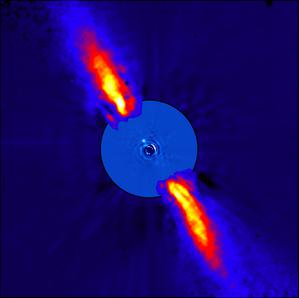
beta Pictoris b
Legenda: This composite of two images shows the planet beta Pictoris b and a disk of material both of which orbit the young star beta Pictoris. Both are taken in infrared light. The inner image was one of the first pictures taken of a planet around another star (an exoplanet). This image was made using a technique called adaptive optics which removes the blurring effect of the Earth's atmosphere that spreads out a star's light. The star's light is then concentrated tightly enough that it can be hidden behind a blocking circle (shown here in black) called a coronagraph. The ripples around this are artifacts of the imaging process. Beta Pictoris b, a gas giant planet about twelve times the mass of Jupiter, appears as a dot above and to the left of the black circle.
The outer image shows the thermal emission from the warm disk of material surrounding the young star beta Pictoris. As we are viewing this disk edge-on it appears as a line. This disk of gas and dust provided the material to form beta Pictoris b.
Crédito: ESO/A.-M. Lagrange et al.
link do crédito
License: CC-BY-4.0 Creative Commons Attribution 4.0 International (CC BY 4.0) ícones

O Very Large Telescope (VLT) da ESO no Observatório Paranal com um halo lunar
Legenda: O Very Large Telescope, localizado no Cerro Paranal, no Chile, possui quatro telescópios refletores, cada um com um espelho primário de 8,2 m de diâmetro. Nesta imagem, uma das cúpulas está aberta e disparando feixes de laser para o céu. Esses lasers criam estrelas artificiais no céu que podem ser usadas para ajustar a óptica do telescópio e remover o efeito de borramento causado pela atmosfera terrestre. Esse processo é conhecido como óptica adaptativa.
No céu, a Lua está rodeada por um halo brilhante. Isso é causado pela luz da Lua refletindo dentro de cristais de gelo na atmosfera terrestre.
Crédito: Juan Carlos Muñoz-Mateos/ESO
link do crédito
License: CC-BY-4.0 Creative Commons Attribution 4.0 International (CC BY 4.0) ícones

O planeta PDS 70b dentro de um disco protoplanetário
Legenda: Uma imagem do planeta PDS 70b. A jovem estrela PDS 70b é rodeada por um disco protoplanetário. Discos como este contêm gás, partículas finas semelhantes a areia que os astrônomos chamam de poeira e também corpos maiores, que variam de objetos do tamanho de seixos a protoplanetas (planetas que ainda estão se formando).
Esta imagem foi capturada em luz infravermelha usando óptica adaptativa. A óptica adaptativa é uma técnica que utiliza espelhos flexíveis e análise computacional para remover o efeito de desfocagem causado pela atmosfera terrestre. Isso permite que os astrônomos observem regiões próximas a estrelas como a PDS 70, que de outra forma seriam ofuscadas pela luz da estrela espalhada pela atmosfera terrestre. No centro há um círculo preto. Isso é causado por um coronógrafo, um pequeno dispositivo que bloqueia a luz da estrela central. Ele é cercado por um oval brilhante, luz infravermelha emitida pelo material no disco protoplanetário. À direita do círculo preto que cobre a estrela há um ponto brilhante. Trata-se de PDS 70b, um planeta gigante ainda em formação.
Crédito: ESO/ A. Müller, MPIA
link do crédito
License: CC-BY-4.0 Creative Commons Attribution 4.0 International (CC BY 4.0) ícones