词条 太空碎片
描述: 太空碎片或太空垃圾是指围绕地球运行但已无任何实用功能的人造物体或其残骸。这些包括退役或故障的卫星、卫星碰撞后产生的碎片,以及用于发射航天器或卫星的火箭上部级,在完成任务后被弃置的部分。随着太空垃圾的数量增加,发生碰撞的风险也随之增大,对航天器构成了严重威胁。因此,航天机构正在讨论并测试清理太空垃圾的方法,同时努力在规划任务时考虑将完成使命的物体引导重新进入地球大气层并燃烧殆尽。
相关词条
用其他语言查看该词条
词条和定义状态: 该术语的英文原始定义已通过天文研究人员和教师的审核 该术语及其定义的译文仍待审核
OAE多语言词汇表是由国际天文学联合会(IAU) 天文教育办公室(OAE) 和 国际天文学联合会(IAU) 天文推广办公室(OAO)合作的项目。. 术语和定义由 OAE中心, OAE 国家天文教育协调员(NAECs) 以及其他志愿者共同选择、撰写和审阅。您可以在 找到完整的致谢列表。所有词汇表术语及其定义均根据 Creative Commons CC BY-4.0许可证发布 且版权归属于 “IAU OAE”。
如果您发现此词汇术语或定义中的事实或翻译错误, 请向 发邮件 联系.
其他语言版本
- 阿拉伯语: الحطام الفضائي
- 德语: Weltraummüll
- 英语: Space Debris
- 西班牙语: Basura espacial
- 法语: Débris spatiaux
- 意大利语: Detriti spaziali
- 巴西葡萄牙语: Detritos espaciais
- 繁体中文: 太空碎片
相关媒体
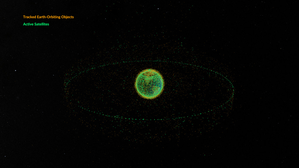
Space debris orbiting the Earth
图注: This animation shows objects orbiting the Earth. The data date from February 2024 and are taken from space-track.org which maintains a public catalogue of objects tracked by the United States Space Command (USSPACECOM).
At first in this video we see green dots, each representing one of the 31,000 human-made objects orbiting Earth. These include both operational and decommissioned satellites, used rocket stages from space launches, and fragments larger than 10cm created by collisions or explosions. Later in the video, some of the green dots are replace by orange dots, each of these representing one of the 9,300 operational satellites orbiting the Earth. Note that since February 2024 more satellites and rockets have been launched in to space and some objects will have fallen back to Earth, so these numbers will have changed.
We see two main groups of objects. The first are those objects orbiting close to the Earth, objects in low Earth orbit. These include communication satellites (many from the satellite constellations used to provide satellite internet services), Earth observation satellites, military satellites, two operational space stations and other objects such as rocket stages and other debris.
More distant from Earth we see a thin ring of satellites. These are in geostationary orbit. This is a special orbit where the orbital period matches the rotation period of the Earth. This means that a satellite in geostationary orbit stays above the same point on the equator and, when observed from the side of the Earth facing the satellite, will appear to stay at a position on the sky that does not change over time. Because of this, geostationary orbit is used by many communications satellites as a satellite dish on Earth used to receive or transmit a signal to that satellite can point in a fixed direction and does not need to dynamically track the satellite. Geostationary orbit is also used by weather observation satellites.
来源: NASA's Scientific Visualization Studio
来源链接
License: PD 公共领域 图标