Termo do glossário: Detritos espaciais
Descrição: Detritos espaciais ou lixo espacial é o termo usado para objetos artificiais, ou os restos de tais objetos, que orbitam a Terra, mas não têm mais uma função útil. Os exemplos são satélites desativados ou defeituosos, peças quebradas resultantes da colisão de satélites ou estágios superiores de foguetes que foram usados no lançamento de espaçonaves ou satélites e descartados após terem cumprido sua finalidade. Quanto mais detritos espaciais existirem, maior será a chance de colisões prejudiciais como um sério risco para as espaçonaves. Consequentemente, as agências espaciais estão discutindo e começaram a testar formas de remover o lixo espacial e estão se esforçando para planejar missões de modo que os objetos que cumpriram sua finalidade sejam reentrados e queimados na atmosfera da Terra.
Termos relacionados:
Ver este termo em outros idiomas
Status do termo e da definição: A definição original deste termo em inglês foi aprovada por um astrônomo(a) pesquisador(a) e um(a) professor(a) A tradução deste termo e de sua definição ainda aguarda aprovação
O Glossário Multilíngue da OAE é um projeto do Escritório da IAU de Astronomia para a Educação (OAE) em colaboração com o Escritório da IAU para Divulgação da Astronomia (OAO). Os termos e definições foram selecionados, escritos e revisados por meio de um esforço coletivo da OAE, dos Centros e Nós da OAE, dos Coordenadores Nacionais de Educação em Astronomia (NAECs) da OAE e de outros voluntários. Você pode encontrar uma lista completa dos créditos aqui. Todos os termos do glossário e suas definições são disponibilizados sob uma licença Creative Commons CC BY-4.0 e devem ser creditados à "IAU OAE".
Se você notar algum erro factual ou de tradução neste termo do glossário ou em sua definição, por favor entre em contato.
Em outros idiomas
- Árabe: الحطام الفضائي
- Alemão: Weltraummüll
- Inglês: Space Debris
- Espanhol: Basura espacial
- Francês: Débris spatiaux
- Italiano: Detriti spaziali
- Chinês Simplificado: 太空碎片
- Chinês Tradicional: 太空碎片
Mídia relacionada
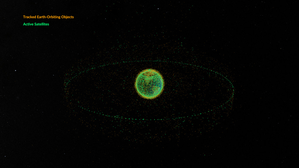
Space debris orbiting the Earth
Legenda: This animation shows objects orbiting the Earth. The data date from February 2024 and are taken from space-track.org which maintains a public catalogue of objects tracked by the United States Space Command (USSPACECOM).
At first in this video we see green dots, each representing one of the 31,000 human-made objects orbiting Earth. These include both operational and decommissioned satellites, used rocket stages from space launches, and fragments larger than 10cm created by collisions or explosions. Later in the video, some of the green dots are replace by orange dots, each of these representing one of the 9,300 operational satellites orbiting the Earth. Note that since February 2024 more satellites and rockets have been launched in to space and some objects will have fallen back to Earth, so these numbers will have changed.
We see two main groups of objects. The first are those objects orbiting close to the Earth, objects in low Earth orbit. These include communication satellites (many from the satellite constellations used to provide satellite internet services), Earth observation satellites, military satellites, two operational space stations and other objects such as rocket stages and other debris.
More distant from Earth we see a thin ring of satellites. These are in geostationary orbit. This is a special orbit where the orbital period matches the rotation period of the Earth. This means that a satellite in geostationary orbit stays above the same point on the equator and, when observed from the side of the Earth facing the satellite, will appear to stay at a position on the sky that does not change over time. Because of this, geostationary orbit is used by many communications satellites as a satellite dish on Earth used to receive or transmit a signal to that satellite can point in a fixed direction and does not need to dynamically track the satellite. Geostationary orbit is also used by weather observation satellites.
Crédito: NASA's Scientific Visualization Studio
link do crédito
License: PD Domínio Público ícones