Glossary term: 太空碎片
Description: 太空碎片或太空垃圾是指圍繞地球運行但已無任何實用功能的人造物體或其殘骸。這些包括退役或故障的衛星、衛星碰撞後產生的碎片,以及用於發射航天器或衛星的火箭上部級,在完成任務後被棄置的部分。隨著太空垃圾的數量增加,發生碰撞的風險也隨之增大,對航天器構成了嚴重威脅。因此,航天機構正在討論並測試清理太空垃圾的方法,同時努力在規劃任務時考慮將完成使命的物體引導重新進入地球大氣層並燃燒殆盡。
Related Terms:
See this term in other languages
Term and definition status: The original definition of this term in English have been approved by a research astronomer and a teacher The translation of this term and its definition is still awaiting approval
This is an automated transliteration of the simplified Chinese translation of this term
The OAE Multilingual Glossary is a project of the IAU Office of Astronomy for Education (OAE) in collaboration with the IAU Office of Astronomy Outreach (OAO). The terms and definitions were chosen, written and reviewed by a collective effort from the OAE, the OAE Centers and Nodes, the OAE National Astronomy Education Coordinators (NAECs) and other volunteers. You can find a full list of credits here. All glossary terms and their definitions are released under a Creative Commons CC BY-4.0 license and should be credited to "IAU OAE".
If you notice a factual or translation error in this glossary term or definition then please get in touch.
In Other Languages
- 阿拉伯語: الحطام الفضائي
- 德語: Weltraummüll
- 英語: Space Debris
- 西班牙語: Basura espacial
- 法語: Débris spatiaux
- 義大利語: Detriti spaziali
- 巴西葡萄牙語: Detritos espaciais
- 簡體中文: 太空碎片
Related Media
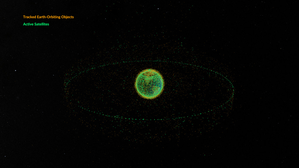
Space debris orbiting the Earth
Caption: This animation shows objects orbiting the Earth. The data date from February 2024 and are taken from space-track.org which maintains a public catalogue of objects tracked by the United States Space Command (USSPACECOM).
At first in this video we see green dots, each representing one of the 31,000 human-made objects orbiting Earth. These include both operational and decommissioned satellites, used rocket stages from space launches, and fragments larger than 10cm created by collisions or explosions. Later in the video, some of the green dots are replace by orange dots, each of these representing one of the 9,300 operational satellites orbiting the Earth. Note that since February 2024 more satellites and rockets have been launched in to space and some objects will have fallen back to Earth, so these numbers will have changed.
We see two main groups of objects. The first are those objects orbiting close to the Earth, objects in low Earth orbit. These include communication satellites (many from the satellite constellations used to provide satellite internet services), Earth observation satellites, military satellites, two operational space stations and other objects such as rocket stages and other debris.
More distant from Earth we see a thin ring of satellites. These are in geostationary orbit. This is a special orbit where the orbital period matches the rotation period of the Earth. This means that a satellite in geostationary orbit stays above the same point on the equator and, when observed from the side of the Earth facing the satellite, will appear to stay at a position on the sky that does not change over time. Because of this, geostationary orbit is used by many communications satellites as a satellite dish on Earth used to receive or transmit a signal to that satellite can point in a fixed direction and does not need to dynamically track the satellite. Geostationary orbit is also used by weather observation satellites.
Credit: NASA's Scientific Visualization Studio
credit link
License: PD Public Domain icons