Terme du glossaire : Débris spatiaux
Description : Les débris spatiaux désignent les objets artificiels, ou les restes de ces objets, qui orbitent autour de la Terre mais ne remplissent aucune fonction utile. Il s'agit par exemple de satellites hors service ou défectueux, de pièces brisées résultant de la collision de satellites ou d'étages supérieurs de fusées utilisés pour le lancement d'engins spatiaux ou de satellites et mis au rebut après avoir rempli leur fonction. Plus il y a de débris spatiaux, plus le risque de collisions dommageables est grand, ce qui constitue un grave danger pour les engins spatiaux. Par conséquent, les agences spatiales discutent et ont commencé à tester des moyens d'éliminer les débris spatiaux et s'efforcent de planifier des missions de manière à ce que les objets qui ont rempli leur fonction rentrent dans l'atmosphère terrestre et s'y consument.
Termes associés :
Voir ce terme dans d'autres langues
Statut du terme et de sa définition : La définition initiale de ce terme en anglais a été aprouvée par un·e spécialiste de la recherche en astronomie et un·e spécialiste de l’éducation La traduction de ce terme et de sa définition n'ont pas encore été aprouvées
Le glossaire multilangue de l'OAE est un projet du Bureau de l'IAU de l'Astronomie pour l'Education (OAE) en collaboration avec le Bureau de l'IAU de diffusion de l'Astronomie (OAO). Les termes et définitions ont été choisis, écrits et relues grâce à un effort collectif de l'OAE, les Centres et les Noeuds de l'OAE, les Coordinateurs Nationaux de l'Astronomie pour l'Education de l'OAE(NAECs) et d'autres volontaires. La liste complète des crédits pour ce projet est disponible ici . Tous les termes du glossaire et leur définition sont déposés sous licence Creative Commons CC BY-4.0 et doivent être créditées au nom de "IAU OAE".
Si vous constatez une erreur dans ce terme ou sa définition, veuillez nous contacter .
Dans d'autres langues
- Arabe: الحطام الفضائي
- Allemand: Weltraummüll
- Anglais: Space Debris
- Espagnol: Basura espacial
- Italien: Detriti spaziali
- Portugais brésilien: Detritos espaciais
- Chinois simplifié: 太空碎片
- Chinois traditionnel: 太空碎片
Media associé
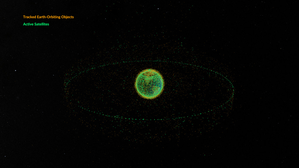
Space debris orbiting the Earth
Légende : This animation shows objects orbiting the Earth. The data date from February 2024 and are taken from space-track.org which maintains a public catalogue of objects tracked by the United States Space Command (USSPACECOM).
At first in this video we see green dots, each representing one of the 31,000 human-made objects orbiting Earth. These include both operational and decommissioned satellites, used rocket stages from space launches, and fragments larger than 10cm created by collisions or explosions. Later in the video, some of the green dots are replace by orange dots, each of these representing one of the 9,300 operational satellites orbiting the Earth. Note that since February 2024 more satellites and rockets have been launched in to space and some objects will have fallen back to Earth, so these numbers will have changed.
We see two main groups of objects. The first are those objects orbiting close to the Earth, objects in low Earth orbit. These include communication satellites (many from the satellite constellations used to provide satellite internet services), Earth observation satellites, military satellites, two operational space stations and other objects such as rocket stages and other debris.
More distant from Earth we see a thin ring of satellites. These are in geostationary orbit. This is a special orbit where the orbital period matches the rotation period of the Earth. This means that a satellite in geostationary orbit stays above the same point on the equator and, when observed from the side of the Earth facing the satellite, will appear to stay at a position on the sky that does not change over time. Because of this, geostationary orbit is used by many communications satellites as a satellite dish on Earth used to receive or transmit a signal to that satellite can point in a fixed direction and does not need to dynamically track the satellite. Geostationary orbit is also used by weather observation satellites.
Crédit : NASA's Scientific Visualization Studio
Lien vers les crédits
License: PD Domaine Public Icônes









- Ressources
- Moteur de recherche des ressources pédagogiques
- Parcourir les ressources pédagogiques par Sujet
- Parcourir les images
- AstroEdu - Activités en classe
- Grandes Idées - Littéracie en astronomie
- Glossaire
- Rapports de l'OAE
- L'astronomie pour l'Education à travers le monde
- Sélection de ressources externes