Glossary term: 航天器
Description: 航天器是為在外太空旅行而建造的飛行器。通常是通過某種火箭發動機推進,向一個方向噴射氣體或等離子體,以向反方向加速。不載人的航天器稱為非載人航天器或機器人航天器,例如用於探索的各種衛星、太空望遠鏡或太空探測器。另一方面,載人航天器需要為其乘員提供生存條件,例如大氣增壓、輻射防護和溫度調節。可以返回地球的航天器稱為可回收航天器;回收後可以再次發射的航天器稱為可重複使用航天器。旨在提供長期基地(如在地球軌道上)的航天器稱為空間站。
Related Terms:
See this term in other languages
Term and definition status: The original definition of this term in English have been approved by a research astronomer and a teacher The translation of this term and its definition is still awaiting approval
This is an automated transliteration of the simplified Chinese translation of this term
The OAE Multilingual Glossary is a project of the IAU Office of Astronomy for Education (OAE) in collaboration with the IAU Office of Astronomy Outreach (OAO). The terms and definitions were chosen, written and reviewed by a collective effort from the OAE, the OAE Centers and Nodes, the OAE National Astronomy Education Coordinators (NAECs) and other volunteers. You can find a full list of credits here. All glossary terms and their definitions are released under a Creative Commons CC BY-4.0 license and should be credited to "IAU OAE".
If you notice a factual or translation error in this glossary term or definition then please get in touch.
In Other Languages
- 阿拉伯語: المركبة الفضائية
- 德語: Raumschiff
- 英語: Spacecraft
- 西班牙語: Nave espacial
- 法語: Vaisseau spatial
- 義大利語: Veicolo spaziale
- 巴西葡萄牙語: Espaçonave
- 簡體中文: 航天器
Related Media
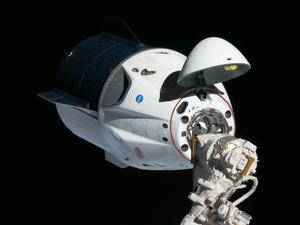
SpaceX“龍”載人飛船
Caption: SpaceX 的“龍”載人飛船是造訪國際空間站(ISS)的第一艘商業載人飛船。圖為“龍”載人飛船在接近國際空間站“和諧號”艙時打開了前錐,露出對接裝置。
Credit: 美國國家航空航天局
License: PD Public Domain icons
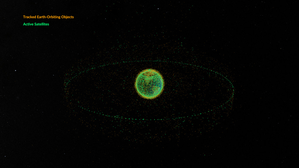
Space debris orbiting the Earth
Caption: This animation shows objects orbiting the Earth. The data date from February 2024 and are taken from space-track.org which maintains a public catalogue of objects tracked by the United States Space Command (USSPACECOM).
At first in this video we see green dots, each representing one of the 31,000 human-made objects orbiting Earth. These include both operational and decommissioned satellites, used rocket stages from space launches, and fragments larger than 10cm created by collisions or explosions. Later in the video, some of the green dots are replace by orange dots, each of these representing one of the 9,300 operational satellites orbiting the Earth. Note that since February 2024 more satellites and rockets have been launched in to space and some objects will have fallen back to Earth, so these numbers will have changed.
We see two main groups of objects. The first are those objects orbiting close to the Earth, objects in low Earth orbit. These include communication satellites (many from the satellite constellations used to provide satellite internet services), Earth observation satellites, military satellites, two operational space stations and other objects such as rocket stages and other debris.
More distant from Earth we see a thin ring of satellites. These are in geostationary orbit. This is a special orbit where the orbital period matches the rotation period of the Earth. This means that a satellite in geostationary orbit stays above the same point on the equator and, when observed from the side of the Earth facing the satellite, will appear to stay at a position on the sky that does not change over time. Because of this, geostationary orbit is used by many communications satellites as a satellite dish on Earth used to receive or transmit a signal to that satellite can point in a fixed direction and does not need to dynamically track the satellite. Geostationary orbit is also used by weather observation satellites.
Credit: NASA's Scientific Visualization Studio
credit link
License: PD Public Domain icons