Glossar-Begriff: Raumschiff
Beschreibung: Ein Raumschiff (oder Raumfahrzeug) ist ein Fahrzeug, das für die Fortbewegung im Weltraum gebaut wird. Es wird üblicherweise durch ein Raketentriebwerk angetrieben, das Gas oder Plasma in eine Richtung ausstößt, um in die entgegengesetzte Richtung zu beschleunigen. Raumschiffe, die keine Menschen an Bord haben, sind unbemannte oder robotische Raumfahrzeuge. Beispiele sind verschiedene Arten von Satelliten, Weltraumteleskopen oder Raumsonden, die zur Erforschung des Weltraums eingesetzt werden. Raumschiffe mit Besatzung hingegen müssen für das Überleben ihrer menschlichen Insassen sorgen: erdähnliche atmosphärische Bedingungen (Luftdruck ähnlich wie auf der Erde), Strahlenschutz und eine geregelte Temperatur. Es gibt wiederverwendbare Raumfahrzeuge, die nach einer Landung auf der Erde weiter benutzt werden können. Ein Raumfahrzeug, das als längerfristige Heimatbasis, z. B. in der Erdumlaufbahn, gedacht ist, wird als Raumstation bezeichnet.
Ähnliche Begriffe:
Dieser Begriff in anderen Sprachen
Begriffs- und Definitionsstatus Die Originaldefinition dieses Begriffes auf Englisch wurden von einem forschenden Astronom und einer Lehrkraft bestätigt Die Übersetzung dieses Begriffs und seiner Definition warten auf Prüfung und Bestätigung
The OAE Multilingual Glossary is a project of the IAU Office of Astronomy for Education (OAE) in collaboration with the IAU Office of Astronomy Outreach (OAO). The terms and definitions were chosen, written and reviewed by a collective effort from the OAE, the OAE Centers and Nodes, the OAE National Astronomy Education Coordinators (NAECs) and other volunteers. You can find a full list of credits here. All glossary terms and their definitions are released under a Creative Commons CC BY-4.0 license and should be credited to "IAU OAE".
Wenn dir ein inhaltlicher oder Übersetzungsfehler in diesem Glossarbegriff oder dieser Definition auffallen, bitte kontaktiere uns.
Auf anderen Sprachen
- Arabisch: المركبة الفضائية
- Englisch: Spacecraft
- Spanisch: Nave espacial
- Französisch: Vaisseau spatial
- Italienisch: Veicolo spaziale
- Brasilianisches Portugiesisch: Espaçonave
- Vereinfachtes Chinesisch: 航天器
- Traditionelles Chinesisch: 航天器
Ähnliche Medien
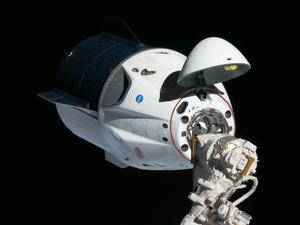
SpaceX Crew Dragon-Raumschiff
Unterschrift: Das SpaceX Crew Dragon-Raumschiff ist das erste kommerzielle Besatzungsfahrzeug, das die Internationale Raumstation (ISS) besucht. Das Bild zeigt es mit geöffneter Bugspitze, die den Andockmechanismus offenbart, während es sich dem Harmony-Modul der Station nähert.
Bild: NASA
License: PD Gemeinfrei Symbole
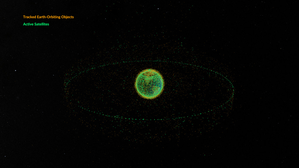
Space debris orbiting the Earth
Unterschrift: This animation shows objects orbiting the Earth. The data date from February 2024 and are taken from space-track.org which maintains a public catalogue of objects tracked by the United States Space Command (USSPACECOM).
At first in this video we see green dots, each representing one of the 31,000 human-made objects orbiting Earth. These include both operational and decommissioned satellites, used rocket stages from space launches, and fragments larger than 10cm created by collisions or explosions. Later in the video, some of the green dots are replace by orange dots, each of these representing one of the 9,300 operational satellites orbiting the Earth. Note that since February 2024 more satellites and rockets have been launched in to space and some objects will have fallen back to Earth, so these numbers will have changed.
We see two main groups of objects. The first are those objects orbiting close to the Earth, objects in low Earth orbit. These include communication satellites (many from the satellite constellations used to provide satellite internet services), Earth observation satellites, military satellites, two operational space stations and other objects such as rocket stages and other debris.
More distant from Earth we see a thin ring of satellites. These are in geostationary orbit. This is a special orbit where the orbital period matches the rotation period of the Earth. This means that a satellite in geostationary orbit stays above the same point on the equator and, when observed from the side of the Earth facing the satellite, will appear to stay at a position on the sky that does not change over time. Because of this, geostationary orbit is used by many communications satellites as a satellite dish on Earth used to receive or transmit a signal to that satellite can point in a fixed direction and does not need to dynamically track the satellite. Geostationary orbit is also used by weather observation satellites.
Bild: NASA's Scientific Visualization Studio
Quellenlink
License: PD Gemeinfrei Symbole