Término del glosario: Núcleo Galáctico Activo
Descripción: Un núcleo galáctico activo (AGN) es una región muy luminosa situada en el centro de una galaxia. Se cree que está alimentado por un agujero negro supermasivo que acreta la materia circundante, formando a su alrededor un disco de acreción extremadamente caliente. Los AGNs tienen estructuras bastante complejas, con muchas regiones diferentes que emiten luz con características distintas, y suelen estar rodeados por un toroide de material polvoriento en forma de una dona. A veces, los AGNs emiten chorros de material en direcciones opuestas. Aunque muchas galaxias tienen un agujero negro supermasivo en el centro, no todas acumulan materia y, por tanto, no todas son AGN.
AGN es un término general que incluye objetos como cuásares, blázares, galaxias Seyfert y radiogalaxias. Se cree que las diferentes propiedades observacionales de estos tipos de objetos se deben en parte a que los AGNs se observan desde ángulos diferentes.
Términos relacionados:
Ver este término en otros idiomas
Estado del término y la definición: La definición original de este término en inglés ha sido aprobada por unastrónomo o astrónoma investigadora y un docente La traducción de este término y su definición aún están pendientes de aprobación
El Glosario multilingüe de la OAE es un proyecto de la Oficina de Astronomía para la Educación de la UAI (OAE) en colaboración con la Oficina de Divulgación de Astronomía de la UAI (OAO). Los términos y definiciones fueron seleccionados, redactados y revisados gracias al esfuerzo colectivo de la OAE, los Centros y Nodos de la OAE, los Coordinadores Nacionales de Educación Astronómica (NAECs) y otros voluntarios. Puedes encontrar una lista completa de créditos aquí. Todos los términos del glosario y sus definiciones se publican bajo la licencia Creative Commons CC BY-4.0 y deben atribuirse a la "IAU OAE".
Si detectas algún error de contenido o de traducción en este término del glosario o en ladefinición, ponte en contacto con nosotros.
En otros idiomas
- Árabe: النواة المجرية النشطة
- Bengalí: সক্রিয় ছায়াপথ কেন্দ্রীণ
- Alemán: Aktiver Galaktischer Kern
- Inglés: Active Galactic Nucleus
- Francés: Noyau actif de galaxie
- Hindi: सक्रिय गैलेक्टिक नाभिक (ऍक्टिव्ह गॅलेक्टिक न्युक्लीअस)
- Italiano: Nucleo galattico attivo
- Japonés: 活動銀河核 (enlace externo)
- Coreano: 활동은하핵
- Maratí: सक्रिय गॅलेक्टिक केंद्रक (ऍक्टिव्ह गॅलेक्टिक न्युक्लीअस)
- Portugués de Brasil: Núcleo Galáctico Ativo
- Chino simplificado: 活动星系核
- Chino tradicional: 活動星系核
Contenidos relacionados

Jet Ejected from the Active Galaxy M87
Pie de foto: A 3000-light-year-long jet streaming from the core of galaxy M87, as captured by the Hubble Space Telescope. The center of this image shows the core of the elliptical galaxy M87 (in the constellation Virgo) which hosts an active galactic nucleus (AGN).
An AGN is a very luminous region around a supermassive black hole. It is powered by matter falling towards the black hole and forming a hot accretion disk. Many galaxies host a supermassive black hole, but not all of them are accreting enough matter to appear as an AGN.
The strong gravity of the supermassive black hole in the heart of M87 has caused a huge jet of charges particles to be flung out from the accretion disk. This extends far out into the galaxy itself, beyond the core region. Here we see the jet as a whitish-blue line which gets wider the further it goes from the core. The light emission we see here is caused by the energetic electrons in the jet interacting with magnetic fields.
Crédito: NASA, ESA, A. Lessing (Stanford University), E. Baltz (Stanford University), M. Shara (AMNH), J. DePasquale (STScI)
enlace de crédito
License: CC-BY-4.0 Creative Commons Reconocimiento 4.0 Internacional (CC BY 4.0) íconos
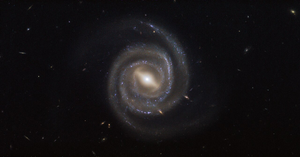
Hubble Image of Barred Spiral Galaxy UGC 6093
Pie de foto: This image from the Hubble Space Telescope shows the barred spiral galaxy UGC 6093. This galaxy has two spiral arms in its outer regions but the inner edge of each arm joins with the outer edge of a straight bar feature that goes across the galaxy's center.
This galaxy has been classified as an active galaxy due to the emissions of certain lines in its spectrum. This indicates that the supermassive black hole that lies in the center of the galaxy is accreting gas from its surroundings. Unlike some active galactic nuclei (AGN), the center of this galaxy does not shine especially brightly in the visible light so its status as an AGN is not immediately visible from this image.
Crédito: ESA/Hubble & NASA
enlace de crédito
License: CC-BY-4.0 Creative Commons Reconocimiento 4.0 Internacional (CC BY 4.0) íconos