Glossary term: Active Galactic Nucleus
Description: An active galactic nucleus (AGN) is a very luminous region at the center of a galaxy. It is thought to be powered by a supermassive black hole which accretes surrounding matter, forming an extremely hot accretion disk around it. AGNs have quite complex structures, with many different regions that emit light with different characteristics, and are often surrounded by a donut-shaped torus of dusty material. An AGN sometimes sends out jets of material in opposite directions. While many galaxies have a supermassive black hole in the center, not all are accreting matter and hence not all are AGN.
AGN is a general term that includes objects such as quasars, blazars, Seyfert galaxies, and radio galaxies. The different observational properties of these types of objects are thought to result in part from AGNs being viewed from different angles.
Related Terms:
See this term in other languages
Term and definition status: This term and its definition have been approved by a research astronomer and a teacher
The OAE Multilingual Glossary is a project of the IAU Office of Astronomy for Education (OAE) in collaboration with the IAU Office of Astronomy Outreach (OAO). The terms and definitions were chosen, written and reviewed by a collective effort from the OAE, the OAE Centers and Nodes, the OAE National Astronomy Education Coordinators (NAECs) and other volunteers. You can find a full list of credits here. All glossary terms and their definitions are released under a Creative Commons CC BY-4.0 license and should be credited to "IAU OAE".
If you notice a factual error in this glossary definition then please get in touch.
In Other Languages
- Arabic: النواة المجرية النشطة
- Bengali: সক্রিয় ছায়াপথ কেন্দ্রীণ
- German: Aktiver Galaktischer Kern
- Spanish: Núcleo Galáctico Activo
- French: Noyau actif de galaxie
- Hindi: सक्रिय गैलेक्टिक नाभिक (ऍक्टिव्ह गॅलेक्टिक न्युक्लीअस)
- Italian: Nucleo galattico attivo
- Japanese: 活動銀河核 (external link)
- Korean: 활동은하핵
- Marathi: सक्रिय गॅलेक्टिक केंद्रक (ऍक्टिव्ह गॅलेक्टिक न्युक्लीअस)
- Brazilian Portuguese: Núcleo Galáctico Ativo
- Simplified Chinese: 活动星系核
- Traditional Chinese: 活動星系核
Related Media

Jet Ejected from the Active Galaxy M87
Caption: A 3000-light-year-long jet streaming from the core of galaxy M87, as captured by the Hubble Space Telescope. The center of this image shows the core of the elliptical galaxy M87 (in the constellation Virgo) which hosts an active galactic nucleus (AGN).
An AGN is a very luminous region around a supermassive black hole. It is powered by matter falling towards the black hole and forming a hot accretion disk. Many galaxies host a supermassive black hole, but not all of them are accreting enough matter to appear as an AGN.
The strong gravity of the supermassive black hole in the heart of M87 has caused a huge jet of charges particles to be flung out from the accretion disk. This extends far out into the galaxy itself, beyond the core region. Here we see the jet as a whitish-blue line which gets wider the further it goes from the core. The light emission we see here is caused by the energetic electrons in the jet interacting with magnetic fields.
Credit: NASA, ESA, A. Lessing (Stanford University), E. Baltz (Stanford University), M. Shara (AMNH), J. DePasquale (STScI)
credit link
License: CC-BY-4.0 Creative Commons Attribution 4.0 International (CC BY 4.0) icons
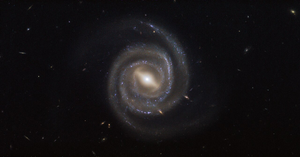
Hubble Image of Barred Spiral Galaxy UGC 6093
Caption: This image from the Hubble Space Telescope shows the barred spiral galaxy UGC 6093. This galaxy has two spiral arms in its outer regions but the inner edge of each arm joins with the outer edge of a straight bar feature that goes across the galaxy's center.
This galaxy has been classified as an active galaxy due to the emissions of certain lines in its spectrum. This indicates that the supermassive black hole that lies in the center of the galaxy is accreting gas from its surroundings. Unlike some active galactic nuclei (AGN), the center of this galaxy does not shine especially brightly in the visible light so its status as an AGN is not immediately visible from this image.
Credit: ESA/Hubble & NASA
credit link
License: CC-BY-4.0 Creative Commons Attribution 4.0 International (CC BY 4.0) icons