Término del glosario: Vía Láctea
Descripción: La Vía Láctea es la galaxia en la que se encuentra el Sistema Solar. Es un conjunto de entre 100 000 y 400 000 millones de estrellas. El Sistema Solar se encuentra a unos 26 600 años luz del centro de la Vía Láctea. En el cielo nocturno podemos verla como una banda tenue que se extiende a lo largo del cielo, con su centro en la constelación de Sagitario.
La Vía Láctea es una galaxia espiral barrada relativamente grande, y la distribución de las estrellas en su interior se extiende a lo largo de unos 100 000 años luz a lo largo del disco, con un espesor de unos 1 000 años luz. El disco galáctico se formó hace entre 8 000 y 10 000 millones de años.
Este disco está rodeado por un halo de estrellas mucho más disperso, que incluye cúmulos globulares. Estos cúmulos globulares se encuentran entre los objetos más antiguos de la Vía Láctea, con edades de unos 12 500 millones de años. Además de las estrellas, la Vía Láctea está compuesta por el gas y el polvo del medio interestelar y por materia oscura. Mientras que el medio interestelar se limita principalmente al disco, el halo de materia oscura que lo rodea se extiende a distancias mucho mayores que el halo estelar.
El centro de la Vía Láctea alberga un agujero negro supermasivo cuya masa es aproximadamente 4 millones de veces la del Sol. Alrededor del centro galáctico hay un bulbo formado principalmente por estrellas más antiguas que se alarga en una dirección, formando una barra.
Términos relacionados:
- Materia oscura
- Bulbo galáctico
- Centro galáctico
- Disco galáctico
- Halo galáctico
- Galaxia
- Zona horaria de Greenwich (GMT)
- Sistema Solar
- Medio interestelar
- Sagitario
Ver este término en otros idiomas
Estado del término y la definición: La definición original de este término en inglés ha sido aprobada por unastrónomo o astrónoma investigadora y un docente La traducción de este término y su definición aún están pendientes de aprobación
El Glosario multilingüe de la OAE es un proyecto de la Oficina de Astronomía para la Educación de la UAI (OAE) en colaboración con la Oficina de Divulgación de Astronomía de la UAI (OAO). Los términos y definiciones fueron seleccionados, redactados y revisados gracias al esfuerzo colectivo de la OAE, los Centros y Nodos de la OAE, los Coordinadores Nacionales de Educación Astronómica (NAECs) y otros voluntarios. Puedes encontrar una lista completa de créditos aquí. Todos los términos del glosario y sus definiciones se publican bajo la licencia Creative Commons CC BY-4.0 y deben atribuirse a la "IAU OAE".
Si detectas algún error de contenido o de traducción en este término del glosario o en ladefinición, ponte en contacto con nosotros.
En otros idiomas
- Árabe: درب التبانة
- Alemán: Milchstraße
- Inglés: Milky Way
- Francés: Voie lactée
- Italiano: Via Lattea
- Japonés: 天の川銀河 (enlace externo)
- Coreano: 은하수
- Portugués de Brasil: Via Láctea
- Chino simplificado: 银河系
- Chino tradicional: 銀河系
Contenidos relacionados
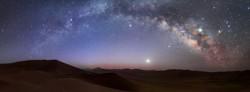
Milky Way Arch over Lut Desert, Iran, by Amirreza Kamkar, Iran (Islamic Republic of)
Pie de foto: Second place in the 2021 IAU OAE Astrophotography Contest, category Wide star fields.
This panoramic dawn image shows the majestic band of the Milky Way – our home Galaxy – made up of a few hundred billion stars, among other structures, most of which are not detectable by our eyes, or in some cases even directly with telescopes. The appearance of the band is because the Milky Way is a disc-shaped galaxy, and we (Earth/Solar System) are situated within the disc.
Diverse cultures and traditions around the world each have their own name and cultural stories for the Milky Way. The dark regions visible in the Milky Way are large, dense, cool nebulae (clouds of dust and gas), which obscure the light from stars in the Milky Way. The Indigenous Australians associate stories with the dark patches of the Milky Way, one of the most prominent being the Emu in the Sky (called Tchingal in Wotjobaluk country). In and around the band of the Milky Way there are a vast range of star clusters, two familiar ones are M6 (Butterfly cluster) and M7 (Ptolemy’s cluster).
The bright point just above the horizon is the planet Venus (known to the Boorong people of Indigenous Australia as Chargee Gnowee, elder sister of the Sun). Within the band of the Milky Way the brightest point in the image is the planet Jupiter (called Ginabongbearp, the Sulphur-crested white cockatoo by the Boorong). The planet Saturn is the bright point between Venus and Jupiter (closer to Venus than Jupiter).
There are two constellations and one asterism that can be easily discerned in the image: Aquila, Scorpio (Maui’s Hook), and Teapot (asterism in Sagittarius). In this image, the center of the Milky Way at an approximate distance of 26,000 light years from Earth, is located roughly to the top right of the Teapot spout.
The bright red-orange point to the right of Jupiter is the red supergiant star Antares and is part of the constellation Scorpio (known as Maui’s Hook in Māori and Polynesian cultures). This variation in the colour of stars is the result of temperature of the stars (lower temperature stars are redder, higher temperatures stars are bluer).
Crédito: Amirreza Kamkar/IAU OAE
License: CC-BY-4.0 Creative Commons Reconocimiento 4.0 Internacional (CC BY 4.0) íconos
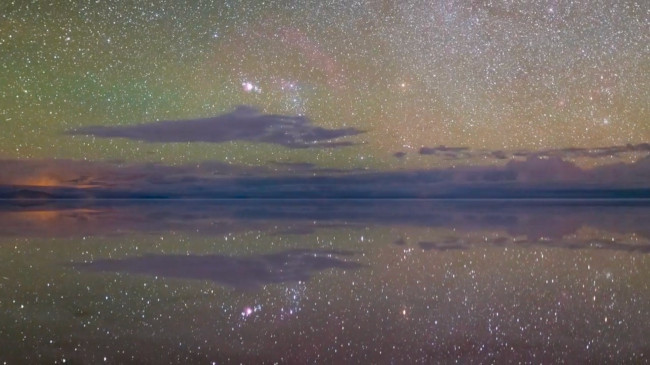
Constellations from the World
Pie de foto: Third place in the 2022 IAU OAE Astrophotography Contest, category Time lapses of celestial patterns.
This video tries to cover a huge variety of phenomena in the night sky from different locations — Iceland and China — and is designed like a theatre play, starring mother nature herself.
It starts with a blue twilight sky that dims and unveils the starry night sky on the stage with terrestrial clouds on a beautiful landscape. The impressive parts of the southern Milky Way between Scorpius and Crux, with the pointer stars Alpha and Beta Centaurus, are shown passing by majestically. The terrestrial clouds blur the stars and allow us to recognise their colours even more clearly.
The first act presents the starry sky in human culture. One scene shows the Pleiades rising over the top of a hill, while a human moves hastily with a flashlight below. At the very moment that the Pleiades rises behind the hill, the beam of the flashlight hits the camera. There is some humour in this remarkable scene referencing the human relationship to the rise of the Pleiades in cultural history.
The next scene shows The Big Dipper, Ursa Major, as a typical northern constellation, with an arch of aurora below it. The aurora evolves and moves but does not change much fundamentally. In northern human cultures, aurorae were often interpreted as the ghosts of ancestors, but this play does not spend any time on human beliefs, instead moving the view southwards in the subsequent scenes. First we see some stars rising shortly before sunrise. The lightcone of Zodiacal light appears in Gemini/Taurus and the horizon gets brighter. In the next scene, at about 1 minute and 13 seconds, we see Orion setting over water, so that the water surface mirrors the celestial scene. Some clouds crossing the image prove that the videos were really taken on our beautiful planet, and, since Orion’s shoulder and foot are seen to set almost simultaneously, this sequence must have been captured almost at the equator. In this area, the bright stars of Orion look like a huge butterfly, with Orion’s Belt forming the body, and the quadrilateral of four bright stars interpreted as the wings.
As in a real theatre, we now see a curtain before the next act of the heavenly play, an aurora curtain. The next act presents several bright stars in original scenes: the Chinese asterisms of The Tail (of the Azure Dragon), the Winnowing Basket and the Southern Dipper, which are seen in the modern constellations Scorpius and Sagittarius. The striking shape of Corona Borealis that has been recognised as an asterism in many cultures all over the globe, is also shown, as are some planets, the stars Vega and Deneb with adjacent areas, Altair, the Milky Way, and the characteristic W shape of Cassiopeia that has also been an asterism for many cultures on Earth.
The outro presents two more scenes with a smooth and silent night sky.
Crédito: Stephanie Ye Ziyi/IAU OAE
License: CC-BY-4.0 Creative Commons Reconocimiento 4.0 Internacional (CC BY 4.0) íconos
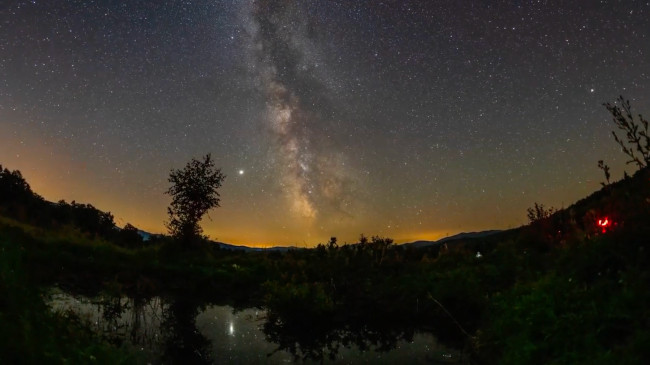
Flowing Night Sky
Pie de foto: Honourable mention in the 2022 IAU OAE Astrophotography Contest, category Time lapses of celestial patterns.
This time-lapse was shot from Slovakia in August 2020. By fixing the relative movement of the sky to Earth's rotation in some of the frames, we can experience a different perspective as a viewer.
The Milky Way, our home galaxy, is visible throughout the whole video. The bright objects near the Milky Way are Jupiter and Saturn, close together, Jupiter being the brighter one.
This video also shows the interaction of amateur astronomers observing the Perseids meteor shower with their telescopes pointed towards the sky. An unfortunate aspect of the art of astronomical observing, clouds can suddenly cover the whole sky. The fog occurs mostly because of the higher humidity after the rain.
Most of the light trails in the sky are made by satellites, but some of them, appearing just very briefly and not very noticeably, are meteors, as the video was shot around the peak of Perseids meteor shower.
Crédito: Robert Barsa/IAU OAE
License: CC-BY-4.0 Creative Commons Reconocimiento 4.0 Internacional (CC BY 4.0) íconos
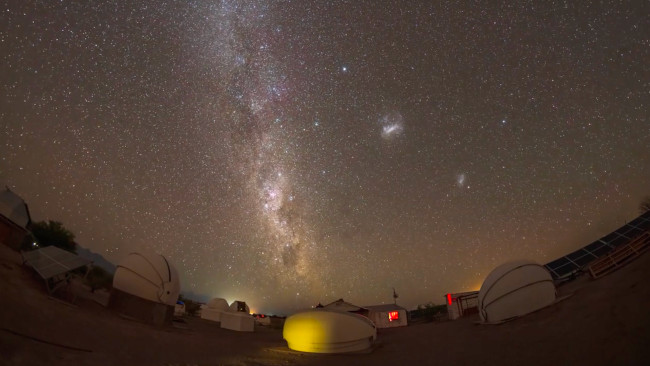
Chilean Nights
Pie de foto: Honourable mention in the 2022 IAU OAE Astrophotography Contest, category Time lapses of celestial patterns.
Shot in December 2020, this time-lapse shows the sky from San Pedro de Atacama, Chile, in the southern hemisphere.
Right in the first frame we can see our home galaxy, the Milky Way, as well as both the Large and Small Magellanic clouds, two satellite galaxies orbiting the Milky Way. In the bottom of the image the bright stars Rigil Kentaurus and Hadar (also known as Alpha and Beta Centauri) are visible, both in the constellation Centaurus. Just above, we can also see the small constellation Crux, visible from the northern tropical circles southwards. It is important for navigation purposes because its longer axis indicates the direction of the celestial south pole. The bright whitish star in the top of the image and to the right of the Galaxy is Canopus, one of the brightest stars in the night sky, located in the constellation Carina. Canopus is the second brightest star in the sky, while Rigil Kentaurus is the third brightest.
In some of the next frames, Orion, the great hunter, appears clearly with its bright stars and its characteristic asterism, the belt, composed of three aligned bright stars. Since this video was taken from the southern hemisphere, the Greek hero from the northern hemisphere seems to be performing a headstand.
We can also see the planets Jupiter and Saturn in a close conjunction, even finding themselves in the significant beam of Zodiacal light setting down below the horizon. There are also a few meteors blinking in some of the frames, one of them with a long-lasting and developing trail. The very bright object rising from behind the volcanoes of the Andes, creating spectacular shadows and crepuscular rays, is the Moon. In the last frame we see the Moon next to Saturn and Jupiter.
Crédito: Robert Barsa/IAU OAE
License: CC-BY-4.0 Creative Commons Reconocimiento 4.0 Internacional (CC BY 4.0) íconos
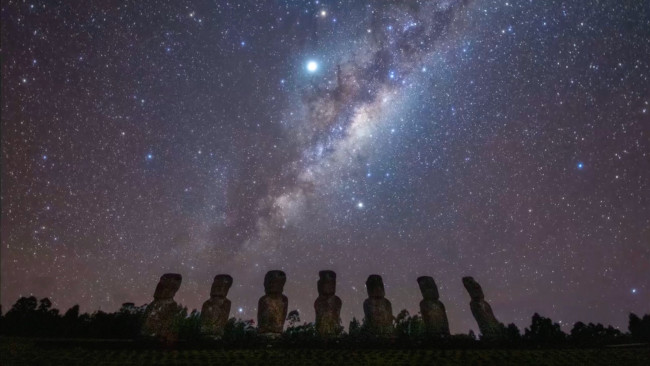
Southern Sky
Pie de foto: First place in the 2022 IAU OAE Astrophotography Contest, category Time lapses of celestial patterns.
This video is a compilation of several recordings taken on various occasions in June 2019, both on Easter Island and in the Atacama Desert in Chile. It starts with an impressive opening of clouds seeming to emerge behind the famous statues on Easter Island and moving directly forwards towards the observer. It evokes the impression of the mighty deities sending clouds to cover the night sky.
In the next couple of scenes, we see landscapes with an impressive Milky Way turning overhead, but this quiet scene is continuously interrupted by hasty satellites or — in one of the scenes — even by car lights on the ground. It illustrates both the majesty of the sky and the disturbance of nature by human influence.
Then there is another scene of clouds passing by, but now from left to right. The terrestrial clouds pass below the clouds of stars that form the Milky Way. The last scene shows an undisturbed still pattern of stars that looks like a flight over a zoomed-in photograph, and shows how we are not used to experiencing nature’s stillness and silence.
Crédito: Jianfeng Dai/IAU OAE
License: CC-BY-4.0 Creative Commons Reconocimiento 4.0 Internacional (CC BY 4.0) íconos
Diagramas relacionados
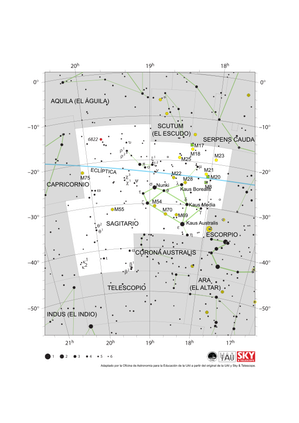
Mapa de la constelación de Sagitario
Pie de foto: La constelación de Sagitario junto con sus estrellas brillantes y las constelaciones circundantes. Sagitario está rodeada por (en el sentido de las agujas del reloj desde arriba) Aquila, Scutum, Serpens Cauda, Ofiuco, Scorpius, Corona Australis, Telescopio, Microscopio y Capricornio. Las estrellas más brillantes de Sagitario dibujan una característica forma de tetera. Sagitario se encuentra en la eclíptica (mostrada aquí como una línea azul), que es la trayectoria que el Sol parece seguir a través del cielo en el transcurso de un año. El Sol está en Sagitario desde mediados de diciembre hasta mediados de enero. Los demás planetas del Sistema Solar se encuentran a menudo en Sagitario.
Sagitario se encuentra al sur del ecuador celeste. La famosa constelación de la tetera es visible en todas las regiones del mundo excepto en las más árticas, pero las partes más meridionales de la constelación no son visibles en las zonas septentrionales de Asia, Europa y Norteamérica. Sagitario es más visible por la noche en verano en el hemisferio norte y en invierno en el hemisferio sur.
El agujero negro supermasivo Sagitario A*, que se encuentra en el centro de nuestra Vía Láctea, está situado en el borde occidental (aquí a la derecha) de Sagitario. Debido a que cubre un área en el centro de nuestra Galaxia, Sagitario alberga muchos cúmulos estelares, incluyendo cúmulos abiertos (marcados aquí con círculos amarillos) y cúmulos globulares (marcados aquí con círculos amarillos con signos + superpuestos). También hay tres nebulosas marcadas aquí con cuadrados verdes.
El eje-y de este diagrama está en grados de declinación con el norte hacia arriba y el eje-x está en horas de ascensión recta con el este a la izquierda. El tamaño de las estrellas marcadas aquí está relacionado con la magnitud aparente de la estrella, una medida de su brillo aparente. Los puntos más grandes representan estrellas más brillantes. Las letras griegas indican las estrellas más brillantes de la constelación. Están ordenadas según su brillo: la estrella más brillante se denomina alfa, la segunda más brillante beta, etc., aunque este orden no siempre se sigue con exactitud. Las líneas punteadas marcan los límites de las constelaciones según la UAI y las líneas verdes continuas marcan una de las formas habituales utilizadas para representar las figuras de las constelaciones. Ni los límites de las constelaciones, ni la línea que marca la eclíptica, ni las líneas que unen las estrellas aparecen en el cielo.
Crédito: Adaptado por la Oficina de Astronomía para la Educación de la UAI a partir del original de UAI/Sky & Telescope
License: CC-BY-4.0 Creative Commons Reconocimiento 4.0 Internacional (CC BY 4.0) íconos
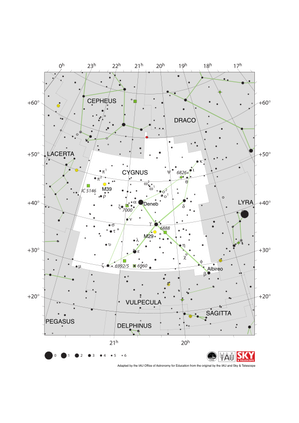
Cygnus Constellation Map
Pie de foto: The constellation Cygnus with its bright stars and surrounding constellations. Cygnus is surrounded by (going clockwise from the top): Cepheus, Draco, Lyra, Vulpecula, Pegasus and Lacerta. Cygnus is notable for its brightest star Deneb. This forms one vertex of the prominent Summer Triangle asterism that is visible in northern hemisphere summer evenings.
Cygnus is a northern constellation and thus the whole of the constellation is visible at some point in the year in the whole northern hemisphere. The whole constellation is also visible from equatorial regions of the southern hemisphere with parts of the constellation visible from temperate southern regions.
The plane of the Milky Way runs through Cygnus and thus the constellation is rich in nebulae and star clusters. These include the North America Nebula (NGC 7000) and the Crescent Nebula (NGC 6888). The Veil Nebula is a huge supernova remnant, parts of which are marked here as NGC 6960 and NGC 6992/5. All of the previously-mentioned nebulae are marked with green squares. The planetary nebula NGC 6826 is marked here with a green circle superimposed on a plus sign. The open star clusters M29 and M39 are marked here with yellow circles.
The y-axis of this diagram is in degrees of declination with north as up and the x-axis is in hours of right ascension with east to the left. The sizes of the stars marked here relate to the star's apparent magnitude, a measure of its apparent brightness. The larger dots represent brighter stars. The Greek letters mark the brightest stars in the constellation. These are ranked by brightness with the brightest star being labeled alpha, the second brightest beta, etc., although this ordering is not always followed exactly. The dotted boundary lines mark the IAU's boundaries of the constellations and the solid green lines mark one of the common forms used to represent the figures of the constellations. Neither the constellation boundaries, nor the lines joining the stars appear on the sky.
Crédito: Adapted by the IAU Office of Astronomy for Education from the original by the IAU and Sky & Telescope
License: CC-BY-4.0 Creative Commons Reconocimiento 4.0 Internacional (CC BY 4.0) íconos
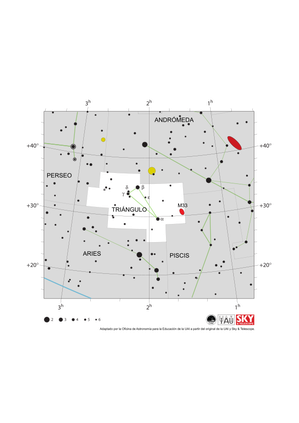
Mapa de la Constelación del Triángulo
Pie de foto: La constelación del Triángulo con sus estrellas brillantes y las constelaciones que la rodean. El Triángulo está rodeado por (en el sentido de las agujas del reloj desde arriba): Andrómeda, Piscis, Aries, y Perseo.
Triángulo es una constelación boreal y, por tanto, toda la constelación es visible en algún momento del año en todo el hemisferio norte. También es visible desde las regiones ecuatoriales y las más templadas del hemisferio sur. El Triángulo se ve mejor al atardecer en invierno en el hemisferio norte y en verano en el hemisferio sur.
La galaxia del Triángulo M33 se encuentra en la constelación. Esta galaxia espiral es el tercer miembro más grande del grupo local de galaxias después de la Galaxia de Andrómeda y la Vía Láctea. Aquí está marcada con una elipse roja.
El eje-y de este diagrama está en grados de declinación con el norte hacia arriba y el eje-x está en horas de ascensión recta con el este a la izquierda. El tamaño de las estrellas marcadas aquí está relacionado con la magnitud aparente de la estrella, una medida de su brillo aparente. Los puntos más grandes representan estrellas más brillantes. Las letras griegas indican las estrellas más brillantes de la constelación. Están ordenadas según su brillo: la estrella más brillante se denomina alfa, la segunda más brillante beta, etc., aunque este orden no siempre se sigue con exactitud. Las líneas punteadas marcan los límites de las constelaciones según la UAI y las líneas verdes continuas marcan una de las formas habituales utilizadas para representar las figuras de las constelaciones. La línea azul de la parte inferior izquierda del diagrama marca la eclíptica. Ni los límites de las constelaciones, ni las líneas que unen las estrellas, ni la eclíptica aparecen en el cielo.
Crédito: Adaptado por la Oficina de Astronomía para la Educación de la UAI a partir del original de la UAI y Sky & Telescope.
License: CC-BY-4.0 Creative Commons Reconocimiento 4.0 Internacional (CC BY 4.0) íconos
Actividades relacionadas

Glitter Your Milky Way
astroEDU educational activity (links to astroEDU website) Description: Explore the Milky Way and characteristics of galaxies using glitter drawing.
License: CC-BY-4.0 Creative Commons Reconocimiento 4.0 Internacional (CC BY 4.0) íconos
Etiquetas:
Art
, Creativity
, Hands-on
, Handcraft
Rango de edades:
6-8
, 8-10
Nivel educativo:
Educación secundaria
, Primaria
Áreas de aprendizaje:
Centrado en las bellas artes
Costos:
Coste medio
Tamaño del grupo:
Grupo
Competencias:
Comunicar información
Living in the Milky Way
astroEDU educational activity (links to astroEDU website) Description: Build a model of the Milky Way to discover what our galaxy contains.
License: CC-BY-4.0 Creative Commons Reconocimiento 4.0 Internacional (CC BY 4.0) íconos
Etiquetas:
Hands-on
, Model
Rango de edades:
6-8
, 8-10
Nivel educativo:
Primaria
Áreas de aprendizaje:
Resolución de problemas
, Aprendizaje basado en la investigación estructurada
Costos:
Coste medio
Duración:
1 hora y 30 minutos
Tamaño del grupo:
Grupo
Competencias:
Plantear preguntas
, Comunicar información
, Desarrollar y utilizar modelos