Glossary term: 은하수
Description: 은하수는 태양계가 속한 은하입니다. 약 1,000억에서 4,000억 개의 별들로 이루어진 은하입니다. 태양계는 은하수 중심에서 약 26,600광년 떨어져 있습니다. 밤하늘을 보면 하늘을 가로지르는 희미한 띠 모양을 볼 수 있는데, 그 중심은 궁수자리에 있습니다.
우리 은하는 비교적 큰 막대나선은하로, 별들이 원반 모양으로 약 10만 광년 넓이에 걸쳐 퍼져 있고, 두께는 약 1,000광년 정도입니다. 은하 원반은 80억~100억 년 전에 형성되었습니다.
은하 원반은 별들이 흩어져 있는 헤일로로 둘러싸여 있으며, 그 안에는 구상성단도 있습니다. 구상성단은 은하에서 가장 오래된 천체 중 하나로, 나이가 약 125억 년에 이릅니다. 우리 은하는 별뿐만 아니라 가스와 먼지같은 성간물질, 그리고 눈에 보이지 않는 암흑 물질도 있습니다. 성간 물질은 대부분 원반에 모여 있지만, 암흑 물질로 이루어진 헤일로는 별로 이루어진 헤일로보다 훨씬 더 멀리까지 뻗어 있습니다.
은하수의 중심부에는 태양 질량의 약 400만 배에 해당하는 초대질량 블랙홀이 있습니다. 은하 중심부를 둘러싼 팽대부에는 오래된 별들이 많이 모여 있으며, 한 쪽으로 길게 뻗어 막대 모양을 이루고 있습니다.
Related Terms:
- 암흑물질
- 은하팽대부
- Galactic Center
- Galactic Disk
- Galactic Halo
- Galaxy
- Greenwich Mean Time Zone (GMT)
- 태양계
- Interstellar Medium
- Sagittarius
See this term in other languages
Term and definition status: The original definition of this term in English have been approved by a research astronomer and a teacher The translation of this term and its definition is still awaiting approval
The OAE Multilingual Glossary is a project of the IAU Office of Astronomy for Education (OAE) in collaboration with the IAU Office of Astronomy Outreach (OAO). The terms and definitions were chosen, written and reviewed by a collective effort from the OAE, the OAE Centers and Nodes, the OAE National Astronomy Education Coordinators (NAECs) and other volunteers. You can find a full list of credits here. All glossary terms and their definitions are released under a Creative Commons CC BY-4.0 license and should be credited to "IAU OAE".
If you notice a factual or translation error in this glossary term or definition then please get in touch.
In Other Languages
- 아랍어: درب التبانة
- 독일어: Milchstraße
- 영어: Milky Way
- 스페인어: Vía Láctea
- 프랑스어: Voie lactée
- 이탈리아어: Via Lattea
- 일본어: 天の川銀河 (external link)
- 브라질 포르투갈어: Via Láctea
- 중국어 간체: 银河系
- 중국어 번체: 銀河系
Related Media
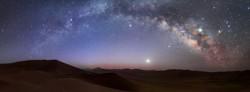
Milky Way Arch over Lut Desert, Iran, by Amirreza Kamkar, Iran (Islamic Republic of)
Caption: Second place in the 2021 IAU OAE Astrophotography Contest, category Wide star fields.
This panoramic dawn image shows the majestic band of the Milky Way – our home Galaxy – made up of a few hundred billion stars, among other structures, most of which are not detectable by our eyes, or in some cases even directly with telescopes. The appearance of the band is because the Milky Way is a disc-shaped galaxy, and we (Earth/Solar System) are situated within the disc.
Diverse cultures and traditions around the world each have their own name and cultural stories for the Milky Way. The dark regions visible in the Milky Way are large, dense, cool nebulae (clouds of dust and gas), which obscure the light from stars in the Milky Way. The Indigenous Australians associate stories with the dark patches of the Milky Way, one of the most prominent being the Emu in the Sky (called Tchingal in Wotjobaluk country). In and around the band of the Milky Way there are a vast range of star clusters, two familiar ones are M6 (Butterfly cluster) and M7 (Ptolemy’s cluster).
The bright point just above the horizon is the planet Venus (known to the Boorong people of Indigenous Australia as Chargee Gnowee, elder sister of the Sun). Within the band of the Milky Way the brightest point in the image is the planet Jupiter (called Ginabongbearp, the Sulphur-crested white cockatoo by the Boorong). The planet Saturn is the bright point between Venus and Jupiter (closer to Venus than Jupiter).
There are two constellations and one asterism that can be easily discerned in the image: Aquila, Scorpio (Maui’s Hook), and Teapot (asterism in Sagittarius). In this image, the center of the Milky Way at an approximate distance of 26,000 light years from Earth, is located roughly to the top right of the Teapot spout.
The bright red-orange point to the right of Jupiter is the red supergiant star Antares and is part of the constellation Scorpio (known as Maui’s Hook in Māori and Polynesian cultures). This variation in the colour of stars is the result of temperature of the stars (lower temperature stars are redder, higher temperatures stars are bluer).
Credit: Amirreza Kamkar/IAU OAE
License: CC-BY-4.0 Creative Commons 저작자표시 4.0 국제 (CC BY 4.0) icons
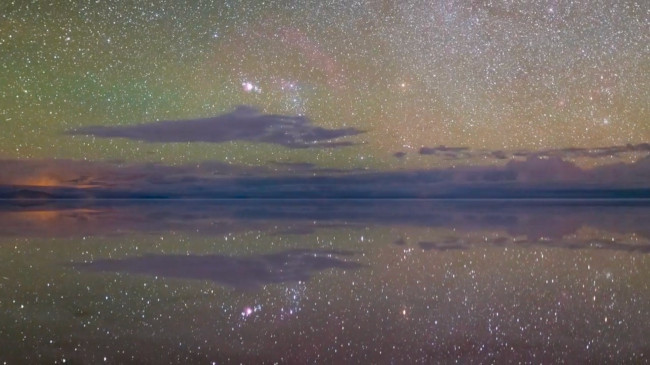
Constellations from the World
Caption: Third place in the 2022 IAU OAE Astrophotography Contest, category Time lapses of celestial patterns.
This video tries to cover a huge variety of phenomena in the night sky from different locations — Iceland and China — and is designed like a theatre play, starring mother nature herself.
It starts with a blue twilight sky that dims and unveils the starry night sky on the stage with terrestrial clouds on a beautiful landscape. The impressive parts of the southern Milky Way between Scorpius and Crux, with the pointer stars Alpha and Beta Centaurus, are shown passing by majestically. The terrestrial clouds blur the stars and allow us to recognise their colours even more clearly.
The first act presents the starry sky in human culture. One scene shows the Pleiades rising over the top of a hill, while a human moves hastily with a flashlight below. At the very moment that the Pleiades rises behind the hill, the beam of the flashlight hits the camera. There is some humour in this remarkable scene referencing the human relationship to the rise of the Pleiades in cultural history.
The next scene shows The Big Dipper, Ursa Major, as a typical northern constellation, with an arch of aurora below it. The aurora evolves and moves but does not change much fundamentally. In northern human cultures, aurorae were often interpreted as the ghosts of ancestors, but this play does not spend any time on human beliefs, instead moving the view southwards in the subsequent scenes. First we see some stars rising shortly before sunrise. The lightcone of Zodiacal light appears in Gemini/Taurus and the horizon gets brighter. In the next scene, at about 1 minute and 13 seconds, we see Orion setting over water, so that the water surface mirrors the celestial scene. Some clouds crossing the image prove that the videos were really taken on our beautiful planet, and, since Orion’s shoulder and foot are seen to set almost simultaneously, this sequence must have been captured almost at the equator. In this area, the bright stars of Orion look like a huge butterfly, with Orion’s Belt forming the body, and the quadrilateral of four bright stars interpreted as the wings.
As in a real theatre, we now see a curtain before the next act of the heavenly play, an aurora curtain. The next act presents several bright stars in original scenes: the Chinese asterisms of The Tail (of the Azure Dragon), the Winnowing Basket and the Southern Dipper, which are seen in the modern constellations Scorpius and Sagittarius. The striking shape of Corona Borealis that has been recognised as an asterism in many cultures all over the globe, is also shown, as are some planets, the stars Vega and Deneb with adjacent areas, Altair, the Milky Way, and the characteristic W shape of Cassiopeia that has also been an asterism for many cultures on Earth.
The outro presents two more scenes with a smooth and silent night sky.
Credit: Stephanie Ye Ziyi/IAU OAE
License: CC-BY-4.0 Creative Commons 저작자표시 4.0 국제 (CC BY 4.0) icons
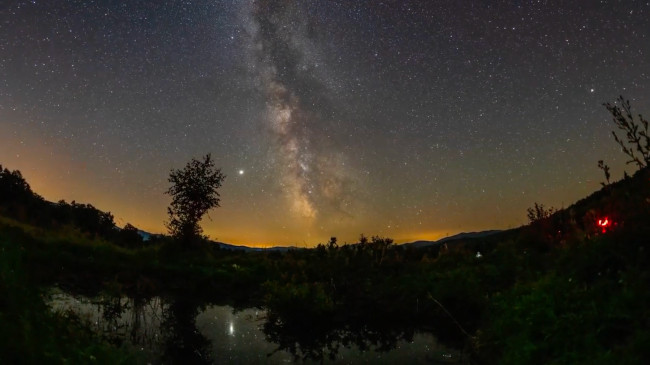
Flowing Night Sky
Caption: Honourable mention in the 2022 IAU OAE Astrophotography Contest, category Time lapses of celestial patterns.
This time-lapse was shot from Slovakia in August 2020. By fixing the relative movement of the sky to Earth's rotation in some of the frames, we can experience a different perspective as a viewer.
The Milky Way, our home galaxy, is visible throughout the whole video. The bright objects near the Milky Way are Jupiter and Saturn, close together, Jupiter being the brighter one.
This video also shows the interaction of amateur astronomers observing the Perseids meteor shower with their telescopes pointed towards the sky. An unfortunate aspect of the art of astronomical observing, clouds can suddenly cover the whole sky. The fog occurs mostly because of the higher humidity after the rain.
Most of the light trails in the sky are made by satellites, but some of them, appearing just very briefly and not very noticeably, are meteors, as the video was shot around the peak of Perseids meteor shower.
Credit: Robert Barsa/IAU OAE
License: CC-BY-4.0 Creative Commons 저작자표시 4.0 국제 (CC BY 4.0) icons
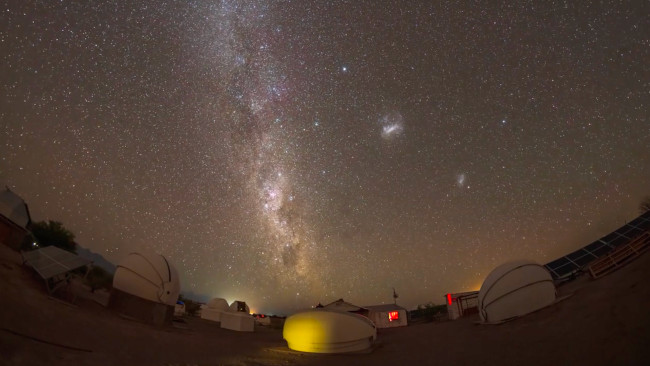
Chilean Nights
Caption: Honourable mention in the 2022 IAU OAE Astrophotography Contest, category Time lapses of celestial patterns.
Shot in December 2020, this time-lapse shows the sky from San Pedro de Atacama, Chile, in the southern hemisphere.
Right in the first frame we can see our home galaxy, the Milky Way, as well as both the Large and Small Magellanic clouds, two satellite galaxies orbiting the Milky Way. In the bottom of the image the bright stars Rigil Kentaurus and Hadar (also known as Alpha and Beta Centauri) are visible, both in the constellation Centaurus. Just above, we can also see the small constellation Crux, visible from the northern tropical circles southwards. It is important for navigation purposes because its longer axis indicates the direction of the celestial south pole. The bright whitish star in the top of the image and to the right of the Galaxy is Canopus, one of the brightest stars in the night sky, located in the constellation Carina. Canopus is the second brightest star in the sky, while Rigil Kentaurus is the third brightest.
In some of the next frames, Orion, the great hunter, appears clearly with its bright stars and its characteristic asterism, the belt, composed of three aligned bright stars. Since this video was taken from the southern hemisphere, the Greek hero from the northern hemisphere seems to be performing a headstand.
We can also see the planets Jupiter and Saturn in a close conjunction, even finding themselves in the significant beam of Zodiacal light setting down below the horizon. There are also a few meteors blinking in some of the frames, one of them with a long-lasting and developing trail. The very bright object rising from behind the volcanoes of the Andes, creating spectacular shadows and crepuscular rays, is the Moon. In the last frame we see the Moon next to Saturn and Jupiter.
Credit: Robert Barsa/IAU OAE
License: CC-BY-4.0 Creative Commons 저작자표시 4.0 국제 (CC BY 4.0) icons
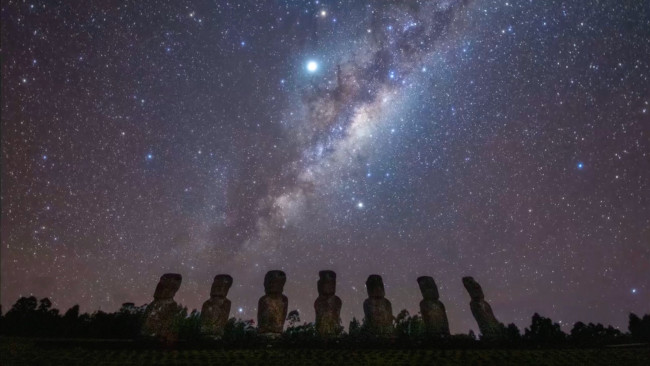
Southern Sky
Caption: First place in the 2022 IAU OAE Astrophotography Contest, category Time lapses of celestial patterns.
This video is a compilation of several recordings taken on various occasions in June 2019, both on Easter Island and in the Atacama Desert in Chile. It starts with an impressive opening of clouds seeming to emerge behind the famous statues on Easter Island and moving directly forwards towards the observer. It evokes the impression of the mighty deities sending clouds to cover the night sky.
In the next couple of scenes, we see landscapes with an impressive Milky Way turning overhead, but this quiet scene is continuously interrupted by hasty satellites or — in one of the scenes — even by car lights on the ground. It illustrates both the majesty of the sky and the disturbance of nature by human influence.
Then there is another scene of clouds passing by, but now from left to right. The terrestrial clouds pass below the clouds of stars that form the Milky Way. The last scene shows an undisturbed still pattern of stars that looks like a flight over a zoomed-in photograph, and shows how we are not used to experiencing nature’s stillness and silence.
Credit: Jianfeng Dai/IAU OAE
License: CC-BY-4.0 Creative Commons 저작자표시 4.0 국제 (CC BY 4.0) icons
Related Diagrams
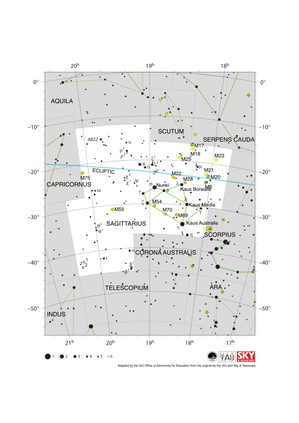
Sagittarius Constellation Map
Caption: The constellation Sagittarius along with its bright stars and surrounding constellations. Sagittarius is surrounded by (going clockwise from the top) Aquila, Scutum, Serpens Cauda, Ophiuchus, Scorpius, Corona Australis, Telescopium, Microscopium and Capricornus. The brighter stars in Sagittarius form a distinctive teapot shape. Sagittarius lies on the ecliptic (shown here as a blue line), this is the path the Sun appears to take across the sky over the course of a year. The Sun is in Sagittarius from mid December to mid January. The other planets of the Solar System can often be found in Sagittarius.
Sagittarius lies south of the celestial equator. The famous teapot asterism is visible for all but the most arctic regions of the world but the most southerly parts of the constellation are not visible in northern parts of Asia, Europe and North America. Sagittarius is most visible in the evenings in the northern hemisphere summer and southern hemisphere winter.
The supermassive black hole Sagittarius A* which lies at the center of our Milky Way Galaxy is sits on the western (here right-hand) edge of Sagittarius. Due to it covering an area at the center of our Galaxy, Sagittarius is home to many star clusters including open clusters (marked here with yellow circles) and globular clusters (marked here with yellow circles with + signs superimposed on them). Three nebulae are also marked here with green squares.
The y-axis of this diagram is in degrees of declination with north as up and the x-axis is in hours of right ascension with east to the left. The sizes of the stars marked here relate to the star's apparent magnitude, a measure of its apparent brightness. The larger dots represent brighter stars. The Greek letters mark the brightest stars in the constellation. These are ranked by brightness with the brightest star being labeled alpha, the second brightest beta, etc., although this ordering is not always followed exactly. The dotted boundary lines mark the IAU's boundaries of the constellations and the solid green lines mark one of the common forms used to represent the figures of the constellations. Neither the constellation boundaries, nor the line marking the ecliptic, nor the lines joining the stars appear on the sky.
Credit: Adapted by the IAU Office of Astronomy for Education from the original by IAU/Sky & Telescope
License: CC-BY-4.0 Creative Commons 저작자표시 4.0 국제 (CC BY 4.0) icons
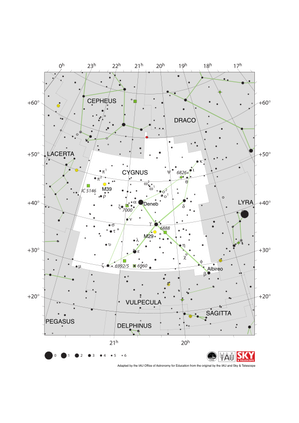
Cygnus Constellation Map
Caption: The constellation Cygnus with its bright stars and surrounding constellations. Cygnus is surrounded by (going clockwise from the top): Cepheus, Draco, Lyra, Vulpecula, Pegasus and Lacerta. Cygnus is notable for its brightest star Deneb. This forms one vertex of the prominent Summer Triangle asterism that is visible in northern hemisphere summer evenings.
Cygnus is a northern constellation and thus the whole of the constellation is visible at some point in the year in the whole northern hemisphere. The whole constellation is also visible from equatorial regions of the southern hemisphere with parts of the constellation visible from temperate southern regions.
The plane of the Milky Way runs through Cygnus and thus the constellation is rich in nebulae and star clusters. These include the North America Nebula (NGC 7000) and the Crescent Nebula (NGC 6888). The Veil Nebula is a huge supernova remnant, parts of which are marked here as NGC 6960 and NGC 6992/5. All of the previously-mentioned nebulae are marked with green squares. The planetary nebula NGC 6826 is marked here with a green circle superimposed on a plus sign. The open star clusters M29 and M39 are marked here with yellow circles.
The y-axis of this diagram is in degrees of declination with north as up and the x-axis is in hours of right ascension with east to the left. The sizes of the stars marked here relate to the star's apparent magnitude, a measure of its apparent brightness. The larger dots represent brighter stars. The Greek letters mark the brightest stars in the constellation. These are ranked by brightness with the brightest star being labeled alpha, the second brightest beta, etc., although this ordering is not always followed exactly. The dotted boundary lines mark the IAU's boundaries of the constellations and the solid green lines mark one of the common forms used to represent the figures of the constellations. Neither the constellation boundaries, nor the lines joining the stars appear on the sky.
Credit: Adapted by the IAU Office of Astronomy for Education from the original by the IAU and Sky & Telescope
License: CC-BY-4.0 Creative Commons 저작자표시 4.0 국제 (CC BY 4.0) icons
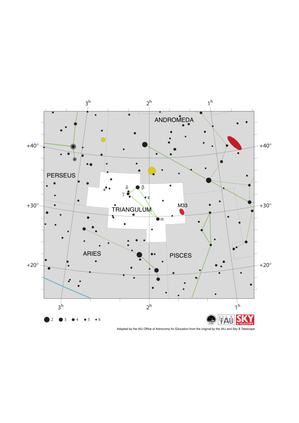
Triangulum Constellation Map
Caption: The constellation Triangulum with its bright stars and surrounding constellations. Triangulum is surrounded by (going clockwise from the top): Andromeda, Pisces, Aries and Perseus.
Triangulum is a northern constellation and thus the whole constellation is visible at some point in the year throughout the northern hemisphere. The whole constellation is also visible from equatorial and most temperate regions of the southern hemisphere. Triangulum is best viewed in the evening in the northern hemisphere winter and southern hemisphere summer.
The Triangulum Galaxy M33 lies in the constellation. This spiral galaxy is the third largest member of the local group of galaxies after the Andromeda Galaxy and Milky Way. It is marked here with a red ellipse.
The y-axis of this diagram is in degrees of declination with north as up and the x-axis is in hours of right ascension with east to the left. The sizes of the stars marked here relate to the star's apparent magnitude, a measure of its apparent brightness. The larger dots represent brighter stars. The Greek letters mark the brightest stars in the constellation. These are ranked by brightness with the brightest star being labeled alpha, the second brightest beta, etc., although this ordering is not always followed exactly. The dotted boundary lines mark the IAU's boundaries of the constellations and the solid green lines mark one of the common forms used to represent the figures of the constellations. The blue line at the bottom left of the diagram marks the ecliptic. Neither the constellation boundaries, nor the lines joining the stars, nor the ecliptic, appear on the sky.
Credit: Adapted by the IAU Office of Astronomy for Education from the original by the IAU and Sky & Telescope
License: CC-BY-4.0 Creative Commons 저작자표시 4.0 국제 (CC BY 4.0) icons
Related Activities

Glitter Your Milky Way
astroEDU educational activity (links to astroEDU website) Description: Explore the Milky Way and characteristics of galaxies using glitter drawing.
License: CC-BY-4.0 Creative Commons 저작자표시 4.0 국제 (CC BY 4.0) icons
Tags:
Art
, Creativity
, Hands-on
, Handcraft
Age Ranges:
6-8
, 8-10
Education Level:
Middle School
, Primary
Areas of Learning:
Fine Art focussed
Costs:
Medium Cost
Group Size:
Group
Skills:
Communicating information
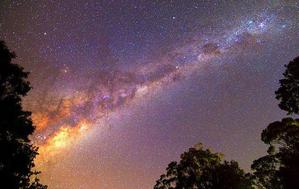
Living in the Milky Way
astroEDU educational activity (links to astroEDU website) Description: Build a model of the Milky Way to discover what our galaxy contains.
License: CC-BY-4.0 Creative Commons 저작자표시 4.0 국제 (CC BY 4.0) icons
Tags:
Hands-on
, Model
Age Ranges:
6-8
, 8-10
Education Level:
Primary
Areas of Learning:
Problem-solving
, Structured-inquiry learning
Costs:
Medium Cost
Duration:
1 hour 30 mins
Group Size:
Group
Skills:
Asking questions
, Communicating information
, Developing and using models