This page describes an image Karte des Sternbilds Schlangenträger
Datei runterladen ( Bild 189.91 kB)
PDF Datei runterladen (PDF file 116.83 kB)
Untertitel Diagramm:
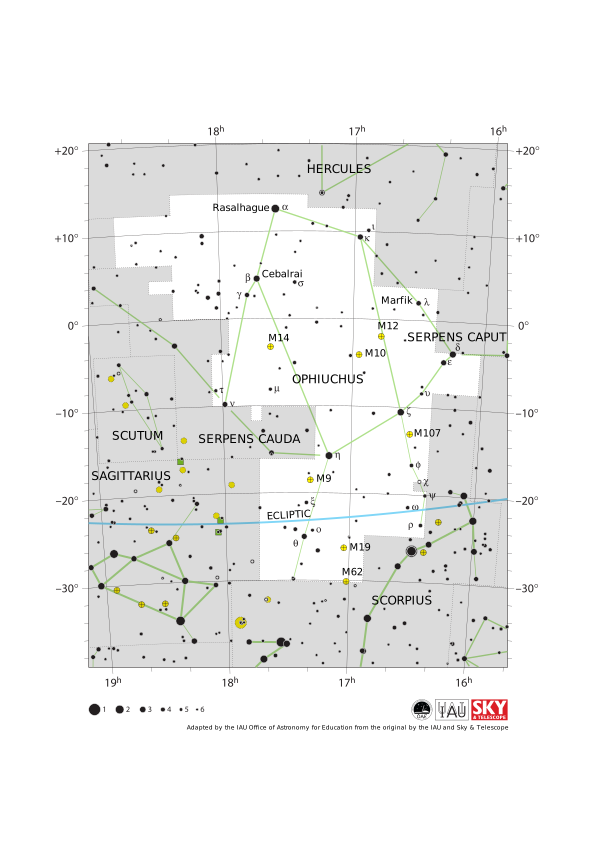
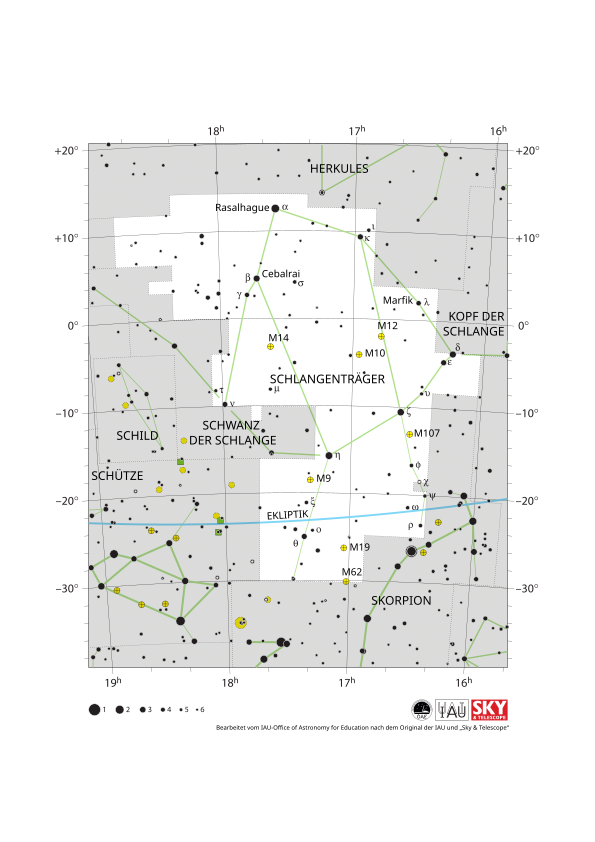
Das Sternbild Schlangenträger (lateinisch Ophiuchus) mit seinen hellen Sternen und den umliegenden Sternbildern. Der Schlangenträger ist umgeben von (im Uhrzeigersinn von oben beginnend): Herkules, Kopf der Schlange, Skorpion, Schütze und Schwanz der Schlange. der Schlangenträger gehört zwar nicht zu den traditionellen zwölf Tierkreiszeichen, liegt jedoch auf der Ekliptik (hier als blaue Linie dargestellt), dies ist die Bahn, die die Sonne im Laufe eines Jahres scheinbar am Himmel zurücklegt. Die Sonne befindet sich von Ende November bis Mitte Dezember im Ophiuchus. Da die Planeten des Sonnensystems der Ekliptik folgen, sind sie regelmäßig auch im Sternbild Schlangenträger zu finden.
Der Schlangenträger erstreckt sich über den Himmelsäquator, sodass ein Teil des Sternbilds zu einem Zeitpunkt des Jahres von der gesamten Erde aus sichtbar ist. Während der Zeit, in der es abends am besten sichtbar ist (im Winter der südlichen Hemisphäre und im Sommer der nördlichen Hemisphäre), herrscht jedoch in weiten Teilen der Arktis ewiges Tageslicht, sodass die Sterne des Sternbilds von dort nicht zu sehen sind. Das gesamte Sternbild ist von den äquatorialen und gemäßigten Regionen beider Hemisphären aus sichtbar.
Da Ophiuchus nahe am galaktischen Zentrum liegt, enthält es viele Kugelsternhaufen wie M9, M10, M12, M14, M19, M62 und M107. Diese sind als gelbe Kreise mit überlagerten Pluszeichen gekennzeichnet.
Die y-Achse dieses Diagramms zeigt die Deklination in Grad, wobei Norden oben liegt, und die x-Achse zeigt die Rektaszension in Stunden mit Osten nach links. Die Größe der hier dargestellten Sterne bezieht sich auf deren scheinbare Helligkeit, ein Maß für die ankommende Strahlungsintensität. Die größeren Punkte repräsentieren hellere Sterne. Die griechischen Buchstaben kennzeichnen die hellsten Sterne des Sternbilds. Diese sind nach Helligkeit geordnet, wobei der hellste Stern mit Alpha bezeichnet wird, der zweithellste mit Beta usw. – wobei diese Reihenfolge nicht immer exakt eingehalten wird. Die gepunkteten Grenzlinien markieren die offiziellen Sternbildgrenzen der IAU, und die durchgezogenen grünen Linien zeigen eine der üblichen Formen, um die Figuren der Sternbilder darzustellen. Weder die Sternbildgrenzen noch die Verbindungslinien zwischen den Sternen sind am realen Himmel zu sehen.
Quelle Diagramm: Bearbeitet vom IAU-Office of Astronomy for Education nach dem Original der IAU und „Sky & Telescope“. Link zur Quelle
Diagramm Übersetzungsstatus: Noch nicht bestätigt von einer*einem Rezensent*in
Diagramm-Übersetzer*in: Simon Kraus
Diagramm-Lizenz: Creative Commons Namensnennung 4.0 International (CC BY 4.0) Creative Commons Namensnennung 4.0 International (CC BY 4.0) Symbole
Ähnliche Glossarbegriffe:
Deklination
, Ekliptik
, Galaktisches Zentrum
, Himmelskoordinaten
, Himmelsäquator
, Kugelsternhaufen
, Rektaszension (RA)
, Scheinbare Helligkeit
, Schütze
, Skorpion
, Sternbild
, Tierkreis
Kategorien:
Astronomie mit bloßem Auge
Möchtest du deine eigene Übersetzung oder Version dieses Diagrammes erstellen? Dann downloade die SVG
Version dieses Diagrammes auf Englisch (645.66 kB). Du kannst diese Version mit Programmen wie Inkscape (kostenlos) oder Adobe Illustrator (kostenpflichtig) bearbeiten. Bitte verweise dennoch auf die*den originale*n Autor*in.
Du kannst Deine eigene Version oder Übersetzung dieses Diagrammes erstellen, indem du einer textlosen Version dieses Diagrammes eigenen Text zufügst.
Downloade einfach eine dieser Dateien:
Download Text-Free File ( Bild 121.92 kB)
Download Text-Free PDF File (PDF file 179.62 kB)
Auf anderen Sprachen
Englisch: Ophiuchus Constellation MapItalienisch: Mappa della costellazione dell'Ofiuco
Spanisch: Mapa de la constelación de Ofiuco
Traditionelles Chinesisch: 蛇夫座星圖
Vereinfachtes Chinesisch: 蛇夫座星图
Nepali: सर्पवाहक (ओफियकस) तारामण्डल नक्शा
Die Diagramm-Unterschriften auf der OAE-Website wurden geschrieben, übersetzt und bestätigt durch einen kollektiven Aufwand vom OAE, dem OAE Zentren und Knotenpunkte, dem OAE Nationale astronomische Bildungskoordinator*innen (NAECs) und anderen Freiwilligen. Du findest eine volle Liste der Mitarbeitenden für unser Übersetzungsprojekt here. Alle Mediendatei-Unterschriften werden veröffentlicht unter Creative Commons CC BY-4.0 license und sollten "IAU OAE" zugeschrieben werden.Die Mediendateien selbst können andere Lizenzen haben (siehe oben), und sollten Quellenverweise erhalten wie oben aufgelistet "credit".
Sollte dir ein Fehler in diesem Diagramm oder seiner Unterschrift auffallen, bitte kontaktiere uns.