Glossar-Begriff: Scheinbare Helligkeit
Beschreibung: Die scheinbare Helligkeit ist ein Maß dafür, wie hell ein Himmelskörper einem Beobachter erscheint. Sie wird als Magnitude (mag) angegeben, einer Zahl auf einer logarithmischen Skala, wobei ein Unterschied von 5 Magnituden einem Faktor von 100 in der gemessenen Helligkeit entspricht. Aus historischen Gründen haben weniger helle Objekte größere Zahlen auf der Magnitudenskala.
Es gibt viele Magnitudenskalen, da die Helligkeit bei verschiedenen Wellenlängen und mit verschiedenen Techniken gemessen werden kann. Die Skala der "visuellen Helligkeit" ist so eingestellt, dass der helle Stern Wega eine scheinbare Helligkeit von Null hat. Auf dieser Skala hat Sirius, der hellste Stern am Nachthimmel, eine Helligkeit von -1,46. Die Helligkeit der Sonne und des Vollmondes beträgt -26,7 bzw. -12,7. Die negativen Zahlen bedeuten, dass diese Objekte heller erscheinen als Wega. Unter sehr dunklen Bedingungen können Menschen mit ausgezeichnetem Sehvermögen Sterne mit einer visuellen Helligkeit von bis zu 6 mag sehen. Das Hubble Ultra Deep Field erreicht eine visuelle Helligkeit von etwa 31. Das ist etwa 100 hoch 5 oder 10.000.000.000 Mal weniger hell als die Magnitude 6.
Ähnliche Begriffe:
Dieser Begriff in anderen Sprachen
Begriffs- und Definitionsstatus Die Originaldefinition dieses Begriffes auf Englisch wurden von einem forschenden Astronom und einer Lehrkraft bestätigt Die Übersetzung dieses Begriffs und seiner Definition warten auf Prüfung und Bestätigung
The OAE Multilingual Glossary is a project of the IAU Office of Astronomy for Education (OAE) in collaboration with the IAU Office of Astronomy Outreach (OAO). The terms and definitions were chosen, written and reviewed by a collective effort from the OAE, the OAE Centers and Nodes, the OAE National Astronomy Education Coordinators (NAECs) and other volunteers. You can find a full list of credits here. All glossary terms and their definitions are released under a Creative Commons CC BY-4.0 license and should be credited to "IAU OAE".
Wenn dir ein inhaltlicher oder Übersetzungsfehler in diesem Glossarbegriff oder dieser Definition auffallen, bitte kontaktiere uns.
Auf anderen Sprachen
- Arabisch: القدرالظاهري
- Englisch: Apparent Magnitude
- Spanisch: Magnitud Aparente
- Französisch: Magnitude apparente
- Italienisch: Magnitudine apparente
- Japanisch: 見かけの等級 (externer Link)
- Brasilianisches Portugiesisch: Magnitude aparente
- Vereinfachtes Chinesisch: 视星等
- Traditionelles Chinesisch: 視星等
Ähnliche Diagramme

Andromeda-Sternbildkarte
Unterschrift: Das Sternbild Andromeda mit den hellen Sternen und den umliegenden Sternbildern. Andromeda ist im Uhrzeigersinn von oben aus gehend umgeben von Kassiopeia, Eidechse, Pegasus, Fische, Widder, Dreieck und Perseus. Der hellste Stern in Andromeda (Alpheratz) befindet sich im unteren Teil des Sternbildes. Zusammen mit drei Sternen im Pegasus bildet er die Sterngruppe, die als "Großes Quadrat des Pegasus" bekannt ist. Die nächsten beiden hellen Sterne im Sternbild (Mirach und Almach) bilden eine Linie, die sich von Alpheratz aus nach Nordosten erstreckt.
Andromeda ist ein nördliches Sternbild und am besten abends im Herbst auf der Nordhalbkugel zu sehen. Es ist von der gesamten nördlichen Hemisphäre und den meisten gemäßigten Regionen der südlichen Hemisphäre aus sichtbar, jedoch nicht von den antarktischen und subantarktischen Regionen aus.
Das berühmteste Objekt in Andromeda, die Andromedagalaxie, ist hier mit einer roten Ellipse und der Messier-Katalognummer M31 gekennzeichnet.
Der gelbe Kreis auf der linken Seite markiert die Position des offenen Sternhaufens NGC 752 und der grüne Kreis auf der rechten Seite markiert NGC 7662 (den blauen Schneeballnebel), einen planetarischen Nebel.
Die y-Achse dieses Diagramms ist in Deklinationsgraden mit Norden nach oben und die x-Achse in Stunden der Rektaszension mit Osten nach links angegeben. Die Größe der hier markierten Sterne bezieht sich auf die scheinbare Helligkeit des Sterns. Je größer die Punkte, desto heller scheinen die Sterne die sie darstellen. Die griechischen Buchstaben kennzeichnen die hellsten Sterne des Sternbildes. Diese sind nach Helligkeit geordnet, wobei der hellste Stern mit Alpha, der zweithellste mit Beta usw. bezeichnet wird, obwohl diese Reihenfolge nicht immer genau eingehalten wird. Die gepunkteten Begrenzungslinien markieren die IAU-Grenzen der Sternbilder und die durchgezogenen grünen Linien markieren eine der üblichen Formen, die zur Darstellung der Sternbilder verwendet werden. Weder die Grenzen der Sternbilder noch die Linien, die die Sterne verbinden, sind so am Himmel sichtbar.
Bild: Angepasst vom IAU Office of Astronomy for Education nach dem Original von IAU/Sky & Telescope
License: CC-BY-4.0 Creative Commons Namensnennung 4.0 International (CC BY 4.0) Symbole
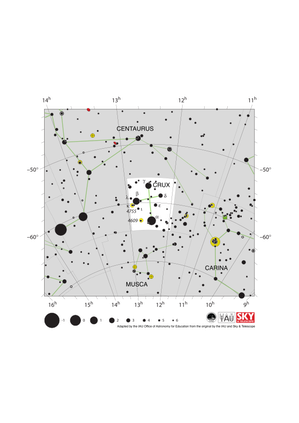
Crux Constellation Map
Unterschrift: The constellation Crux (commonly known as the Southern Cross or Crux Australis) showing its bright stars and surrounding constellations. The Southern Cross is surrounding by (going clockwise from the top) Centaurus, Carina and Musca. The brightest star is alpha Crucis which appears at the bottom of the constellation's famous kite shape. The Southern Cross is visible from southern and equatorial regions of the world. In more southerly parts of the world it is circumpolar so is always above the horizon. In other parts of the southern hemisphere and in equatorial regions it is most visible in the evenings in the southern hemisphere autumn.
The yellow circles show the locations of two open clusters, NGC 4755 (known as the Jewel Box) and NGC 4609.
The line joining gamma and alpha Crucis (the third and first brightest stars in the Southern Cross) points in the approximate direction of the South Celestial Pole. This has led to the Southern Cross playing an important role in celestial navigation, allowing navigators from different astronomical traditions to find their bearings.
The y-axis of this diagram is in degrees of declination with north as up and the x-axis is in hours of right ascension with east to the left. The sizes of the stars marked here relate to the star's apparent magnitude, a measure of its apparent brightness. The larger dots represent brighter stars. The Greek letters mark the brightest stars in the constellation. These are ranked by brightness with the brightest star being labeled alpha, the second brightest beta, etc., although this ordering is not always followed exactly. The dotted boundary lines mark the IAU's boundaries of the constellations and the solid green lines mark one of the common forms used to represent the figures of the constellations. Neither the constellation boundaries, nor the lines joining the stars appear on the sky.
Bild: Adapted by the IAU Office of Astronomy for Education from the original by IAU/Sky & Telescope.
License: CC-BY-4.0 Creative Commons Namensnennung 4.0 International (CC BY 4.0) Symbole

Orion-Sternkarte
Unterschrift: Das Sternbild Orion mit seinen hellen Sternen und den umliegenden Sternbildern. Im Uhrzeigersinn von Oben ist Orion umgeben von dem Stier, Eridanus, dem Hasen, dem Einhorn und Zwilling. Die hellsten Sterne des Orion, Betelgeuze und Rigel, befinden sich am nördlichen (in dieser Abbildung oberen) bzw. südlichen (unteren) Ende des Sternbilds, mit dem berühmten Dreisternegürtel in der Mitte.
Orion erstreckt sich über den Himmelsäquator und ist daher im Laufe des Jahres irgendwann von der gesamten Erde aus sichtbar. In den arktischen oder antarktischen Regionen der Welt sind einige Teile des Sternbilds möglicherweise nicht sichtbar. Orion ist am besten Abends im Winter auf der Nordhalbkugel und im Sommer auf der Südhalbkugel zu sehen. Die blaue Linie über Orion markiert die Ekliptik, also den Weg, den die Sonne im Laufe eines Jahres über den Himmel zu gehen scheint. Die Sonne läuft nie durch den Orion, aber man kann gelegentlich die anderen Planeten des Sonnensystems und den Mond im Orion finden.
Direkt südlich des Gürtels des Orion liegen die beiden Messier-Objekte M42 (der Orionnebel) und M43, die durch grüne Quadrate gekennzeichnet sind. Diese Nebel sind zusammen mit M78 (hier das grüne Quadrat links vom Gürtel) Teil des riesigen Orion-Molekülwolkenkomplexes. Dieser erstreckt sich über den größten Teil des Sternbilds und umfasst Regionen, in denen diese Molekülwolken kollabieren und junge Sterne bilden.
Die y-Achse dieses Diagramms ist in Deklinationsgraden mit Norden nach oben und die x-Achse in Rektaszensionsstunden mit Osten nach links angegeben. Die Größe der hier markierten Sterne bezieht sich auf die scheinbare Helligkeit des Sterns. Je größer die Punkte, desto heller scheinen die Sterne die sie darstellen. Die griechischen Buchstaben kennzeichnen die hellsten Sterne des Sternbildes. Sie sind nach Helligkeit geordnet, wobei der hellste Stern mit Alpha, der zweithellste mit Beta usw. bezeichnet wird, obwohl diese Reihenfolge nicht immer genau eingehalten wird. Der Kreis um Betelgeuse zeigt an, dass es sich um einen veränderlichen Stern handelt. Die gepunkteten Begrenzungslinien markieren die IAU-Grenzen der Sternbilder und die durchgezogenen grünen Linien markieren eine der üblichen Formen, die zur Darstellung der Sternbilder verwendet werden. Weder die Sternbildgrenzen noch die Linie, die die Ekliptik markiert, noch die Linien, die die Sterne miteinander verbinden, sind so am Himmel sichtbar.
Bild: Angepasst vom IAU Office of Astronomy for Education nach dem Original von IAU/Sky & Telescope
License: CC-BY-4.0 Creative Commons Namensnennung 4.0 International (CC BY 4.0) Symbole
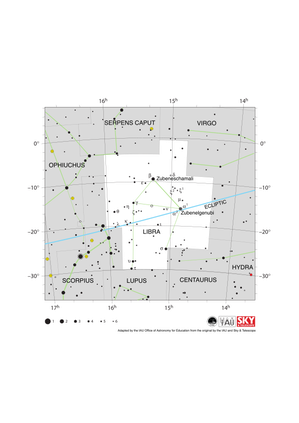
Libra Constellation Map
Unterschrift: The constellation Libra along with its bright stars and surrounding constellations. Libra is surrounded by (going clockwise from the top) Serpens Caput, Virgo, Hydra, Centaurus, Lupus, Scorpius and Ophiuchus. Libra lies on the ecliptic (shown here as a blue line), this is the path the Sun appears to take across the sky over the course of a year. The Sun is in Libra from late October to late November. The other planets of the Solar System can often be found in Libra.
Libra lies just south of the celestial equator and is thus visible at some time in all but the most arctic regions. Libra is most visible in the evenings in the northern hemisphere late spring/early summer and southern hemisphere late autumn/early winter.
The y-axis of this diagram is in degrees of declination with north as up and the x-axis is in hours of right ascension with east to the left. The sizes of the stars marked here relate to the star's apparent magnitude, a measure of its apparent brightness. The larger dots represent brighter stars. The Greek letters mark the brightest stars in the constellation. These are ranked by brightness with the brightest star being labeled alpha, the second brightest beta, etc., although this ordering is not always followed exactly. The dotted boundary lines mark the IAU's boundaries of the constellations and the solid green lines mark one of the common forms used to represent the figures of the constellations. Neither the constellation boundaries, nor the line marking the ecliptic, nor the lines joining the stars appear on the sky.
Bild: Adapted by the IAU Office of Astronomy for Education from the original by IAU/Sky & Telescope
License: CC-BY-4.0 Creative Commons Namensnennung 4.0 International (CC BY 4.0) Symbole
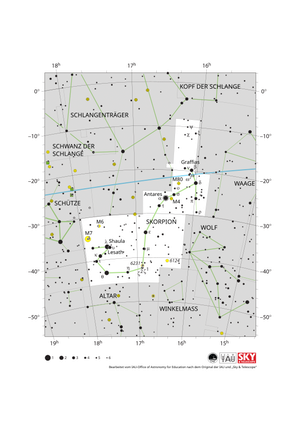
Karte des Sternbilds Skorpion
Unterschrift: Das Sternbild Skorpion (lateinisch Scorpio) mit seinen hellen Sternen und den umliegenden Sternbildern. Der Skorpion ist umgeben von (im Uhrzeigersinn von oben beginnend) dem Schlangenträger, dem Kopf der Schlange, der Waage, dem Wolf, dem Winkelmaß, dem Altar, der südlichen Krone und dem Schützen. Der hellste Stern des Skorpions, Antares, befindet sich im Herzen des Sternbilds, während sich der berühmte Schwanz des Skorpions nach Südosten (unten links) erstreckt. Der Skorpion liegt auf der Ekliptik (hier als blaue Linie dargestellt); dies ist die Bahn, die die Sonne im Laufe eines Jahres scheinbar am Himmel zurücklegt. Die Sonne verbringt nur eine kurze Zeit Ende November im Sternbild Skorpion. Die Planeten des Sonnensystems sind regelmäßig im Skorpion zu finden.
Der Skorpion liegt südlich des Himmelsäquators. Das gesamte Sternbild ist von den arktischen Regionen der Erde aus nicht sichtbar. Für Beobachter in den nördlichen Teilen Asiens, Europas und Nordamerikas sind Teile des Skorpions verdeckt. Der Skorpion ist am besten abends im Sommer der nördlichen Hemisphäre und im Winter der südlichen Hemisphäre zu sehen.
Die gelben Kreise markieren die Positionen der offenen Sternhaufen M6, M7 und NGC 6231, während die gelben Kreise mit darübergelegten Pluszeichen die Kugelsternhaufen M4 und M80 kennzeichnen.
Die y-Achse dieses Diagramms zeigt die Deklination in Grad, wobei Norden oben liegt, und die x-Achse zeigt die Rektaszension in Stunden mit Osten nach links. Die Größe der hier dargestellten Sterne bezieht sich auf deren scheinbare Helligkeit, ein Maß für die ankommende Strahlungsintensität. Die größeren Punkte repräsentieren hellere Sterne. Die griechischen Buchstaben kennzeichnen die hellsten Sterne des Sternbilds. Diese sind nach Helligkeit geordnet, wobei der hellste Stern mit Alpha bezeichnet wird, der zweithellste mit Beta usw. – wobei diese Reihenfolge nicht immer exakt eingehalten wird. Die gepunkteten Grenzlinien markieren die offiziellen Sternbildgrenzen der IAU, und die durchgezogenen grünen Linien zeigen eine der üblichen Formen, um die Figuren der Sternbilder darzustellen. Weder die Sternbildgrenzen noch die Verbindungslinien zwischen den Sternen sind am realen Himmel zu sehen.
Bild: Bearbeitet vom IAU-Office of Astronomy for Education nach dem Original der IAU und „Sky & Telescope“
License: CC-BY-4.0 Creative Commons Namensnennung 4.0 International (CC BY 4.0) Symbole
Ähnliche Aktivitäten
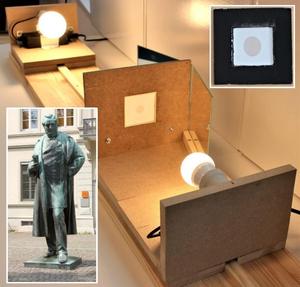
Wie hell scheint die Sonne? Ein Fettfleck hilft
astroEDU educational activity (links to astroEDU website) Description: Im Fokus des WIS-Beitrags steht die Fotometrie – die Lichtmessung mit dem Auge als Detektor. Dazu wird das erste zur Anwendung gekommene Fotometer, das Fettfleckfotometer nach Bunsen, eingeführt und in einer Selbstbauversion vorgestellt. Ergänzt durch ein helligkeitsminderndes Bauelement wird das Fettfleckfotometer zur Bestimmung der fotometrischen Größen der Sonne genutzt. Eine Einführung in die Grundgrößen der Fotometrie (deren Einheiten man auf Leuchtmittelverpackungen im Baumarkt lesen kann) ergänzt notwendigerweise den Beitrag. Die Besonderheiten der in der Astronomie verwendeten fotometrischen Größen kommen abschließend zur Sprache, wobei auch zu den astrofotometrischen Größen der Sonne hingeführt wird.
Altersgruppen: 16-19 Bildungsniveau: Secundaria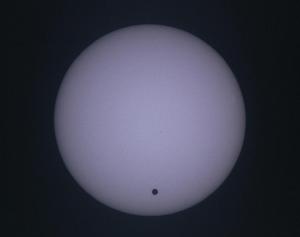
Die Suche nach der zweiten Erde
astroEDU educational activity (links to astroEDU website) Description: In den letzten Jahren haben die beiden Weltraumteleskope CoRoT und Kepler zahlreiche mögliche Planeten bei anderen Sternen entdeckt. Welche Schwierigkeiten bei der Suche nach Planeten zu bewältigen sind, können Schüler der Mittelstufe mit dem Material erarbeiten. Mit kleinen Versuchen werden astronomische Begriffe wie Helligkeit und Helligkeitsschwankung und andere für das Verständnis der Transitmethode wichtige Grundlagen verdeutlicht.
Altersgruppen: 14-16 Bildungsniveau: Secundaria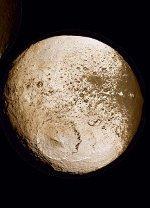
Wenn Licht auf Oberflächen trifft
astroEDU educational activity (links to astroEDU website) Description: Analog zur Helligkeitsmessung bei Sternen kann man die diffus reflektierte Lichtmenge als eine Art „Leuchtkraft“ auffassen und damit die Größe der „im Streulicht leuchtenden Himmelskörper“ bestimmen.
Altersgruppen: 16-19 Bildungsniveau: Secundaria
Schwächung, Rötung und Polarisation
astroEDU educational activity (links to astroEDU website) Description: Dem Schüler Daniel bleibt manches im Beitrag „Staub im Weltall“ von H.-U. Keller unklar. Er sucht Rat beim Studenten Jan.
Altersgruppen: 16-19 Bildungsniveau: Secundaria