Glossar-Begriff: Himmelsäquator
Beschreibung: Der Himmelsäquator ist definiert als der Großkreis (d.h. der größtmögliche Kreis auf der Oberfläche einer Kugel) der Himmelskugel. Seine Ebene liegt senkrecht zur Rotationsachse der Erde. Im Grunde genommen erhält man den Himmelsäquator, wenn man den Erdäquator auf die Himmelskugel projiziert.
Ähnliche Begriffe:
Dieser Begriff in anderen Sprachen
Begriffs- und Definitionsstatus Die Originaldefinition dieses Begriffes auf Englisch wurden von einem forschenden Astronom und einer Lehrkraft bestätigt Die Übersetzung dieses Begriffs und seiner Definition warten auf Prüfung und Bestätigung
The OAE Multilingual Glossary is a project of the IAU Office of Astronomy for Education (OAE) in collaboration with the IAU Office of Astronomy Outreach (OAO). The terms and definitions were chosen, written and reviewed by a collective effort from the OAE, the OAE Centers and Nodes, the OAE National Astronomy Education Coordinators (NAECs) and other volunteers. You can find a full list of credits here. All glossary terms and their definitions are released under a Creative Commons CC BY-4.0 license and should be credited to "IAU OAE".
Wenn dir ein inhaltlicher oder Übersetzungsfehler in diesem Glossarbegriff oder dieser Definition auffallen, bitte kontaktiere uns.
Auf anderen Sprachen
- Arabisch: خط الاستواء السماوي
- Bengali: মহাকাশীয় বিষুবরেখা
- Englisch: Celestial Equator
- Spanisch: Ecuador celeste
- Französisch: Équateur céleste
- Ungarisch: Égi Egyenlítő
- Indonesisch: Khatulistiwa Langit
- Italienisch: Equatore celeste
- Japanisch: 天の赤道 (externer Link)
- Koreanisch: 천구적도
- Brasilianisches Portugiesisch: Equador Celeste
- Vereinfachtes Chinesisch: 天赤道
- Traditionelles Chinesisch: 天赤道
Ähnliche Diagramme
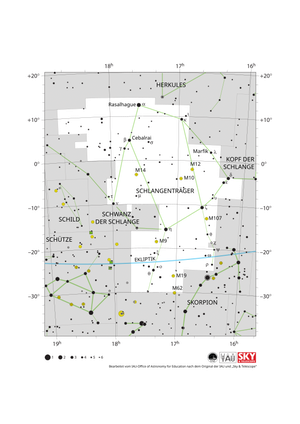
Karte des Sternbilds Schlangenträger
Unterschrift: Das Sternbild Schlangenträger (lateinisch Ophiuchus) mit seinen hellen Sternen und den umliegenden Sternbildern. Der Schlangenträger ist umgeben von (im Uhrzeigersinn von oben beginnend): Herkules, Kopf der Schlange, Skorpion, Schütze und Schwanz der Schlange. der Schlangenträger gehört zwar nicht zu den traditionellen zwölf Tierkreiszeichen, liegt jedoch auf der Ekliptik (hier als blaue Linie dargestellt), dies ist die Bahn, die die Sonne im Laufe eines Jahres scheinbar am Himmel zurücklegt. Die Sonne befindet sich von Ende November bis Mitte Dezember im Ophiuchus. Da die Planeten des Sonnensystems der Ekliptik folgen, sind sie regelmäßig auch im Sternbild Schlangenträger zu finden.
Der Schlangenträger erstreckt sich über den Himmelsäquator, sodass ein Teil des Sternbilds zu einem Zeitpunkt des Jahres von der gesamten Erde aus sichtbar ist. Während der Zeit, in der es abends am besten sichtbar ist (im Winter der südlichen Hemisphäre und im Sommer der nördlichen Hemisphäre), herrscht jedoch in weiten Teilen der Arktis ewiges Tageslicht, sodass die Sterne des Sternbilds von dort nicht zu sehen sind. Das gesamte Sternbild ist von den äquatorialen und gemäßigten Regionen beider Hemisphären aus sichtbar.
Da Ophiuchus nahe am galaktischen Zentrum liegt, enthält es viele Kugelsternhaufen wie M9, M10, M12, M14, M19, M62 und M107. Diese sind als gelbe Kreise mit überlagerten Pluszeichen gekennzeichnet.
Die y-Achse dieses Diagramms zeigt die Deklination in Grad, wobei Norden oben liegt, und die x-Achse zeigt die Rektaszension in Stunden mit Osten nach links. Die Größe der hier dargestellten Sterne bezieht sich auf deren scheinbare Helligkeit, ein Maß für die ankommende Strahlungsintensität. Die größeren Punkte repräsentieren hellere Sterne. Die griechischen Buchstaben kennzeichnen die hellsten Sterne des Sternbilds. Diese sind nach Helligkeit geordnet, wobei der hellste Stern mit Alpha bezeichnet wird, der zweithellste mit Beta usw. – wobei diese Reihenfolge nicht immer exakt eingehalten wird. Die gepunkteten Grenzlinien markieren die offiziellen Sternbildgrenzen der IAU, und die durchgezogenen grünen Linien zeigen eine der üblichen Formen, um die Figuren der Sternbilder darzustellen. Weder die Sternbildgrenzen noch die Verbindungslinien zwischen den Sternen sind am realen Himmel zu sehen.
Bild: Bearbeitet vom IAU-Office of Astronomy for Education nach dem Original der IAU und „Sky & Telescope“
License: CC-BY-4.0 Creative Commons Namensnennung 4.0 International (CC BY 4.0) Symbole

Großer Hund-Sternenkarte
Unterschrift: Das Sternbild Großer Hund mit seinen hellen Sternen und den umliegenden Sternbildern. Im Uhrzeigersinn von oben gehend ist der Große Hund umgeben von dem Einhorn, dem Hasen, der Taube und dem Hinterdeck Des Schiffes. Das Sternbild wird von Sirius dominiert, dem Stern, der am Nachthimmel am hellsten erscheint und alle anderen Sterne des Sternbilds weit überstrahlt.
Der Große Hund liegt knapp südlich des Himmelsäquators und ist von der gesamten südlichen Hemisphäre sowie von den äquatorialen und gemäßigten Regionen der nördlichen Hemisphäre aus sichtbar. Sirius ist von allen außer den arktischen Regionen aus sichtbar. Der Große Hund ist in den Abendstunden im Spätwinter auf der Nordhalbkugel und im Spätsommer auf der Südhalbkugel am besten sichtbar.
Die offenen Sternhaufen M41, NGC 2360 und NGC 2362 befinden sich in diesem Sternbild. Diese sind mit gelben Kreisen markiert.
Die y-Achse dieses Diagramms ist in Deklinationsgraden mit Norden nach oben und die x-Achse ist in Rektaszensionsstunden mit Osten nach links. Die Größe der hier markierten Sterne bezieht sich auf die scheinbare Helligkeit des Sterns. Je größer die Punkte, desto heller sind die Sterne die sie darstellen. Die griechischen Buchstaben kennzeichnen die hellsten Sterne des Sternbildes. Diese sind nach Helligkeit geordnet, wobei der hellste Stern mit Alpha, der zweithellste mit Beta usw. bezeichnet wird, obwohl diese Reihenfolge nicht immer genau eingehalten wird. Die gepunkteten Begrenzungslinien markieren die IAU-Grenzen der Sternbilder und die durchgezogenen grünen Linien markieren eine der üblichen Formen, die zur Darstellung der Sternbilder verwendet werden. Weder die Grenzen der Sternbilder noch die Linien, die die Sterne verbinden, sind am Himmel sichtbar.
Bild: Angepasst vom IAU Office of Astronomy for Education nach dem Original von IAU/Sky & Telescope
License: CC-BY-4.0 Creative Commons Namensnennung 4.0 International (CC BY 4.0) Symbole
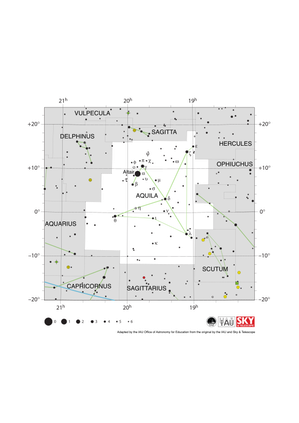
Aquila Constellation Map
Unterschrift: The constellation Aquila with its bright stars and surrounding constellations. Aquila is surrounded by (going clockwise from the top): Sagitta, Hercules, Ophiuchus, Serpens Cauda, Scutum, Sagittarius, Capricornus, Aquarius and Delphinus. Aquila is most notable for its brightest star Altair. This forms one vertex of the prominent Summer Triangle asterism that is visible in northern hemisphere summer evenings.
Aquila spans the celestial equator and thus some part of it is visible from all of the Earth at some point in the year. It is most visible in the evenings in the late northern hemisphere summer and late southern hemisphere winter.
The y-axis of this diagram is in degrees of declination with north as up and the x-axis is in hours of right ascension with east to the left. The sizes of the stars marked here relate to the star's apparent magnitude, a measure of its apparent brightness. The larger dots represent brighter stars. The Greek letters mark the brightest stars in the constellation. These are ranked by brightness with the brightest star being labeled alpha, the second brightest beta, etc., although this ordering is not always followed exactly. The dotted boundary lines mark the IAU's boundaries of the constellations and the solid green lines mark one of the common forms used to represent the figures of the constellations. The blue line in the lower right of the diagram is the ecliptic. Neither the constellation boundaries, nor the line marking the ecliptic, nor the lines joining the stars appear on the sky.
Bild: Adapted by the IAU Office of Astronomy for Education from the original by IAU/Sky & Telescope
License: CC-BY-4.0 Creative Commons Namensnennung 4.0 International (CC BY 4.0) Symbole
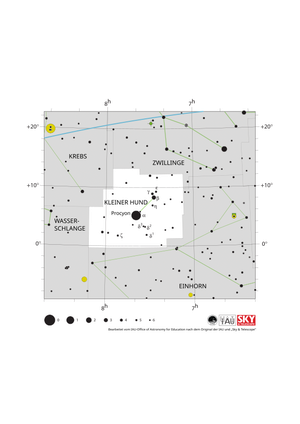
Karte des Sternbilds „Kleiner Hund“
Unterschrift: Das Sternbild Kleiner Hund (lateinisch Canis Minor) mit seinen hellen Sternen und den umliegenden Sternbildern. Der Kleine Hund ist umgeben von (im Uhrzeigersinn von oben): Zwillinge, Einhorn, Wasserschlange und Krebs. Der Kleine Hund hat relativ wenige helle Sterne, doch sein hellster Stern, Procyon, ist der achthellste Stern am Himmel.
Der Kleine Hund erstreckt sich über den Himmelsäquator, sodass ein Teil des Sternbilds zu einem bestimmten Zeitpunkt im Jahr von der gesamten Erdoberfläche aus sichtbar ist. Das gesamte Sternbild ist von allen Regionen aus sichtbar, mit Ausnahme der extrem arktischen und antarktischen Gebiete.
Die y-Achse dieses Diagramms zeigt die Deklination in Grad, wobei Norden oben liegt, und die x-Achse zeigt die Rektaszension in Stunden mit Osten nach links. Die Größe der hier dargestellten Sterne bezieht sich auf deren scheinbare Helligkeit, ein Maß für die ankommende Strahlungsintensität. Die größeren Punkte repräsentieren hellere Sterne. Die griechischen Buchstaben kennzeichnen die hellsten Sterne des Sternbilds. Diese sind nach Helligkeit geordnet, wobei der hellste Stern mit Alpha bezeichnet wird, der zweithellste mit Beta usw. – wobei diese Reihenfolge nicht immer exakt eingehalten wird. Die gepunkteten Grenzlinien markieren die offiziellen Sternbildgrenzen der IAU, und die durchgezogenen grünen Linien zeigen eine der üblichen Formen, um die Figuren der Sternbilder darzustellen. Weder die Sternbildgrenzen noch die Verbindungslinien zwischen den Sternen sind am realen Himmel zu sehen.
Bild: Bearbeitet vom IAU-Office of Astronomy for Education nach dem Original der IAU und „Sky & Telescope“
License: CC-BY-4.0 Creative Commons Namensnennung 4.0 International (CC BY 4.0) Symbole
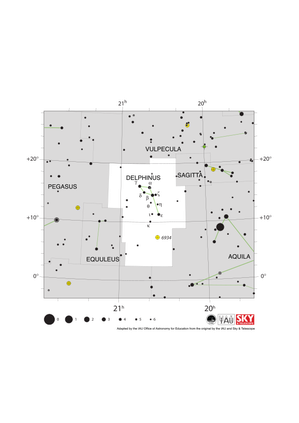
Delphinus Constellation Map
Unterschrift: The constellation Delphinus with its brighter stars and surrounding constellations. Delphinus is surrounded by (going clockwise from the top): Vulpecula, Sagitta, Aquila, Aquarius, Equuleus and Pegasus. Delphinus is a relatively small constellation with few bright stars.
Delphinus lies just north of the celestial equator and thus the whole constellation is visible at some point in the year to all but the most antarctic regions. The constellation is best viewed in the evenings in the early northern hemisphere autumn and early southern hemisphere spring.
The globular cluster NGC 6934 lies in Dephinus. It is marked here with a yellow circle with a plus sign superimposed on it.
The y-axis of this diagram is in degrees of declination with north as up and the x-axis is in hours of right ascension with east to the left. The sizes of the stars marked here relate to the star's apparent magnitude, a measure of its apparent brightness. The larger dots represent brighter stars. The Greek letters mark the brightest stars in the constellation. These are ranked by brightness with the brightest star being labeled alpha, the second brightest beta, etc., although this ordering is not always followed exactly. The dotted boundary lines mark the IAU's boundaries of the constellations and the solid green lines mark one of the common forms used to represent the figures of the constellations. Neither the constellation boundaries, nor the lines joining the stars appear on the sky.
Bild: Adapted by the IAU Office of Astronomy for Education from the original by the IAU and Sky & Telescope
License: CC-BY-4.0 Creative Commons Namensnennung 4.0 International (CC BY 4.0) Symbole
Ähnliche Aktivitäten
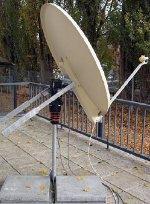
Wie die kosmischen Radiowellen in die Schule kommen
astroEDU educational activity (links to astroEDU website) Description: Die ersten Schritte zur Radioastronomie in der Schule lassen sich mit sehr geringem Aufwand tun und können den Begriff der Radiowellen etwas mit Leben erfüllen.
Altersgruppen: 16-19 Bildungsniveau: Secundaria