Término del glosario: Ecuador celeste
Descripción: El ecuador celeste se define como el gran círculo de la esfera celeste, cuyo plano es perpendicular al eje de rotación de la Tierra. En esencia, es la proyección del ecuador terrestre sobre la esfera celeste.
Términos relacionados:
Ver este término en otros idiomas
Estado del término y la definición: La definición original de este término en inglés ha sido aprobada por unastrónomo o astrónoma investigadora y un docente La traducción de este término y su definición aún están pendientes de aprobación
El Glosario multilingüe de la OAE es un proyecto de la Oficina de Astronomía para la Educación de la UAI (OAE) en colaboración con la Oficina de Divulgación de Astronomía de la UAI (OAO). Los términos y definiciones fueron seleccionados, redactados y revisados gracias al esfuerzo colectivo de la OAE, los Centros y Nodos de la OAE, los Coordinadores Nacionales de Educación Astronómica (NAECs) y otros voluntarios. Puedes encontrar una lista completa de créditos aquí. Todos los términos del glosario y sus definiciones se publican bajo la licencia Creative Commons CC BY-4.0 y deben atribuirse a la "IAU OAE".
Si detectas algún error de contenido o de traducción en este término del glosario o en ladefinición, ponte en contacto con nosotros.
En otros idiomas
- Árabe: خط الاستواء السماوي
- Bengalí: মহাকাশীয় বিষুবরেখা
- Alemán: Himmelsäquator
- Inglés: Celestial Equator
- Francés: Équateur céleste
- Húngaro: Égi Egyenlítő
- Indonesio: Khatulistiwa Langit
- Italiano: Equatore celeste
- Japonés: 天の赤道 (enlace externo)
- Coreano: 천구적도
- Portugués de Brasil: Equador Celeste
- Chino simplificado: 天赤道
- Chino tradicional: 天赤道
Diagramas relacionados

Mapa de la constelación de Ofiuco
Pie de foto: La constelación de Ofiuco junto con sus estrellas brillantes y las constelaciones que la rodean. Ofiuco está rodeada por (en el sentido de las agujas del reloj desde arriba): Hércules, Serpens Caput, Escorpión, Sagitario y Serpens Cauda. Ofiuco no forma parte de las doce constelaciones zodiacales tradicionales, pero se encuentra en la eclíptica (mostrada aquí como una línea azul), que es la trayectoria que el Sol parece seguir a través del cielo en el transcurso de un año. El Sol se encuentra en Ofiuco desde finales de noviembre hasta mediados de diciembre. Los demás planetas del Sistema Solar se encuentran a menudo en Ofiuco.
Ofiuco se extiende a lo largo del ecuador celeste, por lo que parte de la constelación es visible en toda la Tierra en algún momento del año. Sin embargo, durante la época en la que es más visible por las tardes (invierno en el hemisferio sur y verano en el hemisferio norte), gran parte del Ártico se encuentra bajo la luz perpetua del día, lo que hace imposible ver las estrellas de la constelación. Toda la constelación es visible desde las regiones ecuatoriales y templadas de ambos hemisferios.
Como Ofiuco se encuentra cerca del centro galáctico, contiene muchos cúmulos globulares como M9, M10, M12, M14, M19, M62 y M107. Estos están marcados como círculos amarillos con símbolos más superpuestos.
El eje-y de este diagrama está en grados de declinación con el norte hacia arriba y el eje-x está en horas de ascensión recta con el este a la izquierda. El tamaño de las estrellas marcadas aquí está relacionado con la magnitud aparente de la estrella, una medida de su brillo aparente. Los puntos más grandes representan estrellas más brillantes. Las letras griegas indican las estrellas más brillantes de la constelación. Están ordenadas según su brillo: la estrella más brillante se denomina alfa, la segunda más brillante beta, etc., aunque este orden no siempre se sigue con exactitud. Las líneas punteadas marcan los límites de las constelaciones según la UAI y las líneas verdes continuas marcan una de las formas habituales utilizadas para representar las figuras de las constelaciones. Ni los límites de las constelaciones, ni la línea que marca la eclíptica, ni las líneas que unen las estrellas aparecen en el cielo.
Crédito: Adaptado por la Oficina de Astronomía para la Educación de la UAI a partir del original de UAI/Sky & Telescope
License: CC-BY-4.0 Creative Commons Reconocimiento 4.0 Internacional (CC BY 4.0) íconos
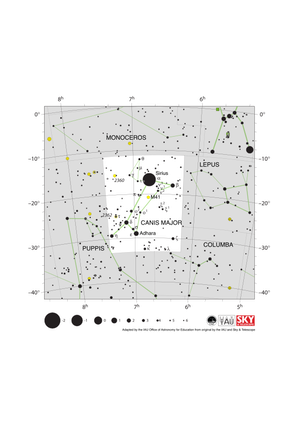
Canis Major Constellation Map
Pie de foto: The constellation Canis Major along with its bright stars and its surrounding constellations. Canis Major is surrounded by (going clockwise from the top): Monoceros, Lepus, Columba and Puppis. The constellation is dominated by Sirius, the star which appears brightest in the night sky, which far outshines all of the other stars in the constellation.
Canis Major lies just south of the celestial equator and is visible from all of the southern hemisphere as well as equatorial and temperate regions of the northern hemisphere. Sirius is visible from all but the most arctic regions. Canis Major is most visible in the evenings in late winter in the northern hemisphere and late summer in the southern hemisphere.
The open star clusters M41, NGC 2360 and NGC 2362 lie in the constellation. These are marked with yellow circles.
The y-axis of this diagram is in degrees of declination with north as up and the x-axis is in hours of right ascension with east to the left. The sizes of the stars marked here relate to the star's apparent magnitude, a measure of its apparent brightness. The larger dots represent brighter stars. The Greek letters mark the brightest stars in the constellation. These are ranked by brightness with the brightest star being labeled alpha, the second brightest beta, etc., although this ordering is not always followed exactly. The dotted boundary lines mark the IAU's boundaries of the constellations and the solid green lines mark one of the common forms used to represent the figures of the constellations. Neither the constellation boundaries, nor the lines joining the stars appear on the sky.
Crédito: Adapted by the IAU Office of Astronomy for Education from the original by IAU/Sky & Telescope
License: CC-BY-4.0 Creative Commons Reconocimiento 4.0 Internacional (CC BY 4.0) íconos
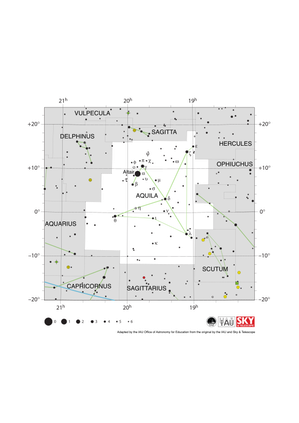
Aquila Constellation Map
Pie de foto: The constellation Aquila with its bright stars and surrounding constellations. Aquila is surrounded by (going clockwise from the top): Sagitta, Hercules, Ophiuchus, Serpens Cauda, Scutum, Sagittarius, Capricornus, Aquarius and Delphinus. Aquila is most notable for its brightest star Altair. This forms one vertex of the prominent Summer Triangle asterism that is visible in northern hemisphere summer evenings.
Aquila spans the celestial equator and thus some part of it is visible from all of the Earth at some point in the year. It is most visible in the evenings in the late northern hemisphere summer and late southern hemisphere winter.
The y-axis of this diagram is in degrees of declination with north as up and the x-axis is in hours of right ascension with east to the left. The sizes of the stars marked here relate to the star's apparent magnitude, a measure of its apparent brightness. The larger dots represent brighter stars. The Greek letters mark the brightest stars in the constellation. These are ranked by brightness with the brightest star being labeled alpha, the second brightest beta, etc., although this ordering is not always followed exactly. The dotted boundary lines mark the IAU's boundaries of the constellations and the solid green lines mark one of the common forms used to represent the figures of the constellations. The blue line in the lower right of the diagram is the ecliptic. Neither the constellation boundaries, nor the line marking the ecliptic, nor the lines joining the stars appear on the sky.
Crédito: Adapted by the IAU Office of Astronomy for Education from the original by IAU/Sky & Telescope
License: CC-BY-4.0 Creative Commons Reconocimiento 4.0 Internacional (CC BY 4.0) íconos
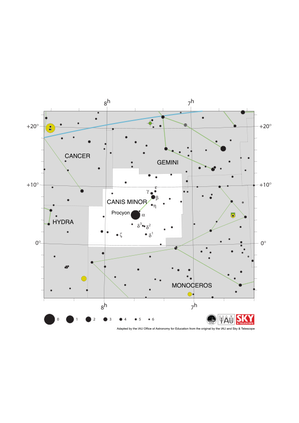
Canis Minor Constellation Map
Pie de foto: The constellation Canis Minor with its bright stars and surrounding constellations. Canis Minor is surrounded by (going clockwise from the top): Gemini, Monoceros, Hydra and Cancer. Canis Minor has relatively few bright stars but its brightest star Procyon is the eight brightest star in the sky.
Canis Minor spans the celestial equator and thus part of the constellation is visible from the whole Earth at some point during the year. The whole constellation is visible to all but the most arctic and antarctic regions.
The y-axis of this diagram is in degrees of declination with north as up and the x-axis is in hours of right ascension with east to the left. The sizes of the stars marked here relate to the star's apparent magnitude, a measure of its apparent brightness. The larger dots represent brighter stars. The Greek letters mark the brightest stars in the constellation. These are ranked by brightness with the brightest star being labeled alpha, the second brightest beta, etc., although this ordering is not always followed exactly. The dotted boundary lines mark the IAU's boundaries of the constellations and the solid green lines mark one of the common forms used to represent the figures of the constellations. The blue line in the top right of the diagram marks the ecliptic. Neither the constellation boundaries, nor the line marking the ecliptic, nor the lines joining the stars appear on the sky.
Crédito: Adapted by the IAU Office of Astronomy for Education from the original by the IAU and Sky & Telescope
License: CC-BY-4.0 Creative Commons Reconocimiento 4.0 Internacional (CC BY 4.0) íconos
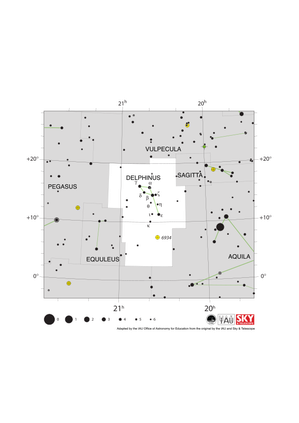
Delphinus Constellation Map
Pie de foto: The constellation Delphinus with its brighter stars and surrounding constellations. Delphinus is surrounded by (going clockwise from the top): Vulpecula, Sagitta, Aquila, Aquarius, Equuleus and Pegasus. Delphinus is a relatively small constellation with few bright stars.
Delphinus lies just north of the celestial equator and thus the whole constellation is visible at some point in the year to all but the most antarctic regions. The constellation is best viewed in the evenings in the early northern hemisphere autumn and early southern hemisphere spring.
The globular cluster NGC 6934 lies in Dephinus. It is marked here with a yellow circle with a plus sign superimposed on it.
The y-axis of this diagram is in degrees of declination with north as up and the x-axis is in hours of right ascension with east to the left. The sizes of the stars marked here relate to the star's apparent magnitude, a measure of its apparent brightness. The larger dots represent brighter stars. The Greek letters mark the brightest stars in the constellation. These are ranked by brightness with the brightest star being labeled alpha, the second brightest beta, etc., although this ordering is not always followed exactly. The dotted boundary lines mark the IAU's boundaries of the constellations and the solid green lines mark one of the common forms used to represent the figures of the constellations. Neither the constellation boundaries, nor the lines joining the stars appear on the sky.
Crédito: Adapted by the IAU Office of Astronomy for Education from the original by the IAU and Sky & Telescope
License: CC-BY-4.0 Creative Commons Reconocimiento 4.0 Internacional (CC BY 4.0) íconos