Termo do glossário: Equador Celeste
Descrição: O equador celeste é definido como o grande círculo da esfera celeste, cujo plano é perpendicular ao eixo de rotação da Terra. Em essência, ele é a projeção do equador terrestre na esfera celeste.
Termos relacionados:
Ver este termo em outros idiomas
Status do termo e da definição: A definição original deste termo em inglês foi aprovada por um astrônomo(a) pesquisador(a) e um(a) professor(a) A tradução deste termo e de sua definição ainda aguarda aprovação
O Glossário Multilíngue da OAE é um projeto do Escritório da IAU de Astronomia para a Educação (OAE) em colaboração com o Escritório da IAU para Divulgação da Astronomia (OAO). Os termos e definições foram selecionados, escritos e revisados por meio de um esforço coletivo da OAE, dos Centros e Nós da OAE, dos Coordenadores Nacionais de Educação em Astronomia (NAECs) da OAE e de outros voluntários. Você pode encontrar uma lista completa dos créditos aqui. Todos os termos do glossário e suas definições são disponibilizados sob uma licença Creative Commons CC BY-4.0 e devem ser creditados à "IAU OAE".
Se você notar algum erro factual ou de tradução neste termo do glossário ou em sua definição, por favor entre em contato.
Em outros idiomas
- Árabe: خط الاستواء السماوي
- Bengali: মহাকাশীয় বিষুবরেখা
- Alemão: Himmelsäquator
- Inglês: Celestial Equator
- Espanhol: Ecuador celeste
- Francês: Équateur céleste
- Húngaro: Égi Egyenlítő
- Indonésio: Khatulistiwa Langit
- Italiano: Equatore celeste
- Japonês: 天の赤道 (link externo)
- Coreano: 천구적도
- Chinês Simplificado: 天赤道
- Chinês Tradicional: 天赤道
Diagramas relacionados
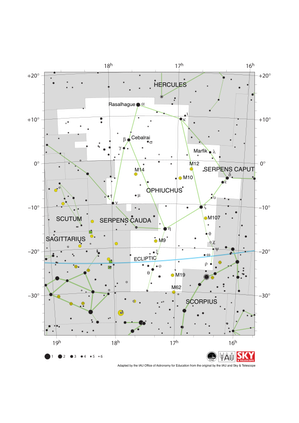
Ophiuchus Constellation Map
Legenda: The constellation Ophiuchus along with its bright stars and its surrounding constellations. Ophiuchus is surrounded by (going clockwise from the top): Hercules, Serpens Caput, Scorpius, Sagittarius and Serpens Cauda. Ophiuchus is not part of the traditional twelve zodiac constellations but it lies on the ecliptic (shown here as a blue line), this is the path the Sun appears to take across the sky over the course of a year. The Sun is in Ophiuchus from late November to mid December. The other planets of the Solar System can often be found in Ophiuchus.
Ophiuchus spans the celestial equator and thus part of the constellation is visible across the whole of the earth at some point in the year. However during the time it is most visible in the evenings (the southern hemisphere winter and northern hemisphere summer) much of the arctic is in perpetual daylight making the stars in the constellation impossible to see. The whole constellation is visible from equatorial and temperate regions of both hemispheres.
As Ophiuchus lies close to the galactic center it contains many globular clusters such as M9, M10, M12, M14, M19, M62, and M107. These are marked as yellow circles with plus symbols superimposed.
The y-axis of this diagram is in degrees of declination with north as up and the x-axis is in hours of right ascension with east to the left. The sizes of the stars marked here relate to the star's apparent magnitude, a measure of its apparent brightness. The larger dots represent brighter stars. The Greek letters mark the brightest stars in the constellation. These are ranked by brightness with the brightest star being labeled alpha, the second brightest beta, etc., although this ordering is not always followed exactly. The dotted boundary lines mark the IAU's boundaries of the constellations and the solid green lines mark one of the common forms used to represent the figures of the constellations. Neither the constellation boundaries, nor the line marking the ecliptic, nor the lines joining the stars appear on the sky.
Crédito: Adapted by the IAU Office of Astronomy for Education from the original by IAU/Sky & Telescope
License: CC-BY-4.0 Creative Commons Attribution 4.0 International (CC BY 4.0) ícones
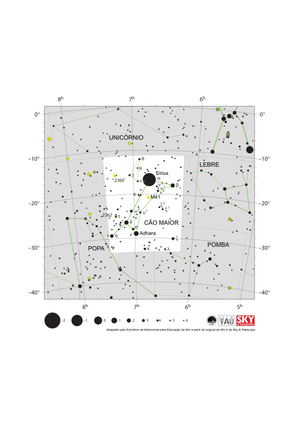
Mapa da Constelação de Cão Maior
Legenda: A constelação de Cão Maior com suas estrelas brilhantes e as constelações vizinhas. Cão Maior é cercada por (no sentido horário a partir do topo): Unicórnio, Lebre, Pomba e Popa. A constelação é dominada por Sirius, a estrela que aparece mais brilhante no céu noturno, que supera em muito todas as outras estrelas da constelação.
Cão Maior fica ao sul do equador celeste e é visível de todo o hemisfério sul, bem como das regiões equatoriais e temperadas do hemisfério norte. Sirius é visível de todas as regiões, com exceção das mais árticas. Cão Maior é mais visível à noite, no final do inverno no hemisfério norte e no final do verão no hemisfério sul.
Os aglomerados estelares abertos M41, NGC 2360 e NGC 2362 estão na constelação. Eles estão marcados com círculos amarelos.
O eixo y desse diagrama está em graus de declinação, com o norte para cima, e o eixo x está em horas de ascensão reta, com o leste à esquerda. Os tamanhos das estrelas marcadas aqui estão relacionados à magnitude aparente da estrela, uma medida de seu brilho aparente. Os pontos maiores representam estrelas mais brilhantes. As letras gregas marcam as estrelas mais brilhantes da constelação. Elas são classificadas por brilho, com a estrela mais brilhante sendo rotulada como alfa, a segunda mais brilhante como beta etc., embora essa ordem nem sempre seja seguida exatamente. As linhas de divisão pontilhadas marcam os limites das constelações da IAU e as linhas verdes sólidas marcam uma das formas comuns usadas para representar as figuras das constelações. Nem os limites da constelação nem as linhas que unem as estrelas aparecem no céu.
Crédito: Adaptado pelo Escritório de Astronomia para Educação da IAU a partir do original da IAU/Sky & Telescope
License: CC-BY-4.0 Creative Commons Attribution 4.0 International (CC BY 4.0) ícones
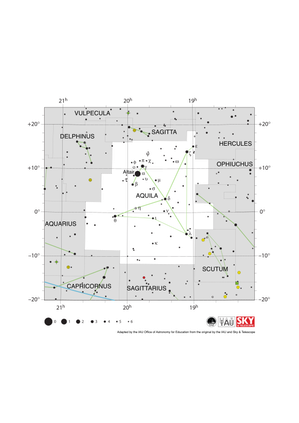
Aquila Constellation Map
Legenda: The constellation Aquila with its bright stars and surrounding constellations. Aquila is surrounded by (going clockwise from the top): Sagitta, Hercules, Ophiuchus, Serpens Cauda, Scutum, Sagittarius, Capricornus, Aquarius and Delphinus. Aquila is most notable for its brightest star Altair. This forms one vertex of the prominent Summer Triangle asterism that is visible in northern hemisphere summer evenings.
Aquila spans the celestial equator and thus some part of it is visible from all of the Earth at some point in the year. It is most visible in the evenings in the late northern hemisphere summer and late southern hemisphere winter.
The y-axis of this diagram is in degrees of declination with north as up and the x-axis is in hours of right ascension with east to the left. The sizes of the stars marked here relate to the star's apparent magnitude, a measure of its apparent brightness. The larger dots represent brighter stars. The Greek letters mark the brightest stars in the constellation. These are ranked by brightness with the brightest star being labeled alpha, the second brightest beta, etc., although this ordering is not always followed exactly. The dotted boundary lines mark the IAU's boundaries of the constellations and the solid green lines mark one of the common forms used to represent the figures of the constellations. The blue line in the lower right of the diagram is the ecliptic. Neither the constellation boundaries, nor the line marking the ecliptic, nor the lines joining the stars appear on the sky.
Crédito: Adapted by the IAU Office of Astronomy for Education from the original by IAU/Sky & Telescope
License: CC-BY-4.0 Creative Commons Attribution 4.0 International (CC BY 4.0) ícones
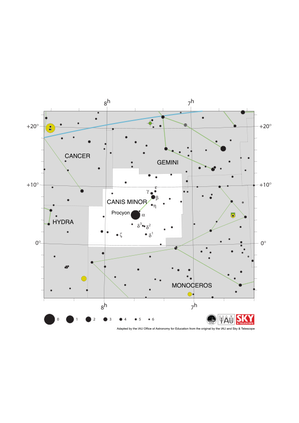
Canis Minor Constellation Map
Legenda: The constellation Canis Minor with its bright stars and surrounding constellations. Canis Minor is surrounded by (going clockwise from the top): Gemini, Monoceros, Hydra and Cancer. Canis Minor has relatively few bright stars but its brightest star Procyon is the eight brightest star in the sky.
Canis Minor spans the celestial equator and thus part of the constellation is visible from the whole Earth at some point during the year. The whole constellation is visible to all but the most arctic and antarctic regions.
The y-axis of this diagram is in degrees of declination with north as up and the x-axis is in hours of right ascension with east to the left. The sizes of the stars marked here relate to the star's apparent magnitude, a measure of its apparent brightness. The larger dots represent brighter stars. The Greek letters mark the brightest stars in the constellation. These are ranked by brightness with the brightest star being labeled alpha, the second brightest beta, etc., although this ordering is not always followed exactly. The dotted boundary lines mark the IAU's boundaries of the constellations and the solid green lines mark one of the common forms used to represent the figures of the constellations. The blue line in the top right of the diagram marks the ecliptic. Neither the constellation boundaries, nor the line marking the ecliptic, nor the lines joining the stars appear on the sky.
Crédito: Adapted by the IAU Office of Astronomy for Education from the original by the IAU and Sky & Telescope
License: CC-BY-4.0 Creative Commons Attribution 4.0 International (CC BY 4.0) ícones
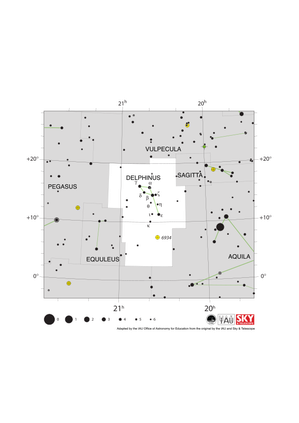
Delphinus Constellation Map
Legenda: The constellation Delphinus with its brighter stars and surrounding constellations. Delphinus is surrounded by (going clockwise from the top): Vulpecula, Sagitta, Aquila, Aquarius, Equuleus and Pegasus. Delphinus is a relatively small constellation with few bright stars.
Delphinus lies just north of the celestial equator and thus the whole constellation is visible at some point in the year to all but the most antarctic regions. The constellation is best viewed in the evenings in the early northern hemisphere autumn and early southern hemisphere spring.
The globular cluster NGC 6934 lies in Dephinus. It is marked here with a yellow circle with a plus sign superimposed on it.
The y-axis of this diagram is in degrees of declination with north as up and the x-axis is in hours of right ascension with east to the left. The sizes of the stars marked here relate to the star's apparent magnitude, a measure of its apparent brightness. The larger dots represent brighter stars. The Greek letters mark the brightest stars in the constellation. These are ranked by brightness with the brightest star being labeled alpha, the second brightest beta, etc., although this ordering is not always followed exactly. The dotted boundary lines mark the IAU's boundaries of the constellations and the solid green lines mark one of the common forms used to represent the figures of the constellations. Neither the constellation boundaries, nor the lines joining the stars appear on the sky.
Crédito: Adapted by the IAU Office of Astronomy for Education from the original by the IAU and Sky & Telescope
License: CC-BY-4.0 Creative Commons Attribution 4.0 International (CC BY 4.0) ícones