词条 洛希极限
描述: 潮汐力拉伸天体,使其形状变长。例如,月球将地球表面的海水拉伸成两个凸起,这就导致了地球上的潮汐。
任何两个大质量天体都会对彼此施加潮汐力。质量越大的天体产生的潮汐力越大,而距离越近,潮汐力也越强。这些潮汐力可能强到足以将其中一个天体撕成碎片。
对于特定质量和大小的天体(例如小行星或卫星)来说,当它靠近另一个大质量天体时,在一定的距离范围内,它会被另一个天体的潮汐力撕成碎片。这个距离被称为 "洛希极限"。
洛希极限的一个常见例子是围绕巨行星运行的岩石和冰质卫星。如果卫星与巨行星的距离小于洛希极限,它就会解体,在巨行星周围形成一个物质环。
在月球和太阳系其他岩石天体上可以看到一连串被称为 "链坑 "的陨石坑,证明了经过的小行星在到达洛希极限时解体,导致它们以一串较小的天体的形式撞击,而不是一个大天体。
词条和定义状态: 该术语的英文原始定义已通过天文研究人员和教师的审核 该术语及其定义的译文仍待审核
OAE多语言词汇表是由国际天文学联合会(IAU) 天文教育办公室(OAE) 和 国际天文学联合会(IAU) 天文推广办公室(OAO)合作的项目。. 术语和定义由 OAE中心, OAE 国家天文教育协调员(NAECs) 以及其他志愿者共同选择、撰写和审阅。您可以在 找到完整的致谢列表。所有词汇表术语及其定义均根据 Creative Commons CC BY-4.0许可证发布 且版权归属于 “IAU OAE”。
如果您发现此词汇术语或定义中的事实或翻译错误, 请向 发邮件 联系.
其他语言版本
- 阿拉伯语: حد روش
- 德语: Roche-Grenze
- 英语: Roche Limit
- 西班牙语: Límite de Roche
- 法语: Limite de Roche
- 意大利语: Limite di Roche
- 日语: ロッシュ限界 (外部链接)
- 韩语: 로시한계
- 巴西葡萄牙语: Limite de Roche
- 繁体中文: 洛希極限
相关媒体
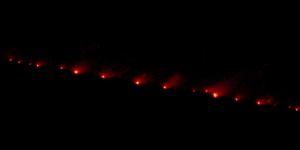
Comet Shoemaker-Levy After Crossing Jupiter's Roche Limit
图注: This panoramic image captured by the Hubble Space Telescope shows fragments of Comet Shoemaker–Levy 9. This comet was discovered in 1993 as the series of fragments you see here. These fragments were orbiting Jupiter. It is thought that at some point in the previous few decades the whole, unfragmented comet had been gravitationally captured by Jupiter. Then in 1992 the comet passed within Jupiter’s Roche limit.
Astronomical objects exert gravitational forces on each other. The closer one is to an object, the larger the force. Astronomical objects have a real physical size and thus the gravitational force exerted on the object will vary across the object, the side of an object closer to another object will feel a stronger gravitational force from that other object than the more distant side. The gravitational stretching distorts the object. This gravitational stretching force is known as the tidal force. When an object is close enough to a large body like Jupiter, the object will feel such a large tidal stretching force that it will overcome the internal gravitational force holding the object together, ripping it to shreds. The distance from the larger body within which this occurs is known as the Roche limit.
When Shoemaker–Levy 9 crossed Jupiter's Roche limit in 1992, the tidal force pulled the comet into separate fragments. Here we see these fragments in a chain as they orbited Jupiter in May 1994. Later in July 1994 the comet fragment plunged into Jupiter’s atmosphere over the course of a week in a spectacular series of impacts. This event provided scientists with a rare opportunity to witness an impact unfolding in real time.
来源: NASA, ESA, and H. Weaver and E. Smith (STScI)
来源链接
License: PD 公共领域 图标