بلغات أخرى
- الألمانيّة: Roche-Grenze
- الإنجليزيّة: Roche Limit
- الإسبانيّة: Límite de Roche
- الفرنسيّة: Limite de Roche
- الإيطاليّة: Limite di Roche
- اليابانيّة: ロッシュ限界 (رابط خارجي)
- الكوريّة: 로시한계
- البرتغاليّة البرازيليّة: Limite de Roche
- الصينيّة المبسطة: 洛希极限
- الصينيّة التقليدية: 洛希極限
وسائط ذات صلة
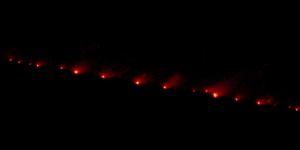
Comet Shoemaker-Levy After Crossing Jupiter's Roche Limit
الشرح: This panoramic image captured by the Hubble Space Telescope shows fragments of Comet Shoemaker–Levy 9. This comet was discovered in 1993 as the series of fragments you see here. These fragments were orbiting Jupiter. It is thought that at some point in the previous few decades the whole, unfragmented comet had been gravitationally captured by Jupiter. Then in 1992 the comet passed within Jupiter’s Roche limit.
Astronomical objects exert gravitational forces on each other. The closer one is to an object, the larger the force. Astronomical objects have a real physical size and thus the gravitational force exerted on the object will vary across the object, the side of an object closer to another object will feel a stronger gravitational force from that other object than the more distant side. The gravitational stretching distorts the object. This gravitational stretching force is known as the tidal force. When an object is close enough to a large body like Jupiter, the object will feel such a large tidal stretching force that it will overcome the internal gravitational force holding the object together, ripping it to shreds. The distance from the larger body within which this occurs is known as the Roche limit.
When Shoemaker–Levy 9 crossed Jupiter's Roche limit in 1992, the tidal force pulled the comet into separate fragments. Here we see these fragments in a chain as they orbited Jupiter in May 1994. Later in July 1994 the comet fragment plunged into Jupiter’s atmosphere over the course of a week in a spectacular series of impacts. This event provided scientists with a rare opportunity to witness an impact unfolding in real time.
المصدر: NASA, ESA, and H. Weaver and E. Smith (STScI)
رابط المصدر
License: PD الملكية العامة أيقونات