Glossary term: Roche Limit
Description: Tidal forces stretch astronomical objects into elongated shapes. For example, the Moon stretches the water around the Earth into two bulges; this causes the tides on the Earth.
Any two massive objects exert tidal forces on each other. More massive objects exert larger tidal forces while tidal forces are stronger for objects that are closer together. These tidal forces can become so strong that the stretching can rip one of the objects to shreds.
For an object (e.g. an asteroid or moon) of a particular mass and size close to another massive object there is a distance within which it will be torn to pieces by the other object's tidal forces. This distance is known as the "Roche limit".
A common example of the Roche limit is rocky and icy moons orbiting giant planets. If a moon is closer to the giant planet than the Roche limit then it will disintegrate, forming a ring of material around the giant planet.
Chains of craters called "catenae" visible on the Moon and other rocky bodies in the Solar System are evidence for incoming asteroids breaking up as they pass the Roche limit, leading them to impact as a string of smaller objects, rather than one large body.
Term and definition status: This term and its definition have been approved by a research astronomer and a teacher
The OAE Multilingual Glossary is a project of the IAU Office of Astronomy for Education (OAE) in collaboration with the IAU Office of Astronomy Outreach (OAO). The terms and definitions were chosen, written and reviewed by a collective effort from the OAE, the OAE Centers and Nodes, the OAE National Astronomy Education Coordinators (NAECs) and other volunteers. You can find a full list of credits here. All glossary terms and their definitions are released under a Creative Commons CC BY-4.0 license and should be credited to "IAU OAE".
If you notice a factual error in this glossary definition then please get in touch.
In Other Languages
- Arabic: حد روش
- German: Roche-Grenze
- Spanish: Límite de Roche
- French: Limite de Roche
- Italian: Limite di Roche
- Japanese: ロッシュ限界 (external link)
- Korean: 로시한계
- Brazilian Portuguese: Limite de Roche
- Simplified Chinese: 洛希极限
- Traditional Chinese: 洛希極限
Related Media
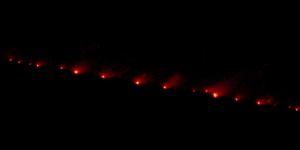
Comet Shoemaker-Levy After Crossing Jupiter's Roche Limit
Caption: This panoramic image captured by the Hubble Space Telescope shows fragments of Comet Shoemaker–Levy 9. This comet was discovered in 1993 as the series of fragments you see here. These fragments were orbiting Jupiter. It is thought that at some point in the previous few decades the whole, unfragmented comet had been gravitationally captured by Jupiter. Then in 1992 the comet passed within Jupiter’s Roche limit.
Astronomical objects exert gravitational forces on each other. The closer one is to an object, the larger the force. Astronomical objects have a real physical size and thus the gravitational force exerted on the object will vary across the object, the side of an object closer to another object will feel a stronger gravitational force from that other object than the more distant side. The gravitational stretching distorts the object. This gravitational stretching force is known as the tidal force. When an object is close enough to a large body like Jupiter, the object will feel such a large tidal stretching force that it will overcome the internal gravitational force holding the object together, ripping it to shreds. The distance from the larger body within which this occurs is known as the Roche limit.
When Shoemaker–Levy 9 crossed Jupiter's Roche limit in 1992, the tidal force pulled the comet into separate fragments. Here we see these fragments in a chain as they orbited Jupiter in May 1994. Later in July 1994 the comet fragment plunged into Jupiter’s atmosphere over the course of a week in a spectacular series of impacts. This event provided scientists with a rare opportunity to witness an impact unfolding in real time.
Credit: NASA, ESA, and H. Weaver and E. Smith (STScI)
credit link
License: PD Public Domain icons