Glossary term: 洛希極限
Description: 潮汐力拉伸天體,使其形狀變長。例如,月球將地球表面的海水拉伸成兩個凸起,這就導致了地球上的潮汐。
任何兩個大質量天體都會對彼此施加潮汐力。質量越大的天體產生的潮汐力越大,而距離越近,潮汐力也越強。這些潮汐力可能強到足以將其中一個天體撕成碎片。
對於特定質量和大小的天體(例如小行星或衛星)來說,當它靠近另一個大質量天體時,在一定的距離範圍內,它會被另一個天體的潮汐力撕成碎片。這個距離被稱為 "洛希極限"。
洛希極限的一個常見例子是圍繞巨行星運行的岩石和冰質衛星。如果衛星與巨行星的距離小於洛希極限,它就會解體,在巨行星週圍形成一個物質環。
在月球和太陽系其他岩石天體上可以看到一連串被稱為 "鍊坑 "的隕石坑,證明瞭經過的小行星在到達洛希極限時解體,導致它們以一串較小的天體的形式撞擊,而不是一個大天體。
Term and definition status: The original definition of this term in English have been approved by a research astronomer and a teacher The translation of this term and its definition is still awaiting approval
This is an automated transliteration of the simplified Chinese translation of this term
The OAE Multilingual Glossary is a project of the IAU Office of Astronomy for Education (OAE) in collaboration with the IAU Office of Astronomy Outreach (OAO). The terms and definitions were chosen, written and reviewed by a collective effort from the OAE, the OAE Centers and Nodes, the OAE National Astronomy Education Coordinators (NAECs) and other volunteers. You can find a full list of credits here. All glossary terms and their definitions are released under a Creative Commons CC BY-4.0 license and should be credited to "IAU OAE".
If you notice a factual or translation error in this glossary term or definition then please get in touch.
In Other Languages
- 阿拉伯語: حد روش
- 德語: Roche-Grenze
- 英語: Roche Limit
- 西班牙語: Límite de Roche
- 法語: Limite de Roche
- 義大利語: Limite di Roche
- 日語: ロッシュ限界 (external link)
- 韓語: 로시한계
- 巴西葡萄牙語: Limite de Roche
- 簡體中文: 洛希极限
Related Media
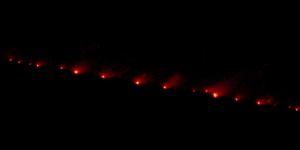
Comet Shoemaker-Levy After Crossing Jupiter's Roche Limit
Caption: This panoramic image captured by the Hubble Space Telescope shows fragments of Comet Shoemaker–Levy 9. This comet was discovered in 1993 as the series of fragments you see here. These fragments were orbiting Jupiter. It is thought that at some point in the previous few decades the whole, unfragmented comet had been gravitationally captured by Jupiter. Then in 1992 the comet passed within Jupiter’s Roche limit.
Astronomical objects exert gravitational forces on each other. The closer one is to an object, the larger the force. Astronomical objects have a real physical size and thus the gravitational force exerted on the object will vary across the object, the side of an object closer to another object will feel a stronger gravitational force from that other object than the more distant side. The gravitational stretching distorts the object. This gravitational stretching force is known as the tidal force. When an object is close enough to a large body like Jupiter, the object will feel such a large tidal stretching force that it will overcome the internal gravitational force holding the object together, ripping it to shreds. The distance from the larger body within which this occurs is known as the Roche limit.
When Shoemaker–Levy 9 crossed Jupiter's Roche limit in 1992, the tidal force pulled the comet into separate fragments. Here we see these fragments in a chain as they orbited Jupiter in May 1994. Later in July 1994 the comet fragment plunged into Jupiter’s atmosphere over the course of a week in a spectacular series of impacts. This event provided scientists with a rare opportunity to witness an impact unfolding in real time.
Credit: NASA, ESA, and H. Weaver and E. Smith (STScI)
credit link
License: PD Public Domain icons