Termo do glossário: Coroa
Descrição: A coroa de uma estrela é uma região de plasma extremamente quente e de baixa densidade que envolve a atmosfera da estrela, podendo se estender por milhões de quilômetros no espaço. Espera-se que toda estrela com um campo magnético razoavelmente forte — produzido por um efeito dínamo à medida que matéria carregada se move no interior da estrela — possua uma coroa. A observação a olho nu da coroa do nosso Sol é possível durante um eclipse solar total, quando a coroa solar se torna visível como uma área esbranquiçada e de formato irregular que envolve o disco solar oculto. De maneira mais geral, a forma da coroa de uma estrela é determinada pelos campos magnéticos da estrela e pela pressão do gás em suas regiões superiores. As coroas estelares apresentam temperaturas muito elevadas: com mais de um milhão de kelvins; a coroa solar é muito mais quente do que a superfície do Sol. O mecanismo responsável pelo aquecimento da coroa até essa temperatura ainda é objeto de pesquisa atualmente, mas parece claro que os campos magnéticos que atravessam a coroa desempenham um papel fundamental. A forma da coroa solar muda em escalas de tempo que variam de segundos a meses, principalmente em resposta à atividade solar, como erupções que ejetam plasma para a coroa ou ejeções de massa coronal que liberam uma quantidade considerável de partículas carregadas. Ela também muda em uma escala de anos com o que é chamado de ciclo solar — a variação periódica na intensidade e na orientação do campo magnético do Sol, com um período de quase onze anos. Mudanças desse tipo também são esperadas de ocorrer de maneira semelhante nas coroas de outras estrelas.
Termos relacionados:
Ver este termo em outros idiomas
Status do termo e da definição: A definição original deste termo em inglês foi aprovada por um astrônomo(a) pesquisador(a) e um(a) professor(a) A tradução deste termo e de sua definição ainda aguarda aprovação
O Glossário Multilíngue da OAE é um projeto do Escritório da IAU de Astronomia para a Educação (OAE) em colaboração com o Escritório da IAU para Divulgação da Astronomia (OAO). Os termos e definições foram selecionados, escritos e revisados por meio de um esforço coletivo da OAE, dos Centros e Nós da OAE, dos Coordenadores Nacionais de Educação em Astronomia (NAECs) da OAE e de outros voluntários. Você pode encontrar uma lista completa dos créditos aqui. Todos os termos do glossário e suas definições são disponibilizados sob uma licença Creative Commons CC BY-4.0 e devem ser creditados à "IAU OAE".
Se você notar algum erro factual ou de tradução neste termo do glossário ou em sua definição, por favor entre em contato.
Mídia relacionada
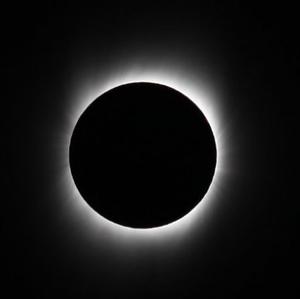
Eclipse total do Sol
Legenda: Esta imagem representa o eclipse solar total observado a partir de Kurigram, em Bangladesh. Os eclipses solares ocorrem quando a Lua, vista da Terra, passa na frente do Sol. A lua é muito menor que o Sol, mas está suficientemente mais próxima de nós de modo que os diâmetros angulares do Sol e da lua são quase iguais (aproximadamente a largura de meio dedo na ponta do braço). Portanto, a Lua pode cobrir o disco solar quando passa diretamente entre o Sol e a Terra. O anel de luz ao redor do círculo preto é chamado de coroa.
Crédito: Lutfar Rahman Nirjhar
link do crédito
License: CC-BY-3.0 Creative Commons Attribution 3.0 Unported ícones

Total Solar Eclipse from Casper, Wyoming, USA
Legenda: This video shows the total solar eclipse of the 21st of August 2017 observed from Casper, Wyoming, USA by a team of astronomers from the European Space Agency (ESA). This video has been sped up considerably, in reality the moment of totality lasted just under two and a half minutes while the time from the Moon first appearing to obscure the Sun until the Sun was completely unobscured was two hours and 48 minutes.
Before the eclipse we can see several sunspots on the Sun. The Moon moves across the Sun, covering the whole solar disk visible from the point on the Earth this video was taken from. At totality we can see the diffuse solar corona which is normally outshone by the bright solar disk.
Note that while edges of the Sun appear brighter just before and just after totality, this is due to exposure time of the camera being adjusted to make the features visible at totality more obvious. Towards the end of the video some thin cloud begins to affect the observations.
Crédito: Video credit: ESA/CESAR ; Music copyright: Flight Of The Angel 3 by Chris Blackwell, audionetwork.com
link do crédito
License: CC-BY-SA-3.0-IGO Creative Commons Attribution-ShareAlike 3.0 IGO ícones