Glossary term: Corona
Description: The corona of a star is a region of extremely hot, low-density plasma surrounding the star's atmosphere, which can stretch millions of kilometers into space. Every star with a reasonably strong magnetic field, produced by a dynamo effect as charged matter moves inside the star, is expected to have a corona. Naked-eye observation of our Sun's corona is possible during a total solar eclipse, when the solar corona becomes visible as a whitish, irregularly shaped area surrounding the hidden solar disk. More generally, the shape of a star's corona is determined by the star's magnetic fields and the outward pressure of gas in its upper regions. Stellar coronas have very high temperatures: At more than a million kelvins, the solar corona is much hotter than the Sun's surface. The mechanism for heating the corona to that temperature is the subject of ongoing research, but it seems clear that the magnetic fields threading the corona play a major role. The shape of the Sun's corona changes on timescales between seconds and months, mostly in response to solar activity, such as flares ejecting plasma into the corona, or coronal mass ejections releasing a considerable amount of charged particles. It also changes on a timescale of years with what is called the solar cycle – the periodic change in strength and orientation of the Sun's magnetic field, with a period of nearly eleven years. Changes of this kind are expected to occur in an analogous fashion in other stars' coronas, as well.
Related Terms:
See this term in other languages
Term and definition status: This term and its definition have been approved by a research astronomer and a teacher
The OAE Multilingual Glossary is a project of the IAU Office of Astronomy for Education (OAE) in collaboration with the IAU Office of Astronomy Outreach (OAO). The terms and definitions were chosen, written and reviewed by a collective effort from the OAE, the OAE Centers and Nodes, the OAE National Astronomy Education Coordinators (NAECs) and other volunteers. You can find a full list of credits here. All glossary terms and their definitions are released under a Creative Commons CC BY-4.0 license and should be credited to "IAU OAE".
If you notice a factual error in this glossary definition then please get in touch.
Related Media
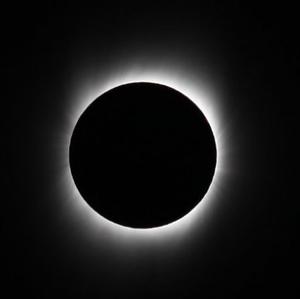
Total Solar Eclipse
Caption: This image represents the total solar eclipse as observed from Kurigram in Bangladesh. Solar eclipses occur when the moon, as seen from earth, passes in front of the Sun. The moon is much smaller than the Sun, it is closer by the night amount that the angular diameters of the Sun and moon are almost the same (~approximately 1/2 a fingertip). Therefore, the moon can cover up the Sun's disk when it passes directly between the Sun and the Earth. The ring of light around the black circle is called the corona.
Credit: Lutfar Rahman Nirjhar
credit link
License: CC-BY-3.0 Creative Commons Attribution 3.0 Unported icons

Total Solar Eclipse from Casper, Wyoming, USA
Caption: This video shows the total solar eclipse of the 21st of August 2017 observed from Casper, Wyoming, USA by a team of astronomers from the European Space Agency (ESA). This video has been sped up considerably, in reality the moment of totality lasted just under two and a half minutes while the time from the Moon first appearing to obscure the Sun until the Sun was completely unobscured was two hours and 48 minutes.
Before the eclipse we can see several sunspots on the Sun. The Moon moves across the Sun, covering the whole solar disk visible from the point on the Earth this video was taken from. At totality we can see the diffuse solar corona which is normally outshone by the bright solar disk.
Note that while edges of the Sun appear brighter just before and just after totality, this is due to exposure time of the camera being adjusted to make the features visible at totality more obvious. Towards the end of the video some thin cloud begins to affect the observations.
Credit: Video credit: ESA/CESAR ; Music copyright: Flight Of The Angel 3 by Chris Blackwell, audionetwork.com
credit link
License: CC-BY-SA-3.0-IGO Creative Commons Attribution-ShareAlike 3.0 IGO icons