Glossary term: Solar Prominence
Description: Solar prominences (sometimes referred to as filaments) are loops of plasma that form due to the magnetic fields around the Sun. These are temporary but may persist for weeks or months and can often be photographed during solar eclipses. A typical prominence extends over many thousands of kilometers (km); the largest on record was estimated at over 800,000 km long, roughly a solar radius. As with many solar phenomena, other stars are also thought to exhibit prominences.
Related Terms:
See this term in other languages
Term and definition status: This term and its definition have been approved by a research astronomer and a teacher
The OAE Multilingual Glossary is a project of the IAU Office of Astronomy for Education (OAE) in collaboration with the IAU Office of Astronomy Outreach (OAO). The terms and definitions were chosen, written and reviewed by a collective effort from the OAE, the OAE Centers and Nodes, the OAE National Astronomy Education Coordinators (NAECs) and other volunteers. You can find a full list of credits here. All glossary terms and their definitions are released under a Creative Commons CC BY-4.0 license and should be credited to "IAU OAE".
If you notice a factual error in this glossary definition then please get in touch.
In Other Languages
- Arabic: الشواظ الشمسي
- German: Sonnenprotuberanz
- Spanish: Protuberancia solar
- French: Protubérance solaire
- Italian: Protuberanza solare
- Japanese: プロミネンス (external link)
- Korean: 태양홍염
- Brazilian Portuguese: Proeminência solar
- Simplified Chinese: 日珥
- Traditional Chinese: 日珥
Related Media

H-alpha image of the Sun's chromosphere
Caption: This false-color image was captured with a 10-cm telescope at the Big Bear Solar Observatory (BBSO) in the United States in July 2002. It depicts the full disk of the Sun using the H-alpha emission line of hydrogen. When observed in this spectral line, the Sun's chromosphere appears particularly prominent due to hydrogen atoms emitting light at the specific wavelength. This emission produces a distinctive red color, making features such as spicules (jets of plasma that look hair-like) and plage (bright patches in the chromosphere) highly visible. Several small solar prominences can be seen protruding from the edge of the solar disk. When prominences (also known as filaments) cross the face of the disk they appear as dark threads caused by the cooler material in the prominence absorbing light. The chromosphere is also visible in the violet part of the solar spectrum due to ionized calcium showing emissions in these wavelengths.
Credit: Big Bear Solar Observatory (BBSO)/New Jersey Institut of Technology (NJIT)
credit link
License: PD Public Domain icons
Related Activities
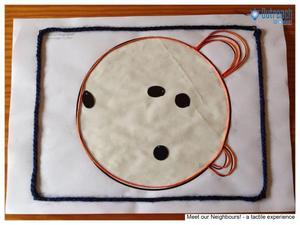
Meet Our Neighbours: Sun
astroEDU educational activity (links to astroEDU website) Description: Explore the tactile version of our star; the Sun with household materials.
License: CC-BY-4.0 Creative Commons Attribution 4.0 International (CC BY 4.0) icons
Tags:
Hands-on
, Model
, Sunspots
, Visually Impaired
, Tactile
Age Ranges:
6-8
, 8-10
, 10-12
Education Level:
Middle School
, Primary
, Secondary
Areas of Learning:
Interactive Lecture
, Modelling
Costs:
Low Cost
Duration:
1 hour
Group Size:
Group
Skills:
Analysing and interpreting data
, Developing and using models