Glossary term: 冕
Description: 恆星的冕是圍繞恆星大氣層的極熱、低密度的等離子體區域,可以在宇宙空間中延伸數百萬千米。每一顆具有相當強磁場的恆星都會有一個冕,這種磁場源於恆星內部帶電物質運動時產生的發電機效應。在日全食時,我們可以用肉眼觀測到一個形狀不規則的白色區域,環繞著被遮掩的太陽圓面,這就是太陽的冕(即“日冕”)。一般來說,恆星冕的形狀是由恆星的磁場及其上部區域氣體的外壓決定的。恆星冕的溫度非常高:例如,日冕的溫度超過一百萬開爾文,比太陽表面的溫度高得多。將日冕加熱到這一溫度的機制是目前正在研究的課題,但似乎很清楚的是,貫穿日冕的磁場發揮了重要作用。日冕形狀變化的時間尺度在幾秒到幾個月之間,主要是太陽活動所引發的,如耀斑將等離子體噴射到日冕,或日冕物質拋射釋放大量帶電粒子。日冕還會隨著所謂的太陽週期(太陽磁場強度和方向的週期性變化,週期近 11 年)的變化而在數年的時間尺度上發生變化。預計其他恆星的冕也會發生類似的變化。
Related Terms:
See this term in other languages
Term and definition status: The original definition of this term in English have been approved by a research astronomer and a teacher The translation of this term and its definition is still awaiting approval
This is an automated transliteration of the simplified Chinese translation of this term
The OAE Multilingual Glossary is a project of the IAU Office of Astronomy for Education (OAE) in collaboration with the IAU Office of Astronomy Outreach (OAO). The terms and definitions were chosen, written and reviewed by a collective effort from the OAE, the OAE Centers and Nodes, the OAE National Astronomy Education Coordinators (NAECs) and other volunteers. You can find a full list of credits here. All glossary terms and their definitions are released under a Creative Commons CC BY-4.0 license and should be credited to "IAU OAE".
If you notice a factual or translation error in this glossary term or definition then please get in touch.
Related Media
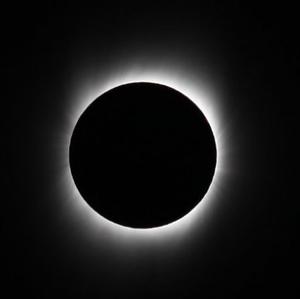
日全食
Caption: 這張照片記錄了在孟加拉國庫里格拉姆觀測到的日全食。日食發生時,從地球上看,月球經過太陽前方時。儘管月球的體積遠小於太陽,但由於月球距離地球更近,兩者的角直徑幾乎相同(約為半根手指的寬度)。因此,當月球恰好位於太陽和地球之間時,能夠完全遮住太陽的盤面。環繞黑色圓盤的光環被稱為日冕。
Credit: 盧特法爾-拉赫曼-尼爾哈爾
credit link
License: CC-BY-3.0 Creative Commons Attribution 3.0 Unported icons

Total Solar Eclipse from Casper, Wyoming, USA
Caption: This video shows the total solar eclipse of the 21st of August 2017 observed from Casper, Wyoming, USA by a team of astronomers from the European Space Agency (ESA). This video has been sped up considerably, in reality the moment of totality lasted just under two and a half minutes while the time from the Moon first appearing to obscure the Sun until the Sun was completely unobscured was two hours and 48 minutes.
Before the eclipse we can see several sunspots on the Sun. The Moon moves across the Sun, covering the whole solar disk visible from the point on the Earth this video was taken from. At totality we can see the diffuse solar corona which is normally outshone by the bright solar disk.
Note that while edges of the Sun appear brighter just before and just after totality, this is due to exposure time of the camera being adjusted to make the features visible at totality more obvious. Towards the end of the video some thin cloud begins to affect the observations.
Credit: Video credit: ESA/CESAR ; Music copyright: Flight Of The Angel 3 by Chris Blackwell, audionetwork.com
credit link
License: CC-BY-SA-3.0-IGO Creative Commons Attribution-ShareAlike 3.0 IGO icons