Termo do glossário: Objeto Messier
Descrição: Um objeto Messier é um dos 110 objetos catalogados pela primeira vez por Charles Messier e Pierre Méchain em 1781. Messier e Méchain estavam procurando cometas, que aparecem difusos e estendidos, mas encontraram muitos objetos difusos e estendidos que não pareciam se mover. Eles catalogaram esses objetos para não desperdiçar tempo de observação com eles caso os observassem novamente. Esses objetos difusos e estendidos além do nosso Sistema Solar passaram a ser conhecidos como “nebulosas”.
Em sua forma atual, o catálogo contém 55 aglomerados estelares, 39 galáxias, 11 nebulosas propriamente ditas e cinco agrupamentos estelares. Esses objetos são alvos favoritos para observação por astrônomos amadores. Como diz o ditado, o que é lixo para um astrônomo é um tesouro para outro.
Os Objetos de Messier são frequentemente referidos por seu número de catálogo, precedido pela letra “M”. Por exemplo, a galáxia espiral Messier 101 é frequentemente chamada de M101.
Termos relacionados:
Ver este termo em outros idiomas
Status do termo e da definição: A definição original deste termo em inglês foi aprovada por um astrônomo(a) pesquisador(a) e um(a) professor(a) A tradução deste termo e de sua definição ainda aguarda aprovação
O Glossário Multilíngue da OAE é um projeto do Escritório da IAU de Astronomia para a Educação (OAE) em colaboração com o Escritório da IAU para Divulgação da Astronomia (OAO). Os termos e definições foram selecionados, escritos e revisados por meio de um esforço coletivo da OAE, dos Centros e Nós da OAE, dos Coordenadores Nacionais de Educação em Astronomia (NAECs) da OAE e de outros voluntários. Você pode encontrar uma lista completa dos créditos aqui. Todos os termos do glossário e suas definições são disponibilizados sob uma licença Creative Commons CC BY-4.0 e devem ser creditados à "IAU OAE".
Se você notar algum erro factual ou de tradução neste termo do glossário ou em sua definição, por favor entre em contato.
Em outros idiomas
- Árabe: جرم مسييه
- Alemão: Messier-Objekt
- Inglês: Messier Object
- Espanhol: Objeto Messier
- Francês: Objet Messier
- Italiano: Oggetto Messier
- Japonês: メシエカタログ (link externo)
- Coreano: 메시에천체
- Marathi: मेसियर ऑब्जेक्ट
- Chinês Simplificado: 梅西耶天体
- Chinês Tradicional: 梅西耶天體
Mídia relacionada
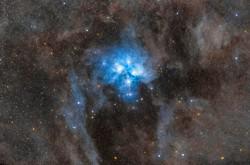
The Pleiades M45 with Majestic Dust
Legenda: Honourable mention in the 2022 IAU OAE Astrophotography Contest, category Still images of celestial patterns.
Taken in Dar Eid in Saint Catherine/Sinai, Egypt, in October 2021, this image shows the Pleiades, an open cluster also known as The Seven Sisters.
The Pleiades are located in the north-western part of the constellation Taurus, the Bull. This constellation originates from ancient Babylonian or even Sumerian belief, where it was designated the Bull of Heaven, a mighty creature owned by the sky god. In Late Babylonian times, the Pleiades were called The Bristle at the hunchback of The Bull. In China, the asterism is also called The Hair, but this does not necessarily imply any relationship between the East Asian and West Asian names of this asterism, although exchange is hypothesised with the establishment of the Silk Road.
In ancient Babylonian texts the term The Hair does not appear. Instead, the Pleiades are only called The Star Cluster in Sumerian, and the Sumerian term was used in later languages as a loanword. The Sumerian and early Babylonian religion associated all constellations with specific deities, including gods, demons, messengers of gods. The Star Cluster was associated with a deity of the Netherworld that was called The Seven and was considered an ensemble of seven speaking weapons or strongly armed gods. The later Greek name of the Seven Sisters might possibly have sprung from an intercultural misunderstanding of this older religious association, since, in fact, seven stars are not seen in this cluster.
The star cluster of the Pleiades is really prominent in the sky, and thus was used for several cultural purposes, such as determining the calendar and the spring equinox. However, its significance is frequently overstated in cultural astronomy. As the tradition of representing it with seven dots originates from an ancient Sumerian belief, we should be careful about interpreting any group of seven dots on cave walls and archaeological sites across Europe, Asia and America from the Stone Age onwards as a representation of the Pleiades.
Modern astrophysics has found that the star cluster of the Pleiades is extraordinarily young, so there was certainly not an additional star in ancient times. Furthermore, we know that the bright stars are only the core region of an open star cluster that consists of hundreds of stars scattered over an area of the sky which exceeds the bright core by one or two of its diameters in any direction. The photograph does not even show the whole cluster. The group is thought to be about 400 light-years away from Earth, which is relatively close in astronomical terms.
Crédito: Mohamed Usama/IAU OAE
License: CC-BY-4.0 Creative Commons Attribution 4.0 International (CC BY 4.0) ícones

Uma imagem da Galáxia de Andrômeda em luz visível
Legenda: A Galáxia de Andrômeda vista em luz visível. Como a nossa Via Láctea, Andrômeda é uma galáxia espiral barrada. Aqui podemos ver seu núcleo brilhante e seu disco espiral. O brilho das estrelas no disco é interrompido por faixas de poeira que fazem parte de sua estrutura espiral.
Andrômeda é a maior galáxia do Grupo Local de galáxias que inclui a Via Láctea.
À esquerda do núcleo e logo acima do disco, vemos a galáxia anã M32 e, à direita e abaixo do disco, vemos a galáxia anã M110. Ambas são galáxias satélites da Galáxia de Andrômeda.
Crédito: Torben Hansen
link do crédito
License: CC-BY-2.0 Creative Commons Attribution 2.0 Generic ícones
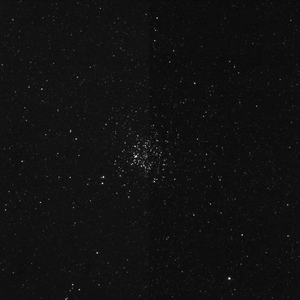
The Wild Duck Open Cluster
Legenda: This image shows the Wild Duck Cluster (also known as Messier 11 or M11), a bright grouping of stars that forms what astronomers call an open cluster in our Milky Way galaxy. Open clusters are collections of stars that were born from the same giant cloud of gas and dust and are still loosely held together by gravity. Most open clusters will slowly fall apart over hundreds of millions of years are they orbit through the galaxy. In this view, hundreds of stars appear close together against the dark background of space, with many shining at different brightnesses depending on their size and temperature.
The Wild Duck Cluster lies about 6,000 light-years from Earth and is around 300 million years old. Because the stars in an open cluster share a common origin, astronomers can use them as laboratories for testing theories on stellar evolution and behaviour.
Crédito: NASA/JPL
link do crédito
License: PD Domínio Público ícones





.jpg)